
The latest news stories of interest in the Rogue Valley and the state of Oregon from the digital home of Southern Oregon, Wynne Broadcasting’s RogueValleyMagazine.com
Monday – January 26, 2026
Rogue Valley Weather

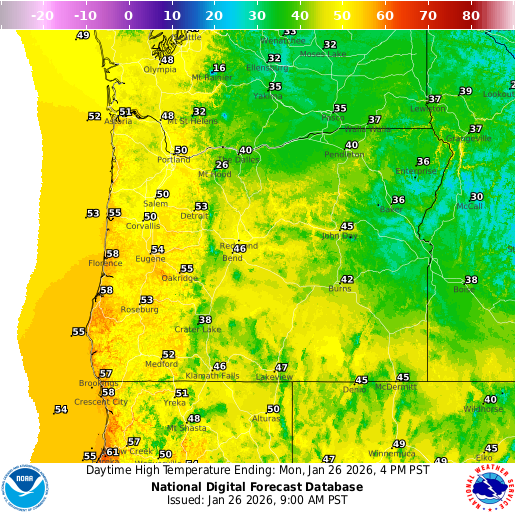
https://graphical.weather.gov/sectors/oregon.php
 Winter is here! Here’s the overview of our winter outlook, but be sure to check out what we’re predicting in your area: https://www.farmersalmanac.com/extended-forecast
As the morning progresses, clouds thin and temperatures climb into the low 50s. Calm winds help conditions improve quickly, but winter remains in control. Another chilly night follows, with lows dipping into the low 30s again. Patchy frost could redevelop early Tuesday, creating brief travel issues for early commuters.
By Tuesday afternoon, the pattern begins to change. Clouds thicken and rain becomes more likely by late day and into Tuesday night. Light rain is expected, with chances increasing into Wednesday. While no heavy rainfall is indicated, wet pavement and reduced visibility could slow traffic along Highway 62 and Interstate 5 during peak travel hours.
Wednesday brings partial clearing at times, though spotty rain remains possible into the evening. Temperatures rise into the mid-50s, easing the freeze threat. Thursday continues the warming trend, with mostly cloudy skies and highs near the mid-50s. Rain chances linger but remain scattered.
Looking ahead, NOAA’s 6–10 day outlook suggests below-normal precipitation and near-normal temperatures into early February, hinting at a quieter stretch after this midweek system.
For now, winter demands attention early, then shifts gears fast. Watch for icy patches this morning, prepare for wet roads midweek, and stay alert as conditions evolve. How cold did it feel outside your door today?
Five-Day Outlook for Medford, Oregon
- Tuesday: Mostly cloudy, chance of rain late, high near 53°F
- Wednesday: Partly sunny, slight chance of rain, high near 53°F
- Thursday: Mostly cloudy, high near 55°F
- Friday: Cloudy, high near 57°F
- Saturday: Slight chance of rain, high near 58°F

Candle Vigil to Remember and Honor Alex Pretti in Ashland Oregon Singing America the Beautiful.

FACEBOOK REEL facebook.com/reel/1433873148072526/?s=single_unit
Rogue Indivisible ICE Out For Good Protest in Grants Pass


Hundreds gathered in Grants Pass for an Ice Out for Good protest on Sunday.
Rogue Indivisible of Josephine County was already planning on putting together an ICE protest, but with the recent news coming out of Minneapolis, the group says more people turned out because people are frustrated with the ongoing ICE enforcement.
Organizers say that protests in Grants Pass are important to them because Josephine County has no democratic representation in Congress. Rogue Indivisible Facebook: https://www.facebook.com/profile.php?id=61578234500144
𝗤𝘂𝗶𝗰𝗸 𝗞𝗻𝗼𝗰𝗸𝗱𝗼𝘄𝗻 𝗣𝗿𝗲𝘃𝗲𝗻𝘁𝘀 𝗗𝗮𝗺𝗮𝗴𝗲 𝗳𝗿𝗼𝗺 𝗦𝘁𝗿𝘂𝗰𝘁𝘂𝗿𝗲 𝗙𝗶𝗿𝗲

 As a reminder, please store wood piles away from structures and ensure ashes are fully extinguished and disposed of in a non-combustible container. Thank you to our crews for the quick response and to the community for helping keep Medford safe.
Passenger Truck Strikes, Kills Pedestrian in I-5 Exit 33 Onramp Crosswalk
JCSO Case 26-0344 CENTRAL POINT, Ore. – A 65-year-old Central Point man driving a passenger truck struck and killed a 48-year-old man in the crosswalk at the Interstate 5 Exit 33 northbound onramp Wednesday evening in Central Point. The Jackson County Serious Traffic Accident Reconstruction (STAR) Team is investigating the incident.
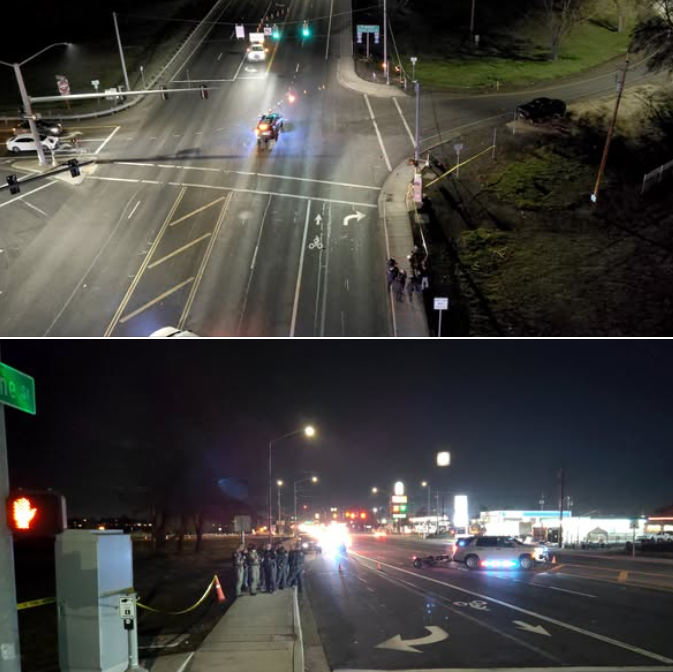
Emergency Communications of Southern Oregon ECSO 911 Dispatch received a report of a pedestrian struck at approximately 5:39 p.m. on Wednesday, January 21 at the intersection of Pine Street and the I-5 Exit 33 northbound onramp. Jackson County Sheriff’s Office (JCSO), Central Point Police Department (CPPD), Jackson County Fire District 3, and Mercy Flights Inc responded to the scene. The vehicle involved was a 2022 GMC Sierra.
Mercy Flights transported the victim to a local hospital, where he was pronounced deceased approximately one hour after the crash. The victim was from the Las Vegas area. Our condolences go out to his family and friends.
JCSO deputies on scene requested a STAR Team callout to conduct a full investigation. The STAR Team includes investigators from JCSO, Medford Police Department, CPPD, Ashland Oregon Police Department, and the Jackson County District Attorney’s Office. The roadway was closed for approximately three hours while the investigation was conducted, and Jackson County Roads assisted with traffic control.
The driver is cooperating with the investigation. Based on the preliminary findings, no criminal charges are being considered at this time. Upon completion of the investigation, the results will be submitted to the DA’s Office for final review. The names of the driver and victim will not be released unless criminal charges are filed. No further information is available at this time.
Jackson County Library Board Votes to Terminate Director
Jackson County Library District board members voted unanimously during a Wednesday afternoon board meeting to move toward termination of district manager Kari May after fallout from incidents that occurred in December at the Talent branch library. Following an open meeting, the board convened into closed session for more than an hour before reconvening in public session, at which time board member Kevin Keating proposed four separate motions.
The motions, all of which were unanimously approved by the five-member board, included authorizing board president Susan Kiefer to sign a written request to May to resign; authorizing district legal counsel to “enter into termination agreement negotiations” with May; and authorizing Kiefer to enter into an agreement with a form that will conduct an internal investigation into the district’s human resource department. Board members on Wednesday also voted to extend May’s administrative leave through noon on Jan. 29. May was placed on administrative leave Jan. 5 through Wednesday. May’s leave of absence coincided with public scrutiny over numerous incidents at the Talent library in December in which 33-year-old registered sex offender Nicholas Johnson, who lives in Talent, was discovered watching videos of naked children on a library computer. The incidents occurred Dec. 11, 13 and 15. Police were contacted Dec. 11 and 15 but only made contact with Johnson Dec. 15.
The library district initially ordered a one-week suspension of library privileges but extended the suspension to six months after public outcry over the incident. A series of recent board meetings — both open and closed — have been held with members of the public voicing concern about the Talent branch incidents and district employees raising issues about district culture and other personnel-related issues. An announcement by the Jackson County District Attorney’s office on Thursday said that no criminal charges would be filed over the incident where police responded Dec. 15, due to the video content of naked babies and toddlers not rising to meet the legal definition of child sexual abuse material, known as CSAM.
Library district officials did not immediately comment following the Wednesday board meeting but said a statement could be released Thursday. A special board meeting, which is expected to include a closed, executive session portion, is set for 10:15 a.m. Jan. 29. Agenda information will be posted to the district website. (SOURCE)
Grants Pass Police Arrest Woman in Stabbing Incident
Umpqua Valley Audubon Society, Roseburg Library Hosts Great Horned Owl Presentation Wednesday 1/28

2026 Josephine County Search & Rescue Academy
DETAILS: The Josephine County Sheriff’s Office Search & Rescue Division will be hosting its annual academy to train new SAR volunteers. The academy, held at 250 Tech Way, Grants Pass, OR, covers Basic Survival Skills, First Aid/CPR, Land Navigation, and more. Completion qualifies attendees as SAR volunteers.
COST: $55. Additional requirements include a background check, criminal history check, and personal equipment purchase.
The Academy runs Tuesday and Thursday evenings (6-9 PM), Saturdays (8 AM-5 PM) from February 17 to March 15. — For registration and details, click here. Application deadline: February 13, 2026.
Calling all artists: BLM seeks Artists-in-Residence at Rogue River Ranch, Cascade-Siskiyou National Monument during Freedom 250
Bureau of Land Management Ore. & Wash.
MEDFORD, Ore. — The Bureau of Land Management is looking for two Artists-in-Residence: one at the historic Rogue River Ranch National Historic Site and another at the Cascade-Siskiyou National Monument.
The selected artists will have the unique opportunity to capture these public lands during a milestone year as the Nation marks its 250th birthday and the BLM celebrates its 80th anniversary. The artists will receive one- to two-week residencies during the summer to create original work while immersed in some of Oregon’s most remarkable environments.
One artist and one alternate will be selected for each residency based on the following criteria: entry materials, residency proposal, professionalism, and creative vision. Applications must be submitted by Feb. 28. As part of the 2026 program, selected artists will also be part of the Freedom 250 celebration, paying tribute to the historic sites and special lands that have contributed to the Nation’s heritage.
“Artists provide a captivating lens through which we can explore our connection to public lands,” said Joel Brumm, Assistant Monument Manager. “Their work provides a unique perspective on these remarkable landscapes, highlighting our mission and role in public land management as we celebrate our 80th anniversary.”
Rogue River Ranch National Historic Site –
The Rogue River Ranch residency will take place between June and August 2026 in a breathtaking setting deep in the Rogue Wild and Scenic River Corridor. The remote outpost is a two-hour drive or a 22-mile river trip from Grave Creek Boat Ramp. The selected artist will reside in the historic house.
Following their residency, the artist will share their vision in a public presentation at the Grants Pass Museum of Art on Oct. 2. Their work will be displayed at the museum for one month and then returned to the artist. The BLM is requesting digital copies of the artwork to promote the Artist-in-Residence program and public lands. The artist retains a non-exclusive use copyright.
In summer 2025, Artist Alisha Whitman created watercolors during her residency. She shared her experience with the BLM.
Artists of all backgrounds are encouraged to apply, and there is no preference given to any style or medium.
Interested artists can learn more information and find an application at the Artist-in-Residence website, by e-mailing Tony Saunders at asaunders@blm.gov, or by calling 541-471-6642.
Cascade-Siskiyou National Monument – The Cascade-Siskiyou National Monument residency will take place in June 2026. The selected artist will be based at a travel trailer at Hyatt Lake Campground while exploring the environment and creating their art. The BLM is seeking visual artists for this residency.
Since 2017, the Artist-in-Residence program has allowed numerous artists to transform the monument’s natural and cultural resources into visual art, objects, and performances.
Last year’s Cascade-Siskiyou National Monument Artist-in-Residence was Paul Atkinson, a gifted photographer who spent his time studying and photographing the monument’s unique landscapes.
During their residency, the artist will share their experience and artistic vision in a public presentation. Following the residency, artists are asked to donate an original artwork piece, which they will retain the rights to.
Interested artists can learn more information and find an application at the Artist-in-Residence website, by e-mailing John Duwe at jduwe@blm.gov, or by calling 541-618-2320.
-BLM-
The BLM manages about 245 million acres of public land located primarily in 12 western states, including Alaska, on behalf of the American people. The BLM also administers 700 million acres of sub-surface mineral estate throughout the nation. Our mission is to sustain the health, diversity, and productivity of America’s public lands for the use and enjoyment of present and future generations.
Grants Pass High School is expanding its automotive program, now in its third year, to give students more space for hands-on training.
Around 150 students learn the basics of car repair while working on staff and student vehicles. Automotive teacher Travis Rappleyea said it’s been difficult to manage working out of the small garage.
“If a job goes sideways on us, as they very frequently tend to do, then we’re down that space until we can get that vehicle out of here,” he said. “And that’s going to butt heads and interfere with all the other classes that we have going on.”
Rappleyea said having twice as much space means that students will have room to take on more complex jobs.
“When we finally got this outdoor expansion, we can actually work on our cars now as a whole group instead of just half and half,” said senior John Higgins. “And it adds two lifts, so people that need lifts have them.”
The expansion was completed over the winter break. Rappleyea said around half of the students are interested in pursuing auto repair as a career. There’s a mechanic shortage in the Rogue Valley and nationwide, so more mechanics are needed.
“There’s an average of — just in our Southern Oregon general area — 400 job postings a year for automotive technicians, or something very closely related,” said Rappleyea. “They typically stay posted anywhere from 40 to 90 days, so there’s a lot of opportunity.”
Rappleyea said he’s working with Rogue Community College to allow students to earn dual credits by completing RCC’s basic automotive maintenance class in high school.
The district funded the $750,000 expansion through a debt restructuring plan that it said cost taxpayers nothing.
dates. To go to the page, click here, or call the “snow phone” at 541-482-2SKI (2754).
To go to the Mt. Ashland webcam, click here.
Mt. Ashland Chairlift Replacement Project U


 https://www.facebook.com/MtAshlandSkiArea
Britt Festival — first round of artists joining us at Britt this summer

 Join as a member today to get early access to tickets! https://britt.org/events/
Southern Oregon PBS has announced that it will persist in its operations despite significant transformations occurring in public broadcasting across the nation, following the recent decision by the Corporation for Public Broadcasting to dissolve after Congress removed all of its federal funding.
Last summer, Congress sanctioned a rescissions package that retracted approximately $1.1 billion in funding that had been previously designated for PBS and NPR via CPB.
At that time, Southern Oregon PBS CEO Phil Meyer cautioned that these cuts would lead to “drastic changes,” highlighting that CPB funding constituted around 37% of the station’s yearly budget. Currently, Meyer indicates that these changes are already in progress — but not in the manner that many had anticipated.
Consequently, Southern Oregon PBS has successfully avoided layoffs and service reductions that have affected various public media stations in other parts of the country.
Meyer notes that viewer contributions now represent approximately 88% of the station’s financial resources.
Southern Oregon PBS Still on The Air Despite Federal Funding Loss

Jackson County Grand Jury Indicts Woman on 88 Felony Animal Abuse And Neglect Charges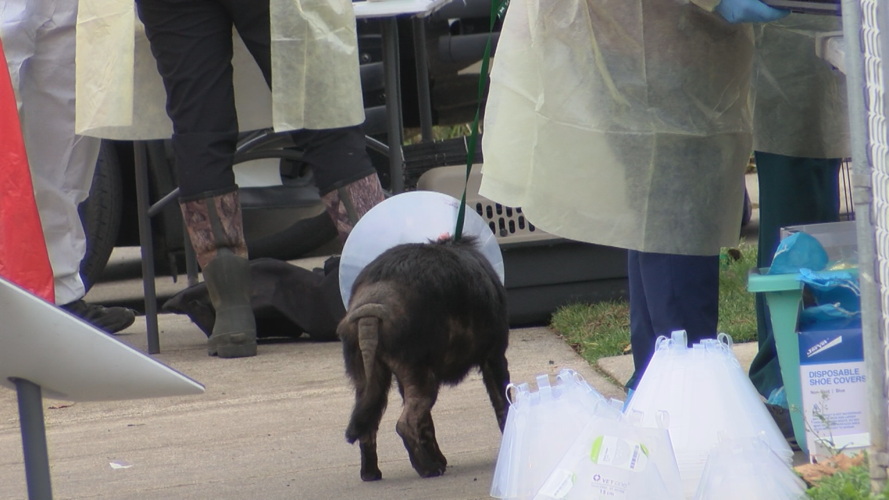
The Jackson County District Attorney’s Office announced that in the afternoon on January 13, 2026 the Jackson County Grand Jury indicted Jana Dene Tepper, 74, on one count of Aggravated Animal Abuse in the First Degree, 29 counts of Felony Animal Neglect in the First Degree, and 58 counts of Felony Animal Neglect in the Second Degree, for a total of 88 felony charges.
The charges follow a search warrant executed on January 6, 2025, at a residence in the 400 block of Crystal Drive in Eagle Point by the Eagle Point Police Department, where officers rescued 58 dogs and discovered 30 deceased dogs. Each charge corresponds to an individual animal found at the residence.
Ms. Tepper is scheduled to appear for arraignment on the indictment today at 1:45 PM. She remains in custody at the Jackson County Jail with bail set at $100,000. This case is being prosecuted by Deputy District Attorney Madelyn Reese. Due to the pending criminal proceedings, no further details will be released at this time.
Ashland Fire & Rescue is hiring Firefighter Paramedics!
City of Grants Pass, Local Government – Applications are being accepted for a position on the Committee on Public Art (CoPA) due to a term expiration. This is a three-year position.
The City Of Talent Temporarily Shutting Off Its Flock Cameras.
There are law enforcement agencies nationwide that use automatic license plate readers from Flock, a safety technology company. Snapshots from these smart cameras can be used as a public safety tool to help track cars involved in crimes or in the event of an Amber Alert.
But the technology is controversial. Many are raising privacy concerns about how the camera data is stored and shared. Eugene and Springfield have recently cancelled Flock Camera after serious consideration.
U.S Senator Ron Wyden (D- OR) said Flock deceived state and local law enforcement customers about its sharing of their data with the Department of Homeland Security and other federal agencies to crack down on immigration.
The city of Talent was granted funding to use the technology more than a year ago. Talent Mayor Darby Ayers-Flood said, “While this technology has already been helpful in supporting investigations in Talent, it has also become controversial nationwide due to concerns about data retention, alleged misuse of information sharing, and the potential for surveillance to extend beyond its original intent.”
Talent Police Chief Jennifer Snook decided to turn off the Flock surveillance cameras until these concerns can be addressed and until more information is gathered about how the technology can be used to support public safety.
The city will not use Flock technology until after the 2026 Oregon legislative session concludes. Ayers-Flood said Talent supports law enforcement and wants to ensure police are equipped with the tools they need. She said this will be an ongoing, open discussion with Talent residents about how the city can support their rights to privacy.
Wrong Way Driver Mitigation Construction Project in Southern Oregon
The Oregon Department of Transportation (ODOT) project hopes to mitigate wrong-way driver incidents along the interstate.
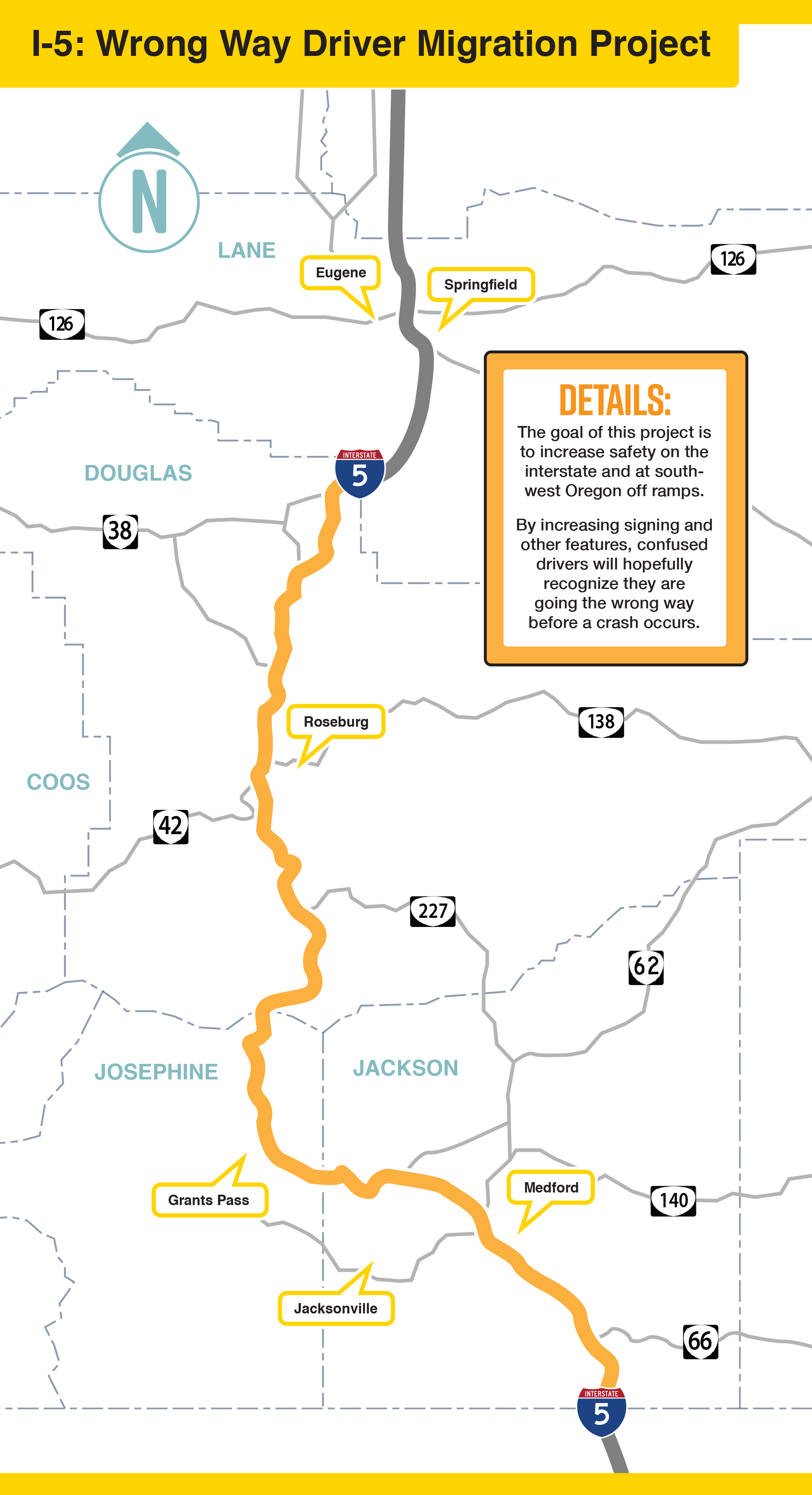
This project hopes to reduce the number of wrong way drivers at I-5 interchanges by evaluating each interchange connection and apply relatively low-cost treatments. These include increased signing and striping. At certain high-risk interchanges, other measures will be considered such as increased illumination, automated warning systems and overhead signing.
The agency said Southwest Oregon sees a higher percentage of wrong-way driver crashes compared to other areas of the state. Just two weeks ago NBC5 reported a 34-year-old Grants Pass woman died driving the wrong way on the interstate. ODOT said these incidents can result in serious injuries or fatalities and many involve impaired drivers.
The project began earlier in June, spanning from the California border to Northern Douglas County. It adds features like permanent signs, reflective pavement markings, flashing beacons at interchanges and more. ODOT’s Julie Denney said, “The work on this project is happening at night so you might see some exit closures, you might see some workers on the side of the road and if that happens, please give them space, slow down and watch your speed.”
ODOT said given the scope of the project, the work could continue till next fall. More information can be found here: https://www.oregon.gov/odot/projects/pages/project-details.aspx?project=21699
Sharing for our friends at Salvation Army
Help Fill Our Food Pantry – Your Donations Make a Difference! Hunger is a reality for many in our community, but together, we can make a change! Our food pantry is in need of non-perishable food items to help families struggling to put meals on the table. Most Needed Items: Canned vegetables & fruits Rice & pasta Peanut butter & jelly Cereal & oatmeal Soup & canned proteins (tuna, chicken, beans) Drop-off Location: 922 N. Central Avenue Medford, OR 97501 Hours: 9am-3pm Monday, Tuesday, Thursday, Friday Every can, box, and bag of food makes a difference in someone’s life. Let’s come together to fight hunger—because no one should go to bed hungry. .
Ashland Rolls Out Free Pre-Approved Plans to Spur Residents into Building Affordable Backyard Homes
Seeking to promote affordability and support residents’ diverse needs, the city of Ashland has encouraged its citizens to develop accessory dwelling units (ADUs) within the city and offers guidance on getting plans approved.
The City of Ashland has streamlined the ADU application process to enhance housing options. It now offers a complete set of pre-approved ADU plans that meet local building codes for free to Ashland property owners.
To get ADU plan approval in Ashland, the Ashland Planning Division offers a free consultation. At the meeting, a City Planner will review your site and provide valuable guidance on the permit application process. The meeting is geared towards helping you understand zoning requirements, building codes, and any other considerations for ADU projects. Find free City of Ashland ADU plans here
Rogue Valley Humane Society
Our Community Food Bank exists to help folks who need an extra helping hand during a difficult month to feed their pets. Our program has a limited budget and so we rely on generous members of our community to donate some of these goods to continue to help assist our community. In 2023 we fed an average of 700 pets a month! This equates to approximately 70 – 40lb bags of food each month! Many pets have benefited from the community’s generosity, and we can’t thank you enough for your kindness.
CSO Case 24-4928 PROSPECT, Ore. – Jackson County Sheriff’s Office (JCSO) detectives and Search and Rescue (SAR) personnel continue to search for a woman missing out of Prospect, Ore. since September 2024.
Deenah Padgett, 69, was reported missing on Sunday, September 8, 2024. She was last seen camping in the Prospect area on September 4, 2024. She is described as a white woman with brownish-red, partially gray hair, standing 4’8” tall and weighing 90-100 lbs. JCSO detectives and SAR personnel have searched the area extensively and are looking for the public’s help. If you see Deenah or know her whereabouts, immediately call ECSO Dispatch at (541) 776-7206 and reference case 24-4928. If you have any information that might help the investigation, call Detective Friend at (541) 864-8774.
The Jackson County Sheriff’s Office (JCSO) is asking for help identifying the owner a motorhome. It could be associated with a missing person from the Prospect area. JCSO says 68-year-old Deenah Padgett has been missing since August 30 from Prospect, described as a white woman, 4’ 8” tall, weighing approximately 95 pounds with brownish red/greying hair. JCSO issued an advisory this weekend asking anyone with information about the owner of the pictured motor home or Padgett’s whereabouts to call Emergency Communications of Southern Oregon (ECSO) dispatch non-emergency phone number at 541-776-7206.
David Grubbs’ Murder Investigation Remains Active
The Ashland Police Department’s investigation into the murder of David Grubbs on November 19, 2011 remains open and active. Recently two new detectives have been assigned to look into new leads that have come in. This case remains important to David’s family, the community, and the Ashland Police Department. As detectives continue to pursue these new leads, anyone with additional information is encouraged to reach out to the Ashland Police Department at 541-488-2211. The reward for information leading to an arrest on this case remains at over $21,000.
Taking Another Look at What Happened to Fauna Frey
Fauna was grieving the recent death of her brother, Dallas, when she set off from Eugene in June of 2020 heading to Grants Pass on what her family believes was both a healing trip and a mission to deliver gifts, silver coins inherited from Dallas, to a few friends.
But somewhere between motel check-ins and checkouts, something went terribly wrong. Her Jeep was found months later. She was never seen again. http://bit.ly/4l63Dle


We will start resharing podcasts and articles. For starters here is a story from Danielle Denham that appeared in the June 29, 2025 edition of That Oregon Life. Ms Denham worked closely with us to insure that the facts she presented were accurate.
Check out the nine episodes of the podcast Nowhere to be Found, a comprehensive, in-depth, sensitive treatment of the details surrounding Fauna’s disappearance. Hear from Fauna’s father, John, and her friends. Posted in spring of 2022, Amanda Popineau shares Fauna’s journey and the mystery that surrounds it. Go to Nowhere to be Found Season Two: Episode One “Under A Half-Moon.” https://podcasts.apple.com/kg/podcast/s2e1-under-a-halfmoon/id1532686678?i=1000512098162
We want to remind people that Fauna’s father is offering a huge reward for information that brings Fauna home.
Please if you have any information no matter how big or small let us know by calling the anonymous tip line or emailing.
Tipline- 541-359-5638
Email – Helpfindfaunafrey@gmail.com
FOLLOW on FACEBOOK GROUP: https://www.facebook.com/groups/341658526970132
Fauna Frey Vanished Without A Trace In Josephine County
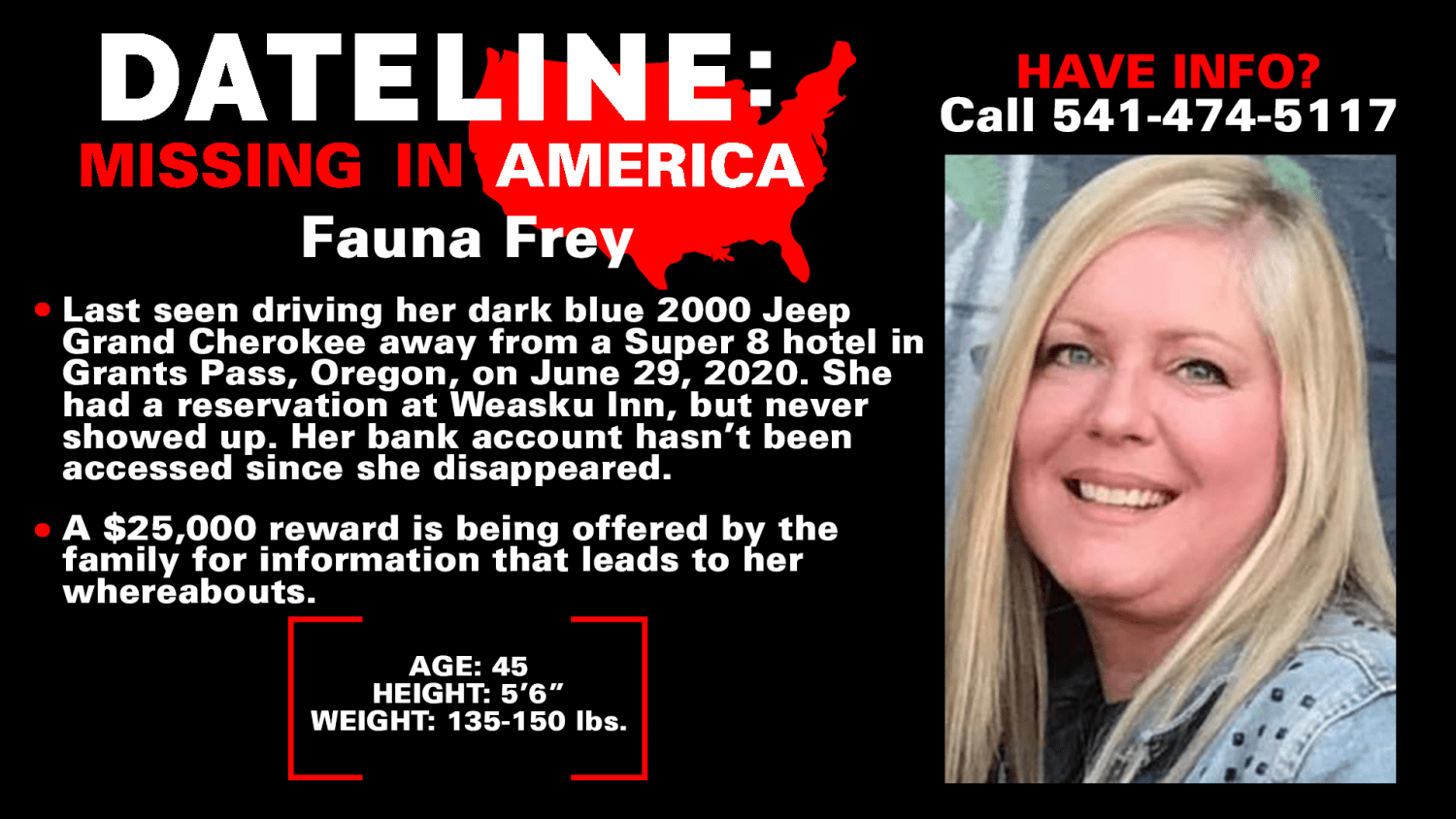 It’s been more than five years since the disappearance of a Lane County Woman, who was last seen in Grants Pass. Back in June of 2020, Fauna Frey disappeared. Police said the 45-year-old left her home in Dexter to drive to Grants Pass to visit her brother’s friend after her brother had recently passed away. The last place she was seen was at the Big 5 in Grants Pass. Investigators said her car was found in the Galice area months later. The circumstances of Fauna’s disappearance remain unclear and her case is currently classified as missing. Her case remains unsolved. Fauna’s disappearance has been featured on multiple investigative podcasts, including Nowhere to be Found, Here One Minute, Gone the Next, and Detective Perspective, each trying to fill the silence left by law enforcement. New listeners continue to discover her story, hoping a fresh set of eyes or a single loose memory might be the key to finding Fauna.
Have Information on Fauna Frey? Please Speak Up!
If you know anything, no matter how small, please contact:
- Josephine County Sheriff’s Office
- Tip line: (541) 359-5638
- Email: FindFaunaFrey@gmail.com
Currrently there is a $50,000 CASH REWARD for information leading to the location of Fauna Frey. LARGE CASH REWARDS are being offered for any other relevant information, such as any objects that could be identified as Fauna’s, i.e. her wallet, keys, or Indian/Buffalo .999 silver bullion coins. Find Fauna Frey Facebook Group: https://www.facebook.com/groups/341658526970132
You can find food in your community at this link
Our network of food banks and pantries provides free food and groceries across Oregon. No proof of income or documentation required.
https://www.oregonfoodbank.org/
If you can’t make it to a food location, someone else can pick up food for you.You will just need to print and fill out the Authorized Representative form at https://lnkd.in/dsskUpkQ, and have them take it with them to the food sites. You can find step-by-step instructions at https://lnkd.in/dVBRxn-A.
Worried about recent changes or losing assistance?
Here are resources that can help:
211Info: Dial 2-1-1 or visit the211Info food webpagefor information and referrals to more than 1,500 food resources across Oregon.
Oregon Food Bank: Use the Oregon Food Bank’s Food Finder Map to find over 100 food pantries, free food markets or hot meal programs near you.
Aging and Disability Resource Connection of Oregon (ADRC): Call 855-673-2372 or visit theADRC food webpage to find local meal programs and food boxes in your area.
Colder overnight temperatures this week prompt home heating fire safety reminder from Oregon State Fire Marshall

With below freezing overnight temperatures and recent home fires related to heating, the Oregon State Fire Marshal would like to remind Oregonians about the importance of fire safety. Since January 1, the agency has investigated 10 home fires across the state from various causes.
“These fires come as a tragic reminder of the importance of home heating fire safety, the second leading cause of home fires every year in Oregon,” State Fire Marshal Mariana Ruiz-Temple said. “Following fire safety guidance and testing smoke alarms regularly are important steps every Oregonian can take this winter.”
The Oregon State Fire Marshal offers these tips:
- Keep things that burn, like paper, curtains, bedding, or furniture, at least three feet away from all heating equipment, including fireplaces, wood stoves, and pellet stoves.
- Always plug space and portable heaters directly into a wall outlet and never into an extension cord or power strip.
- Have heating equipment and chimneys cleaned and inspected every year by a qualified professional.
- Keep space heaters out of the way of foot traffic. Never block an exit.
- Remember to turn portable heaters off when leaving the room or going to bed.
- Test smoke alarms at least once a month.
According to the National Fire Protection Association, nearly half of heating equipment fires (46%) occurred in the three-month period from December through February. In the first two weeks of 2026, three fire-related deaths were reported to the Oregon State Fire Marshal. – For more home heating safety tips, visit the OSFM’s website.

Eugene and around the state, as well as all across our country hold Candlelight Vigils for Alex Pretti


ONA Statement on the Shooting of Alex Pretti, an ICU Nurse For Veterans
Oregon Nurses Assn.
Portland, Ore. — The Oregon Nurses Association is outraged, heartbroken, and profoundly disturbed by the fatal shooting of 37-year-old registered nurse Alex Jeffrey Pretti by federal agents in Minneapolis on January 24, 2026. Alex was an intensive care unit nurse and union member at the VA hospital who dedicated his life to caring for military veterans and their families. A life devoted to healing was cut short — gunned down in the streets by federal agents while speaking out.
Our deepest condolences go out to Alex’s family, his patients, his colleagues, and the people of Minneapolis as they grieve this senseless and devastating loss.
A nurse’s job is to care for their patients — but they are also ethically bound to speak out in the face of injustice and human rights violations. Provision 8.2 of the American Nurses Association Code of Ethics for Nurses is clear: “Where there are human rights violations, nurses ought to and must stand up for those rights and demand accountability.” That is exactly what Alex was doing.
No one should be targeted by federal agents for speaking out. No nurse should be killed for standing up for human rights.
ONA members in Oregon are reporting growing fear and distress as they encounter federal agents in healthcare settings, particularly at Legacy Emanuel Medical Center. The killing of a nurse is intensifying these fears and could create unsafe conditions for patients, their families, and frontline caregivers alike. Healthcare settings must be places of care, not sites of intimidation or terror.
The Oregon Nurses Association stands in unequivocal solidarity with immigrant communities, with nurses, and with all frontline healthcare professionals across the country who are demanding accountability and an independent investigation. Federal enforcement tactics that endanger lives and traumatize communities have no place in a just society.
We call on all major healthcare systems in Oregon to stand up for nurses, publicly denounce this killing, and to hold ICE and similar federal agents accountable in healthcare settings.
A nurse who spent his life caring for veterans was killed by his own government for speaking out. He deserves justice.
The Oregon Nurses Association (ONA) represents a diverse community of more than 24,000 nurses and healthcare professionals throughout Oregon. Together, we use our collective power to advocate for critical issues impacting patients, nurses and healthcare professionals including a more effective, affordable and accessible healthcare system; better working conditions for all healthcare professionals; and healthier communities. For more information visit www.OregonRN.org.
ONA Statement on the Detainment of a Family at Adventist Hospital
Oregon Nurses Assn.
Reports by The Oregonian on January 23 and Noticias Noroeste that a family was detained by ICE while seeking medical care for their 7-year-old child at Adventist Health in Portland are alarming, chilling, and deeply shameful. No parent should ever be forced to weigh their child’s health against the risk of detention. No child should be subjected to this level of fear. Every child deserves access to quality and timely healthcare.
Provision 8.2 of the Nurses Code of Ethics is clear: “Where there are human rights violations, nurses ought to and must stand up for those rights and demand accountability.” That is why we are speaking out.
Detaining a family while they seek medical care for a child is unconscionable and does not just violate the ethical obligations of frontline caregivers; it violates the fundamental ethical obligation of healthcare institutions.
ONA members—nurses and frontline caregivers across Oregon—have been warning for months about the devastating consequences of ICE enforcement occurring in or near hospitals. Hospitals must be places of healing, safety, and trust. When that trust is broken, families delay care or avoid it altogether, turning preventable and treatable conditions into life-threatening emergencies. For children, the consequences of delayed or denied care are especially severe.
When law enforcement actions intrude into medical spaces, patient care is compromised—and in this case, a child’s well-being was placed at risk. This unjustified action raises urgent and disturbing questions that demand answers. Did the child ever receive the healthcare they needed? What capacity does ICE have to ensure the medical stability of a child whose parents sought emergency care in a hospital setting? Who assumed responsibility for the child’s health and safety once the family was detained, and under what clinical standards? These are not abstract concerns; they are matters of life, health, and basic human dignity.
ONA calls on Oregon’s healthcare executives, hospital systems, and elected officials at every level to forcefully put an end to this heinous practice and to take immediate action to ensure that hospitals remain safe spaces for all families, without exception. ONA will continue to stand with immigrant communities, our patients, our families, and caregivers to demand accountability and protect access to care for all.
###The Oregon Nurses Association (ONA) represents a diverse community of more than 24,000 nurses and healthcare professionals throughout Oregon. Together, we use our collective power to advocate for critical issues impacting patients, nurses and healthcare professionals including a more effective, affordable and accessible healthcare system; better working conditions for all healthcare professionals; and healthier communities. For more information visit www.OregonRN.org.
Oregon hospitals fall short in meeting national standards for preventing some health care-associated infection measures
OHA continues support for hospitals in improving infection control, but visitors to health care facilities can also help
Oregon hospitals made gains in lowering the number of health care-associated infections (HAIs) among hospitalized patients and meeting some federal infection reduction goals during 2024, according to newly published Oregon Health Authority (OHA) data.
But hospitals around the state fell short of meeting national standards—and when compared with hospitals nationwide—for reducing deadly surgical site infections, catheter-associated urinary tract infections, central line-associated bloodstream infections and methicillin-resistant Staphylococcus aureus (MRSA) bloodstream infections.
The Healthcare-Associated Infections Program at OHA’s Public Health Division annually publishes the hospital HAI data for 61 individual hospitals in Oregon. The HAI Program’s interactive data dashboard provides statewide summaries and facility-specific data of Oregon hospital performance on nine HAI metrics, with comparable national benchmarks.
OHA works to prevent infections because of the significant risk to patient safety. On a given day, one in every 31 patients in U.S. hospitals will get an infection in a hospital or health care setting. In 2024, Oregon hospitals reported 957 such injuries.
“No health care provider wants to see a hospital-associated infection in one of their patients,” said Dat Tran, M.D., MS, HAI Program medical director. “These data are intended to help hospitals and health care providers understand where they’re doing well and where they may need to step up their infection control efforts to prevent HAIs and keep patients safe.”
HAI Program staff use four methods to assess progress Oregon and individual health care facilities are making in reducing HAIs:
- Comparison to 2015 Centers for Disease Control and Prevention HAI data used as a baseline to calculate a predicted number of HAIs.
- Comparison to national reduction goals set by the U.S. Department of Health and Human Services to achieve 50% reduction in central line-associated bloodstream infections and hospital-onset MRSA bloodstream infections; 30% reduction in hospital-onset Clostridium difficile infections and surgical site infections; and 25% reduction in catheter-associated urinary tract infections.
- Comparison to 2023 statewide data to calculate a percent change for 2024.
- Comparison between 2024 statewide data and 2024 data reported by hospitals nationwide.
Among the HAI Program’s observations in this year’s data:
- With the exception of hysterectomy procedures, Oregon hospitals performed worse than the 2015 baseline for the four other reportable surgical site infections, including those resulting from colon procedures, coronary artery bypass grafts, hip prosthesis and knee prosthesis. Oregon hospitals saw more surgical site infections in 2024 compared with 2023.
- In 2024, Oregon hospitals performed better than the 2015 baseline for catheter-associated urinary tract infections, Clostridioides difficile infections, and surgical site infections following hysterectomy procedures.
- While Oregon acute care hospitals performed better than the 2015 baseline in 2024 for central line-associated bloodstream infections and MRSA bloodstream infections, Oregon critical access hospitals performed worse than the 2015 baseline for both infections.
- Compared with hospitals nationwide, Oregon hospitals performed similarly in 2024 for most measures but performed worse for catheter-associated urinary tract infections, Clostridioides difficile infections and MRSA bloodstream infections in critical access hospitals.
- Oregon hospitals met the HHS target in 2024 for Clostridioides difficile infections in both acute care and critical access hospitals. No other HAI metric met the HHS target in 2024.
- Similar to 2023, catheter-associated urinary tract infections and MRSA bloodstream infections in critical access hospitals continue to perform worse than the 2015 baseline and should be targeted for prevention.
New to the data dashboard is an “Antibiotic Stewardship” tab, which provides state- and facility-level information on use of seven core elements of antimicrobial stewardship. HAI Program staff found that 100% of Oregon hospitals met all seven core elements of stewardship in 2024.
To support Oregon facilities in improving their performance on these HAI metrics, OHA continues to:
- Conduct studies to assess and understand statewide and regional trends.
- Provide one-on-one infection control technical assistance to health care facilities statewide.
- Collaborating with CDC to offer direct-to-provider infection control education to ensure all health care staff have the tools to prevent health care-associated infections.
There also are infection prevention strategies that families, friends and the public visiting these settings can follow. Visitors to health care settings should frequently wash their hands, look for worsening signs and symptoms of infection, and notify providers of these signs and symptoms. Visitors should follow facility infection prevention policies and procedures. Most importantly, visitors should avoid visiting a facility if they are sick. — Click here to learn more about OHA’s HAI Program, the impacts of infection and prevention steps.
Oregon, IRS begin processing e-filed returns; First state refunds expected February 17
Salem, OR—As Oregon and the IRS begin processing electronically-filed tax year 2025 returns today, the Department of Revenue expects the first Oregon taxpayers to receive their refunds—including their share of the state’s $1.41 billion kicker—as soon as February 17.
The department announced earlier this month that taxpayers who choose to file paper returns face a significantly longer wait. For paper filed returns, refunds will not start being issued until early April.
To help taxpayers avoid missteps that could further delay their refund, the department is opening 2026 tax season with a series of best practices suggestions.
File a return to claim your kicker
The kicker is a refundable credit that will either increase a taxpayer’s Oregon state income tax refund or decrease the amount of state taxes they owe. It is not sent to taxpayers separately as a check.
Only taxpayers who filed a tax year 2024 return and also file a tax year 2025 return can receive a kicker. The credit is a percentage of Oregon personal income tax liability for the 2024 tax year.
Personal income taxpayers can determine the amount of their kicker using the “What’s My Kicker? calculator available on Revenue Online. To use the calculator, taxpayers will need to enter their name, Social Security Number, and filing status for 2024 and 2025.
File electronically, request direct deposit
On average, taxpayers who e-file their returns and request their refund via direct deposit receive their refund within two weeks. Those who file paper returns will experience a significantly longer wait in 2026 due to processing delays.
In the closing months of 2025, the IRS was late providing necessary tax forms and information to the Oregon Department of Revenue. As a result, the state’s processing of paper-filed Oregon personal income tax returns can’t begin until the end of March.
Taxpayers should file just once unless they need to make a change to their return. They should choose to either file electronically or by paper. Doing both will delay processing of their return.
Gather all tax records before filing
In a kicker year, taxpayers can be in a hurry to file their return so they can get their refund as soon as possible. The department warns taxpayers not to get in too much of a hurry. They should make sure they have all necessary records—including Form W-2s from their employers and Form 1099s reporting other income—needed to file a complete and accurate tax return to avoid errors.
Getting in a hurry can cause taxpayers to file before they have all the information necessary to report all of their income. If income reported on a return doesn’t match the income reported by employers, the return, and any corresponding refund, will be delayed.
Revenue Online
Revenue Online is the state’s internet tax portal and is the best way to communicate with the department.
Taxpayers with a Revenue Online account should make sure their information is current before they file. They should check their username, password, and address; and verify any estimated tax payments they’ve made.
Those who don’t have a Revenue Online account can create one. They can simply go to Revenue Online, click “Sign Up” in the box at the top right and follow the prompts.
Download Form 1099-G
The department reminds taxpayers that it no longer mails Form 1099-G to taxpayers. The form reports the amount of refunds, credits, or other offsets of personal income, statewide transit individual tax, TriMet transit self-employment tax, or Lane transit self-employment tax paid during the previous year.
Only those who itemized deductions on their tax year 2024 federal income tax return will need a Form 1099-G to file their tax year 2025 return. Those taxpayers can view and download their Form 1099-G through Revenue Online.
Taxpayers who received unemployment insurance or Paid Leave Oregon benefits in 2025 will receive a separate 1099-G by January 31 from the Oregon Employment Department.
Governor Kotek taps interim Oregon public defense head for permanent position
Oregon Governor Tina Kotek on Friday chose one of the state’s most experienced criminal justice analysts to take full control over the Public Defense Commission as the state moves closer to stemming its shortage of public defense attorneys.

The governor said that Kenneth Sanchagrin, the agency’s interim director, had shown progress on his efforts to reduce the number of Oregonians without a defense attorney provided by the state.
“Ken stepped in last April at my request, and he is delivering on the expectations I set forth to address the unrepresented crisis and end the needless delay of justice for defendants and crime victims,” Kotek said in a Friday statement. “The Oregon Public Defense Commission has a duty to provide attorneys to defendants who cannot afford them, and under Ken’s direction, there is a stronger coordinated effort among all branches of government to resolve this crisis with urgency and transparency.”
Oregon lawmakers in 2023 voted to give the governor more control over the agency, moving it from the purview of the Oregon Judicial Department to the executive branch and Kotek’s administration. The Oregon Senate will still need to confirm Sanchagrin’s formal appointment to the executive director role in the upcoming legislative session starting February.
The governor in April fired the public defense commission’s previous executive director, Jessica Kampfe, amid concern that the agency was not making enough progress, with more than 4,000 unrepresented Oregonians at that time. The crisis for years has left many Oregonians without a defense attorney if they cannot afford to hire their own, despite them being guaranteed representation by both Oregon’s and the United States’ Constitution.
Following Kampfe’s removal, Kotek tapped Sanchagrin, formerly the executive director of Oregon’s Criminal Justice Commission, to take the reins of the public defense commission as interim executive director. In June, he announced a 12-month, seven-point plan that sought to expand contracts with lawyers and nonprofits across the state, increase voluntary caseloads for available attorneys and work to onboard law students who can be supervised.
The governor’s office on Friday suggested those efforts appear to be working, saying in a press release that the number of defendants in the state without an attorney has “dropped significantly.” They pointed to a December 2025 report noting that unrepresented defendants in the state had decreased by 32% to 2,559 from 3,778 a year prior. One of the previously so-called “crisis” counties where the shortage has been most acute, Coos County, has seen three months of having “few to zero people without counsel,” Kotek’s office said.
On Friday, Sanchagrin characterized his work as the result of a collaborative approach with staff, courts, district attorneys’ offices and public defense providers.
“Together, we are working diligently to find and implement solutions that will reduce the number of unrepresented defendants,” he said in a statement. “We have made important progress, but more work remains. I look forward to building on these efforts to address Oregon’s constitutional obligations while creating a more sustainable, accountable and data-driven public defense system.”
Oregon relies on a patchwork of systems to provide defense attorneys for thousands of people accused of crimes, including through contracts with nonprofits and a “consortia” model through agreements with law firms.
The state’s trial representation division, with offices in areas such as Portland, Salem and Medford, has historically been the smallest unit aiming to provide representation for defendants. They take on specialized cases that require representation within seven days of a person being taken into custody or handle complex dynamics such as mental health, language barriers or lengthy investigations.
Lawmakers held off on significantly expanding the trial division’s team in the 2025 legislative session, but Kotek and the defense commission have been pushing for an expansion that would likely need legislative approval. In a December request to lawmakers to reroute $1.6 million toward the trial division, Sanchagrin wrote that the money would allow the commission to “replace the equivalent of four hourly caseloads while also funding two additional Trial Division attorneys with zero impact on the agency’s budget and no additional cost to the state general fund.”
Rep. Paul Evans, D-Monmouth, helped lead the push in 2023 for legislation that allocated around $90 million to overhaul the public defense system, and he previously told the Capital Chronicle he would be monitoring the agency’s progress going into the 2026 legislative session.
On Friday, he said that Sanchagrin is “doing well in a tough situation.”
“His continued leadership will provide critical stability as we pivot into the next phases of reform and improvement,” Evans said in a text message. “He has my personal and professional support.”
Before leading the state’s Criminal Justice Commission, Sanchagrin worked as the commission’s director of research. He also holds doctoral and master’s degrees in sociology from the University of Iowa, a law degree from Michigan State University, and a bachelor’s in history from the College of Charleston in South Carolina.
Tiffany Woods, a spokesperson for the public defense commission, confirmed that a new offer letter and salary will be issued for Sanchagrin should he be approved by the Oregon Senate. Sanchagrin does not know what the figure will be, she said, but until his confirmation, he will continue to receive his interim salary of $20,063 per month, or an annual rate of $240,756. (SOURCE)
Red Cross Declares Severe Shortage after Blood Supply Falls 35% in Past Month

- The American Red Cross is issuing a severe blood shortage after the national blood supply fell about 35% over the past month.
- A nationwide flu outbreak may be sidelining blood donors. Already, the flu has overburdened hospitals — and this blood shortage means they’re now being forced to triage critical blood products.
- With more winter weather forecast, the problem could worsen without immediate blood donor action. Last month alone, 400 blood drives were impacted by winter weather, causing thousands of blood donations to go uncollected.
- Those who may be eligible are urged to book an appointment now at RedCrossBlood.org.
Despite efforts to rebuild the national blood supply in recent weeks, the inventory has continued to drop at an alarming rate of about 35% over the past month — forcing the American Red Cross to issue a severe blood shortage. This comes as flu activity is exploding across the country, where overburdened hospitals are now being forced to triage critical blood products.
High flu activity in nearly every state may be sidelining donors, slowing efforts to rebuild vital blood inventories to help patients and relieve pressure on hospitals. The shortage is especially serious for types O, A negative and B negative. Without immediate action, patients who rely on transfusions — including trauma victims, mothers in childbirth, and people with sickle cell disease or cancer — face serious risk.
There’s no time to wait. Book an appointment now to give blood by using the Blood Donor App, visiting RedCrossBlood.org or calling 1-800-RED CROSS (1-800-733-2767).
“This time of year is always challenging for blood collection — but right now, the perfect storm of a long holiday season, record flu activity and winter weather are all impeding donation efforts,” said Dr. Courtney Lawrence, executive medical director for the Red Cross. “Every person’s blood donation can help save lives — plus you help ease the tremendous burden on our doctors and nurses, allowing them to focus on caring for patients.”
Intense winter weather and freezing temperatures are expected across much of the country in the coming weeks, potentially delaying or canceling blood drives and forcing vital units of blood to uncollected. Last month alone, about 400 blood drives were impacted due to extreme winter weather — more than three times the number of those affected during the same time the previous year. As a result, thousands of blood donations went uncollected.
‘I Had a Successful Ending Because the Blood I Needed Was There’
When emergencies like postpartum hemorrhage occur, the difference between life and death for a mother and her baby can hinge on the availability of a blood transfusion. Postpartum hemorrhage is a leading cause of maternal deaths in the United States. These crises can happen suddenly — even in pregnancies without complications — underscoring the vital need for a ready supply of blood to help save lives.
For first-time mother Reihaneh Hajibeigi, childbirth complications caused her to hemorrhage and lose nearly 40% of her blood supply. She recalled that, as she crashed, a team of doctors rushed in to save her life, asking, “Where’s her blood? She needs this blood to save her life.”
“It was about 10 minutes from the time I started to feel faint until they had the blood in my system, and I was basically coming back to life,” Reihaneh said. “I think about the people who made it possible for me to live,” she said. Watch Reihaneh share her remarkable story of survival.
The Red Cross is also extending its thanks to those who come to donate Jan. 26-Feb. 28 with a $20 e-gift card to a merchant of your choice. See RedCrossBlood.org/Heart for details.
How to Donate Blood
Download the Red Cross Blood Donor App, visit RedCrossBlood.org, call 1-800-RED CROSS (1-800-733-2767) or enable the Blood Donor Skill on any Alexa Echo device to make an appointment and learn more. All blood types are needed to ensure a reliable supply for patients.
- A blood donor card or driver’s license or two other forms of identification are required at check-in
- Individuals who are 17 years of age in most states (16 with parental consent where allowed by state law), weigh at least 110 pounds and are in generally good health may be eligible to donate blood.
- High school students and other donors 18 years of age and younger also have to meet certain height and weight requirements.
Blood and platelet donors can save time at their next donation by using RapidPass® to complete their pre-donation reading and health history questionnaire online, on the day of their donation, before arriving at the blood drive. To get started, follow the instructions at RedCrossBlood.org/RapidPass or use the Blood Donor App.
About the American Red Cross: The American Red Cross shelters, feeds and provides comfort to victims of disasters; supplies about 40% of the nation’s blood; teaches skills that save lives; distributes international humanitarian aid; and supports veterans, military members and their families. The Red Cross is a nonprofit organization that depends on volunteers and the generosity of the American public to deliver its mission. For more information, please visit redcross.org or CruzRojaAmericana.org, or follow us on social media. https://www.redcross.org/local/oregon.html?srsltid=AfmBOoqQ-oQRSOha1nl8QTzVG4BDk_UtPu7nK9Ao6jYxWqU1Acruynxs
The Oregon Division of Financial Regulation is a proud supporter of the Bank On movement, a nationwide effort to reduce barriers to banking access and increase the availability of safe and affordable bank and credit union accounts.

Bank On certified accounts do not have overdraft fees, have low monthly maintenance fees, and require just $25 to open an account. When consumers have access to affordable and safe checking accounts, they can avoid paying for costly check cashing services and money orders. Find a Bank On certified account near you at https://www.oregon.gov/bankonoregon/Pages/index.aspx.
Govenor Tina Kotek picks Nevada state forester as first woman to lead Oregon Forestry Department
Kacey KC would be the first permanent, female leader of the Oregon Department of Forestry in its 115-year history
After a year-long search, Gov. Tina Kotek has chosen Nevada’s state forester to take the helm of the Oregon Department of Forestry.

Kacey KC would be the first woman to permanently hold the director’s position in the 115-year-old agency’s history. The Oregon State Senate would need to confirm her appointment during the upcoming legislative session before she could take office on March 1.
KC, from Nevada, most recently spent eight years as Nevada’s State Forester Firewarden and three years as president of the National Association of State Foresters.
“Kacey KC brings tenacity and a get-it-done style to her management approach and knows how to build strong partnerships across all levels of government to tackle complex challenges,” Kotek said in a statement.
It’s also the first time Kotek has had the authority to choose the state forester, rather than leaving the decision to the governor-appointed Board of Forestry, following the passage of Senate Bill 1051 during the summer.
Leading up to the change in hiring authority in 2025, the Oregon Department of Forestry had been roiled by controversies in 2024, including going to the Legislature for emergency money to cover its wildfire season bills, executive investigations and firings over workplace misconduct, as reported by The Oregonian/OregonLive. Former director Cal Mukumoto resigned early last year at the urging of Kotek and the agency has been run by interim director Kate Skinner, who was previously lead forester in the Tillamook district.
The Oregon state forester reports to the governor and the forestry board, and oversees the management and protection of 745,000 acres of forestland owned by the state of Oregon, as well as wildfire protection for 16 million acres of forestland in the state. All of this requires negotiating the desires of environmentalists, logging companies, tribes and private property owners.
They also oversee a biennial budget of more than $570 million and roughly 1,400 employees. If confirmed, KC would earn $19,700 per month for the first six months on the job, after which her salary would increase to $21,069 per month, or roughly $252,000 per year.
KC holds a bachelor’s degree in forestry from the University of Montana and is an alumna of the Peace Corps, where she volunteered for two years on community forestry projects in Nepal. Afterward, she returned to her home state to work for the Nevada Division of Forestry, then spent 10 years working on wildfire fuels reduction programs at the Nevada Department of Conservation and Natural Resources, including as program manager of the state’s Sagebrush Ecosystem Program.
She returned to the forestry division as a deputy administrator of wildfire management in 2015, and in 2018 Nevada’s governor appointed her as state forester firewarden.
In 2021, she was appointed by Congress to a national Wildland Fire Mitigation and Management Commission to update the nation’s wildfire protection systems, and in 2023 her peers elected her president of the National Association of State Foresters.
“I am extremely excited for the opportunity to join the Oregon Department of Forestry team,” KC said in a statement. “While I am not from Oregon, my experience at both the national and state level equips me to deepen key relationships while leading and supporting the strong work and mission of the Department.” (SOURCE)
Oregon legislation poised to tackle ‘fishing expedition’ searches of license plate data
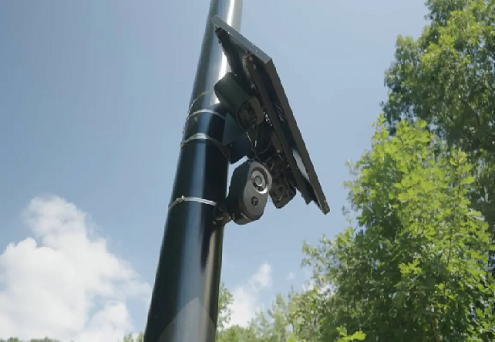
The idea comes as a result of a legislative workgroup convened last year to study the issue of inappropriate usage of automated license plate recognition software employed by law enforcement agencies in Oregon and nationwide
A powerful Oregon legislative committee chair is calling for increased “safeguards and protections” on the use of data collected by a controversial crime-fighting technology scanning license plates that critics fear the Trump administration will weaponize.
Sen. Floyd Prozanski, a Eugene Democrat who chairs the Senate Judiciary Committee, helped convene a group of law enforcement stakeholders, privacy advocates and legislative leaders, which met in December to tackle the issue as cities across the state have debated whether to turn off their cameras employing the technology. One vendor in particular, the Atlanta-based Flock Safety, has drawn condemnation from U.S. Sen. Ron Wyden, who previously said the company is “unable and uninterested” in addressing abuses of its products.
But views among workgroup stakeholders were diverse, including law enforcement who have defended license plate readers as a valuable tool for intercepting crime to progressive activists who say such technology itself is far too vulnerable for abuse by the federal government. Critics of some license plate reading technology have pointed to instances where the software’s data has been accessed by federal immigration enforcement agencies or used to target out-of-state abortion seekers.
“At this point, Prozanski is leaning more towards putting up some guardrails that will make it safe,” Ky Fireside, an Oregon House candidate and Springfield-based progressive organizer who is part of the workgroup, told the Capital Chronicle in December. “But the fact of the matter is, there’s not anything you can do to make this kind of technology safe. It’s just designed to be abused.”
Prozanski, however, said in an interview that he values the technology for “legitimate, lawful enforcement purposes,” pointing to its use in the arrests of suspected criminals tied to a Pacific Northwest burglary ring targeting Asian American households, including in the Eugene-Springfield area.
He said he was also concerned about inappropriate data-sharing with the federal government or other states, as well as data brokers who are mining and selling such data for unlawful use. He added that law enforcement agencies across the state may be entering into contracts for the software without adequate data privacy protections, calling for similar protections employed by other Oregon state agencies for safeguarding information.
“They have protocols in place already on the duration of the length that can be held, (to) cross check for if someone’s making inquiries, to ensure that there has been something assigned to it, like a case number, and someone’s not going on what some people would call a fishing expedition and just picking out this request or that request,” Prozanski said. “That’s the type of stuff that we’re working on.”
Key to the debate over the license plate readers have been Oregon’s sanctuary laws, which prevent state and local law enforcement from assisting federal immigration enforcement without a court order. U.S. Border Patrol employed automated license plate reading technology in the 1990s, and it spread to police departments across the country in the next decade.
A November state court ruling in Washington found that the images captured by Flock’s license plate readers are not exempt from disclosure under public records law. Prozanski confirmed he is still considering a public records exemption for such information as well as increased audits, a pathway to allow individuals whose data is improperly accessed to receive redress and certification requirements for license plate reading software vendors.
A Flock company spokesperson did not respond to requests for comment about legislative efforts in Oregon, but company leadership have previously accused opponents of spreading misinformation, pointing to improved filters for sanctuary states.
“We’re working under state law of Oregon, and if someone is making queries for something that happened or potentially could be actionable in a different state, it’s not what their state law provides, it’s what Oregon provides,” Prozanski said. “So we’re going to maintain safeguards and protections for those within this state.”
The state has already funded the proliferation of the technology’s use across Oregon, though in cities such as Eugene, police have backed away from their contracts with Flock. In that instance, local authorities confirmed that a license plate reading camera in the area was turned on without the city’s consent.
Meanwhile, hundreds of thousands of dollars in funding for law enforcement agencies across the state has gone toward the technology, drawing from an Oregon organized retail theft grant program, according to the state’s Criminal Justice Commission. As of December, however, there have been no instances where the agency has needed to investigate reports of state law violations involving the use of state funds for license plate reading technology, according to Ryan Keck, the commission’s director.
He said that his agency uses quarterly reports from recipients and can also conduct information audits within the scope of its grant agreements. If there were a reported violation, Keck said the agency would forward the matter for investigation.
For new grants issued after Dec. 1, 2025, however, the agency has tightened its purse strings. New contracts include additional language for returning any funds that have been spent outside the scope of the agreement, which includes requirements to comply with state laws, Keck said. The commission in October also agreed to establish a new methodology for determining how the retail theft grant money would be awarded.
“The Commission’s methodology prioritized applications to support local programs specific to organized retail theft (to include equipment) over applications solely requesting equipment with no specified support (ex: personnel, operations) to address organized retail theft,” he wrote in a statement.
“Moving forward, CJC will continue to monitor its grants in accordance with the terms of executed grant agreements, and remain responsive to any legislative changes,” he added.
In an interview Friday, Fireside said that while they appreciate the work the legislative workgroup has done, the deck felt stacked in favor of law enforcement.
The line in the sand they and other privacy advocates are drawing has to do with support for end-to-end encryption, the process by which secure data is encoded before it is transferred to its destination and decoded. Having such a safeguard would make it difficult for federal authorities to subpoena vendors for information stored securely by a law enforcement agency, Fireside said.
“They are trying to push for like, ‘Oh, well, it’s, it’s encrypted in transit, and it’s encrypted at rest’, and that just doesn’t mean anything,” they said. “It doesn’t provide any protection.”
Prozanski, in the meantime, suggested there would be more than one proposal in the works, potentially for future sessions. Some ideas involve allocating additional funding, which is not feasible given the state’s current financial outlook, he told the Capital Chronicle, but could be in the future.
“This is probably the first beginning of more than one session dealing with this,” he said. “We’re not going to get everything done the first time.” (SOURCE)
Oregon Health Authority seeks new members for Oversight and Accountability Council
Oregon Health Authority (OHA) is seeking applicants to serve on the Oversight and Accountability Council (OAC), a Council established by Ballot Measure 110 in 2020. The OAC is a public body of the state of Oregon that advises the Oregon Health Authority on the grant program described in ORS 430.389
Members of the OAC serve four-year terms. Members may be eligible for a stipend to compensate them for their time engaged official duties of the OAC. OHA is seeking new members in the categories described below:
- An academic researcher specializing in drug use or drug policy
- A representative of a coordinated care organization
To apply, submit an application here by 11:59 pm, January 30, 2026.
A team at OHA will review applications and inform applicants of appointments by Feb 13, 2026.
For questions or more information, email HRN@OHA.oregon.gov” style=”color: rgb(6, 66, 118); text-decoration-line: none; text-size-adjust: 100%;”>BHRN@OHA.oregon.gov or contact Karli Moon at li.moon@oha.oregon.gov” style=”color: rgb(6, 66, 118); text-decoration-line: none; text-size-adjust: 100%;”>Karli.moon@oha.oregon.gov or 971-240-8690.
OPRD seeks public input on proposed rules for UAS use in Oregon State Parks
Oregon Parks and Recreation Department (OPRD) is seeking public feedback on proposed rules governing unmanned aircraft systems (UAS) takeoff and landing in Oregon’s state parks and along the ocean shore.
The proposed rules establish where and how UAS may take off and land on state park property, to balance recreational opportunities with protection of natural, cultural, scenic and recreational resources.
Public comments on the proposed rule changes will be accepted beginning January 1, 2026 at 8:00 a.m. and can be submitted:
- Online:
- By email:
- By mail:
- Oregon Parks and Recreation Department
Attn: Robert Ellison
725 Summer St. NE, Suite C
Salem, OR 97301
- Oregon Parks and Recreation Department
A public hearing will be held to allow members of the public to provide testimony.
- Virtual hearing
January 20, 2026 at 5:00 p.m.
Zoom: https://us06web.zoom.us/webinar/register/WN_X3ChSlJkTE-Y3FRh3WIy-Q
The draft rules focus on regulating takeoff and landing locations, which are within the department’s authority, while recognizing that UAS flight is regulated by the Federal Aviation Administration (FAA). Under the proposal, UAS use would generally be limited to designated areas for drone operations, with additional requirements for commercial or research purposes.
The proposed rules were developed in response to Senate Bill 109 (2021), which directed OPRD to create a regulatory framework that provides recreational UAS access while protecting sensitive park resources and minimizing conflicts with other visitors.
OPRD convened a Rule Advisory Committee made up of recreation user groups, conservation organizations, natural resource specialists, commercial operators and other stakeholders. The committee reviewed draft rules and provided recommendations that helped shape the proposal now open for public comment.
Once the public comment period closes, OPRD staff will review all feedback, revise the draft rules as appropriate, and present a final proposal to the Oregon State Parks and Recreation Commission for consideration later in 2026.
If adopted, the rules would be implemented in phases, allowing the department to adapt management strategies over time, based on resource conditions, visitor use and operational experience.
For over 30 years the Yachats Lions Club has held an annual Crab Feed event in Yachats, Oregon. The annual trek to Yachats to eat Dungeness crab is a tradition for families and groups from across Oregon, Washington and beyond.
Our annual Yachats Lions Club Crab Feed is DINE-IN on Saturday, January 31, 2026! After selling out in 2025, the 2026 Crab Feed will now offer 4 seatings, 12:30 pm and 4:00 pm at the Yachats Lions Hall and 12:30 pm and 4:00 pm at the Yachats Commons.
Meals purchased will consist of “All you can eat Dungeness crab“, fresh locally baked bread, coleslaw, baked beans, and soda for $50.
Crab Feed 2026 Tickets – All You Can Eat

The $50 per person meal tickets are available for sale online at https://yachatslionsclub.org/ You can select the seating and order as many meals as you like. For more information please send an email to YachatsLionsCrabFeed@gmail.com.
Lion David O’Kelley, coordinator of the popular Crab Feed, says “We are very pleased to be offering the fund-raiser as we have done for so many years.” We get great support from the community and local businesses in Yachats, Waldport and Newport. South Beach Fish Market cooks and cleans the best tasting local crab you have ever eaten.
With our motto of “WE SERVE” among the many services we provide eyeglasses and exams, hearing aids and exams, eye screening in Lincoln County schools, pancake breakfasts, crab feed, lunch bunch, speaker series, peace poster and flag day events in our schools, and ommunity use of our clubhouse. Through community donations to the Yachats Lions Thrift Store our sales allow us to donate to local, student scholarships, food pantries, school programs, projects, and upkeep of the clubhouse.
In addition, donations are made to Oregon Lions Sight and Hearing as well as Lions Club International Foundation. Lions Club International is the world’s largest service club organization with a network of 1.4 million men and women in more than 200 countries and geographical locations. We serve where we live, as well as globally, and we have fun doing it.
The proceeds for this fund-raising event are for Oregon Lions Sight and Hearing Foundation.
Oregon has enhanced its online voter registration system in anticipation of a crucial election season, enabling eligible voters without a state-issued ID to register digitally for the first time.
Voters can access the system via sos.oregon.gov by navigating to the voting section of the website.
Applicants lacking an Oregon Department of Motor Vehicles number can now indicate this directly on the form and proceed with the online registration process. These users are required to provide their name, residential address, date of birth, the last four digits of their Social Security number, and an uploaded image of their signature.
This modification arises from House Bill 4133, which was enacted by lawmakers in 2022. Previously, online registration was restricted to voters whose identity and signature had already been authenticated through the DMV. Individuals without qualifying identification were obligated to fill out a paper registration form, which was subsequently processed by county elections offices.
State election officials indicate that this update aims to modernize the registration system and eliminate obstacles for eligible voters, including those who no longer drive, have never possessed an Oregon driver license, or encounter difficulties registering by mail.
The Oregon DMV has now implemented a local preference system for rural customers who are scheduling behind-the-wheel drive tests for Class C driver licenses, which is the standard license for passenger vehicles.
Becoming effective on January 1st, Senate Bill 9 mandates that DMV field offices located in 20 rural counties prioritize applicants who either reside within the same county, are within 50 miles of a DMV field office, or live in one of the two counties that do not have a DMV office.
This legislation benefits customers residing in Baker, Clatsop, Crook, Curry, Gilliam, Grant, Harney, Hood River, Jefferson, Klamath, Lake, Malheur, Morrow, Sherman, Tillamook, Umatilla, Union, Wallowa, Wasco, and Wheeler counties. It is important to note that the DMV does not conduct drive tests in Gilliam, Morrow, Sherman, or Wheeler counties.
Customers from these counties have the option to schedule a local-preference drive test at any rural DMV office that provides this service.
Raise Funds to Plant Trees in Oregon
Registration is open for the Bob Ross-inspired Happy Little (Virtual) 5K
Inspired by American painter and PBS television personality Bob Ross’ love of the outdoors, Oregon Parks Forever is sponsoring a virtual 5K race to help plant trees in Oregon’s parks & forests. You must register by April 1st in order to get your shirts and medal before the event.

Participants can walk, run, paddle or roll to complete their 5K anywhere outdoors anytime between April 18 and 26 (covering Earth Day and Arbor Day). Participants are encouraged to register by April 1 to ensure that your swag arrives before the event week. Last year, we had to close registration early due to higher than anticipated participation, so register as soon as possible. If you register after April 1, you may not receive your swag before race week. Registration will close on April 15, or earlier if more participants sign up than we have available swag.
For $36 per person, each participant will receive a keepsake Happy Little T-shirt, a commemorative bib number and a finisher’s medal. All Oregon race proceeds support tree planting and forest protection efforts in Oregon parks. Ten trees will be planted in Oregon for each registration. This year’s tree plantings will be placed in the Santiam Canyon.
Initially, the “Happy Little Trees” program began with a partnership between the Michigan Department of Natural Resources and Bob Ross Inc., with hundreds of volunteers helping to plant “happy little trees” at locations hard-hit by invasive pests and tree diseases. The partnership quickly expanded to include the Run for the Trees / Happy Little (Virtual) 5K.
As the Happy Little 5K gained popularity, more states have joined the effort. Now in its sixth year, the Happy Little 5K has expanded its reach to include fifteen other states. Together, all sixteen states will help raise awareness and funding for stewardship efforts in each state’s parks.
“We are thrilled to honor Bob Ross and continue our efforts to plant at least One Million Trees in Oregon.” said Seth Miller, Executive Director of Oregon Parks Forever. “To date, we have funded the planting of 850,000 trees.”
“The official Bob Ross 5K is probably our most favorite initiative,” says Joan Kowalski, president of Bob Ross Company. “It’s the perfect blend of everything Bob held dear; nature, taking care of the environment, and happy trees too of course. He would have been so pleased to see how it’s getting so popular around the world.”
Participants can register at www.orparksforever.org.
For more information, contact Seth Miller at 503/966-1053 or seth@orparksforever.org
The Oregon Department of Revenue will open the application period in January 2026 for the Agricultural Employer Overtime Tax Credit.
Paying overtime to agricultural workers became a requirement of employers in Oregon as of January 1, 2023. In 2025, agricultural workers are paid overtime after they work 48 hours in one work week. If an employer paid overtime, they may qualify for a refundable personal or corporate income tax credit, regardless of the size of the business.
The tax credit for employers is a percentage of overtime premium pay paid as wages.
All applications must be submitted no later than February 2, 2026.
The 2025 filing period marks the third year since eligible employers have been able to apply for the tax credit.
Applications can only be made through the department’s Revenue Online website. Qualifying agricultural employers who have not applied for the tax credit previously need a Revenue Online account to apply during the application period. No paper applications will be accepted. We have published a new video to help customers with their Revenue Online applications.
DOR encourages employers to prepare in advance to ensure an easier and faster filing experience. DOR’s webpage provides guidance for how to apply, documentation you may need, program information, and frequently asked questions to help employers apply for the tax credit.
For general questions about the Agricultural Employer Overtime Tax Credit, email: Ag.Overtime@dor.oregon.gov.
Tax practitioners with other tax or customer account questions are encouraged to contact a dedicated practitioner specialist by email at prac.revenue@dor.oregon.gov, or by phone at 503-947-3541.
NW Natural Warms Up Winter with “Fireside Friends” Pet Photo Contest
Customers are invited to share photos of their pets for a chance to win a prize; NW Natural is also supporting The Pongo Fund
NW Natural is inviting customers to warm up this winter and celebrate their pets with the launch of the Fireside Friends Sweepstakes. The contest offers the chance to win a prize while also supporting a local charity.
Running now through February 1, 2026, the sweepstakes welcomes customers to share photos of their furry friends enjoying the warmth and comfort of a natural gas fireplace for the chance to win a $200 Chewy gift card.
NW Natural has also pledged a $1,000 donation to The Pongo Fund Pet Food Bank, which helps support people and their pets throughout Oregon and Southwest Washington.
How to Enter:
NW Natural customers can enter the sweepstakes via social media in two simple steps:
- Follow @nwnaturalgas on Instagram or Facebook. (Media can find some of the wonderful pet photos that have already been posted by customers on both platforms!)
- Post a photo of their pet(s) cozying up by their natural gas fireplace and tag @nwnaturalgas or use the hashtag #nwnaturalgas.
The contest is open now and entries will be accepted until February 1, 2026. For full terms and conditions visit nwnatural.com/FiresideFriends
About NW Natural
NW Natural is a local distribution company that currently provides service to approximately 2 million people in more than 140 communities through approximately 806,000 meters in Oregon and Southwest Washington with one of the most modern pipeline systems in the nation. NW Natural owns and operates 21.6 Bcf of underground gas storage capacity in Oregon. It is the largest natural gas utility in Oregon and one of the state’s oldest companies.
Oregon Department of Veterans’ Affairs
No veteran should be without a place to call home, and the Oregon Department of Veterans’ Affairs is committed to ending veteran homelessness in our state. The new ODVA Houseless Veterans Program collaborates with federal, state, county, and Tribal agencies, veteran services offices, and community homeless service providers to meet the urgent and unique needs of Oregon’s diverse veteran communities challenged with housing stability.
In addition to advocating for Oregon veterans experiencing or at risk for houselessness, the program provides direct service to veterans and their families seeking federal and state veterans’ benefits, including access to local VA health care, documentation of service, as well as other available state benefits, and local homeless services organizations and low-income assistance programs. If you or a veteran you know is dealing with homelessness, contact the ODVA Houseless Veterans Coordinator today at houselessvets@odva.oregon.gov or visit https://ow.ly/V4EH50VnL93 to learn more.
Staying Informed During a Communications Outage: Best Practices for the Public
Disasters can damage critical infrastructure, leading to temporary outages in cell service, internet, and power. When communication systems go down, it’s vital to be prepared with alternate ways to get emergency information and stay connected. Here’s how you can prepare and respond:
Have a Battery-Powered or Hand-Crank Emergency Weather Radio
- Why it matters: Emergency radios can receive Emergency Alert System (EAS) broadcasts via AM/FM or NOAA Weather Radio frequencies—even when cell towers and the internet are down.
- Note: Emergency radios do not receive Wireless Emergency Alerts (WEA) like cell phones do. Tip: Pre-tune your radio to your local emergency broadcast station (e.g., OPB in Oregon or NOAA frequencies).
Turn On WEA Alerts on Your Phone
- Make sure Wireless Emergency Alerts (WEA) are enabled in your phone’s settings. These alerts include evacuation orders, severe weather warnings, and other urgent notifications.
- WEA messages are sent through cell towers—if cell service is out, WEA alerts will not be delivered. This is why having backup methods like a radio is essential.
Charge Everything in Advance and Have Backup Power
- Charge phones, power banks, laptops, and rechargeable flashlights before fire weather conditions worsen.
- Consider solar-powered chargers or car chargers as backups.
- If you are sheltering in place, a generator (solar or gas powered) is helpful.
Know Your Evacuation Routes in Advance
- Save printed or downloaded evacuation maps in case you can’t access GPS or navigation apps.
- Most mapping services (like Google Maps or Apple Maps) offer the ability to “Make maps available offline.” Download your area in advance so you can navigate even if cell towers or internet access are down.
- When in doubt, call 511 or visit the TripCheck.com website if you have cell service.
- Don’t wait for a notification—if you feel unsafe, evacuate early.
Print or Write Down Critical Contacts and Info
- Phone numbers of family, neighbors, and local emergency contacts.
- Address of evacuation shelters, veterinary services (for pets/livestock), and medical facilities.
- Your own emergency plan, including meeting locations.
- Have copies of vital documents in your go-bag and take video of your property (inside and out) for insurance claims later.
If Calling 9-1-1 Over Wi-Fi or Satellite, Check Your Location Settings
If you call 9-1-1 using Wi-Fi calling or a satellite-connected phone (like an iPhone or Android), your location might not be automatically visible to dispatch. Instead, it may rely on the emergency address saved in your phone’s settings.
- Update this emergency address when you travel or relocate—especially in evacuation zones or rural areas.
- Most importantly, always tell the dispatcher exactly where you are—include your address, landmarks, road names, or mile markers to help first responders reach you quickly.
Sign Up for Alerts Before There’s an Outage
- Register for OR-Alert and your county’s local alert system.
- Follow your local emergency management officials’ and bookmark resources like: wildfire.oregon.gov.
Prepare for Alert Delays or Gaps
- Know the three levels of evacuation:
- Level 1 – Be Ready
- Level 2 – Be Set
- Level 3 – GO NOW
- If you hear a siren, see a neighbor evacuating, or witness fire behavior increasing—take action even if you haven’t received an alert.
Be Your Own Info Network
- Check on neighbors, especially seniors or those with disabilities.
- Post printed signs with updates for those passing by.
In rural areas, community bulletin boards or fire stations may serve as local information points. Support and Restoration in Progress To help maintain emergency communications during this incident, OEM deployed eight Starlink terminals under the guidance of ESF 2 and the Statewide Interoperability Coordinator (SWIC). A Communications Technician (Jeff Perkins) was also deployed to assess connectivity needs on the ground. These Starlink terminals have been providing service to the Lake County Emergency Operations Center (EOC), Oregon State Police (OSP), Warner Creek Correctional Facility, and will soon support the town of Lakeview, the Bureau of Land Management (BLM), and the Lakeview Ranger Station. OEM’s Regional Coordinator (Stacey) is also on-site supporting the Lake County EOC. Coordination has been strong across local, state, and private sector partners. *** Update: As of 7/10/25 at 1:47 PM, fiber service has been restored.
Reconnect When Service Returns
- Once communications are restored, check official websites:
- Oregon.gov/oem
- Your county emergency management page
- TripCheck.com for road conditions
- Share verified info—not rumors—on social media or community pages.
Prepare for Delays in Restoration
- Communication may come back in phases. Damage to fiber lines or cell towers can take time to repair.
- Continue using backup methods and stay alert for updates via radio or in-person notices.
Final Tip:
In an emergency, CALL 9-1-1 to report life-threatening danger, not for general information. Use local non-emergency numbers or go to physical information points if needed. You can find more tips for preparing in OEM’s Be2Weeks Ready toolkit.

Oregon’s Missing Persons
Many times you’ll see postings without case numbers or police contact. There is rarely a nefarious reason why (the nefarious ones are pretty obvious). Usually the loved one tried to call to report their missing person and they are either refused or told to wait a day or two by people who are unaware of SB 351 and the laws that they are bound to when answering the phone. Many people don’t bother calling LE if their loved one is homeless or in transition because they believe LE won’t care. The biggest myth is the 24 hour rule.

In Oregon we don’t have those rules and an officer or person answering the phone is not allowed to decide. The law decides. We have Senate Bill 351 and it states that the police CANNOT refuse a request for any reason and they must begin working on it within 12 hours. The person making the report does not have to be related to missing person either. Here is SB 351 written by families of the missing here in Oregon in conjunction with Oregon law enforcement officers. This should be common knowledge, please make it this way. https://olis.oregonlegislature.gov/…/SB351/Introduced

 Oregon State Police are reminding parents and students of the SafeOregon hotline. It takes reports of potential threats against students and schools. The tips can be made anonymously. They can include safety threats, fights, drugs, weapons on campus, cyberbullying and students considering self-harm or suicide. A technician reviews the reports and assigns them either to police or school administrators. Tips can be made by phone, text, email or on the website https://www.safeoregon.com

Call us at 5 41-363-7503 Or email us at Info@RogueValleyMagazine.com