
The latest news stories of interest in the Rogue Valley and the state of Oregon from the digital home of Southern Oregon, Wynne Broadcasting’s RogueValleyMagazine.com
Monday, June 29, 2026
Rogue Valley Weather

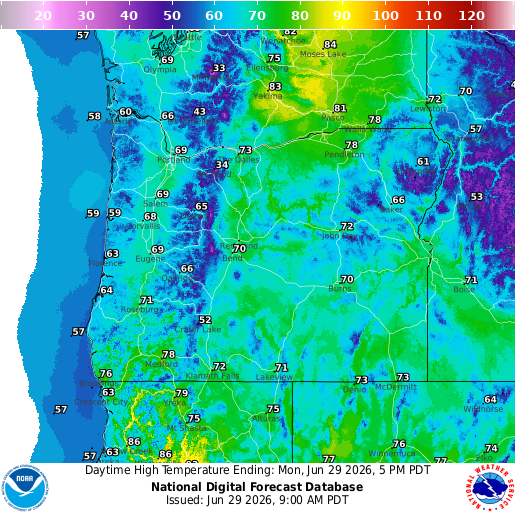
https://graphical.weather.gov/sectors/oregon.php
 https://graphical.weather.gov/sectors/oregon.php
Oregon State Fire Marshal urges Oregonians to check fireworks restrictions, keep celebrations legal and safe

– As fireworks sales beganTuesday, the Oregon State Fire Marshal is reminding people to celebrate the Fourth of July responsibly and legally. The 2026 fireworks retail sales season in Oregon runs from June 23 through July 6, and the agency’s message is clear: “Keep it legal. Keep it safe.” As Oregonians make plans for the holiday, they’re urged to check local rules and restrictions on both the sale and use of fireworks, whether celebrating at home or traveling.
“Before lighting any fireworks, make sure you know what’s allowed where you are,” Oregon State Fire Marshal Assistant Chief Deputy Mark Johnston said. “We want everyone to enjoy the holiday, but it’s critical to follow the law and avoid actions that could cause a fire or injury.”
Local governments across Oregon may set additional restrictions on the sale or use of fireworks, especially in areas at higher risk of wildfires. It’s the responsibility of those using fireworks to understand and follow local laws.
Fireworks safety and legal reminders — Consumer-legal fireworks may be purchased only from permitted retailers and stands. These fireworks may not be used on:
- Public lands and parks
- National parks and forests
- Bureau of Land Management lands
- U.S. Fish and Wildlife Service properties
- Oregon state beaches, parks, and campgrounds
- Private lands protected by the Oregon Department of Forestry
To help reduce the risk of fire and injury, fire officials urge Oregonians to follow the four Bs of safe fireworks use:
- Be prepared: Have a bucket of water or a hose nearby.
- Be safe: Keep children and pets at a safe distance. Never use fireworks near dry grass or other flammable materials.
- Be responsible: Do not relight duds. Soak used fireworks in water before disposal.
- Be aware: Use only legal fireworks and only where they are allowed.
Illegal fireworks and consequences
Oregon law prohibits the possession, use, or sale of any fireworks that fly into the air, explode, or travel more than 12 feet horizontally on the ground without a permit from the state fire marshal. This includes items such as bottle rockets, Roman candles, and firecrackers.
Violations are a Class B misdemeanor, with a maximum fine of $2,500. Those who misuse fireworks or are found to be responsible for them causing damage may be held financially responsible for fire suppression and other costs. Parents can also be held liable for damage caused by their children.
Learn more — The Oregon State Fire Marshal offers resources on fireworks laws, retail sale permits, and safety tips on its fireworks webpage.
For a safe celebration this Fourth of July, know the law, check local restrictions, and always keep it legal and safe.
ABOUT THE DEPARTMENT OF THE STATE FIRE MARSHAL — Since 1917, the Oregon State Fire Marshal has been dedicated to protecting people, property, and the environment from fire and hazardous materials. The agency works with local fire agencies, communities, and other partners to strengthen fire prevention, preparedness, and response statewide. Please note: the Oregon State Fire Marshal is no longer an office after becoming an independent state agency in 2023.



Detectives Investigating Wimer Domestic Violence Homicide Have Suspect in Custody
JCSO Case 26-3265 ROGUE RIVER, Ore. – Jackson County Sheriff’s Office (JCSO) detectives are investigating a domestic violence homicide that occurred at a residence in rural Rogue River. The suspect is in custody.


On Saturday, June 27 at 12:35 AM, ECSO Dispatch received a call from a man that he had shot a woman during a domestic violence altercation. JCSO deputies responded to the residence in the 1900 block of Sykes Creek Road and took the suspect into custody without incident.
Next-of-kin has been notified. The victim is Onalea Clay, 59, of Wimer. Our condolences go out to her family and friends. The victim and suspect were in a domestic relationship.
The suspect, Norman Henry Chapman, 80, of Wimer, is charged with second-degree murder. He was cleared for confinement at a local hospital before being lodged in the Jackson County Jail.
Oregon State Police (OSP), Medford Police Department (MPD), Ashland Police Department (APD), and the Jackson County Major Assault Death Investigation Unit (MADIU) responded to assist. The OSP Forensics Lab processed the crime scene.
MADIU consists of detectives from OSP, JCSO, MPD, Central Point Police Department, APD, and the Jackson County District Attorney’s Office. There is no further information available for release at this time.
Wildfire season can be a stressful time, especially for older adults.
If you find this true for yourself, OSU is hosting “Living with Wildfire: Empowerment through Preparation for Older Adults”.

 How wildfires spread and impact homesSimple and affordable ways to make your home more fire-resilientPractical preparedness tipsHow to care for emotional wellbeing during fire seasonHow to build connection, readiness, and resilience as a community
Missing Woman Located Safe After Two-Day Search Effort
ROGUE RIVER, Ore. – A 75-year-old woman reported missing in the Wimer area was located safe Sunday morning after an extensive two-day search involving numerous local, state, federal, and volunteer resources.
 On Saturday, June 27, at approximately 11:00 AM, Jackson County Sheriff’s Office (JCSO) received a report of a missing 75-year-old woman who was last known to be driving in the Wimer area in rural Rogue River.
JCSO Search and Rescue (SAR) personnel immediately began searching with assistance from the Oregon State Police providing aircraft support. Throughout the day, JCSO worked closely with Evans Valley Fire District 6, whose personnel played a critical role in coordinating and conducting search operations in the rugged terrain.
As the search continued into Sunday, the California and Oregon Regional Search and Rescue (CORSAR) task force activated additional search resources from across the region. Personnel from Douglas, Klamath, Siskiyou, and Lake counties joined the effort, along with the US Bureau of Land Management, private timber company security personnel, and many dedicated volunteers.
At approximately 11:45 a.m. Sunday, June 28, local volunteer pilots spotted the missing woman, allowing search teams to quickly reach her location. JCSO SAR personnel contacted the woman and assisted her to safety. She was evaluated after being located and is doing well.
JCSO is grateful for the tremendous teamwork demonstrated throughout this operation. The successful outcome was made possible by the coordinated efforts of numerous agencies and volunteers, with special appreciation to Evans Valley Fire District 6 for their close partnership and commitment throughout the search.
JCSO also extends its appreciation to the SAR volunteers who dedicated many hours over two days to help bring this search to a safe conclusion. Their willingness to answer the call at a moment’s notice continues to make a difference for our community. See less
Deadline for Temporary Rent and Utility Assistance Through ReOregon is June 30
The deadline forIntermediate Housing Assistance (IHA)for survivors of the 2020 Labor Day wildfires and straight-line winds is coming soon. Oregon Housing and Community Services (OHCS) administers IHA, which provides temporary rent and utility assistance for renters who lived in the disaster-affected counties of Clackamas, Douglas, Jackson, Klamath, Lane, Lincoln, Linn, or Marion at the time of the wildfires and have a verified loss.
Survivors have until June 30 to apply for the program, which has expanded eligibility, including higher incomes, so more households can get help. Assistance may last for up to 24 months or until the program’s funding is fully spent.
OHCS encourages any interested folks to reach out to a local community action agency to find out more and get started on an application.
“IHA provides a vital need for renters who are also wildfire survivors to help keep them stably housed as they figure out their permanent housing solution,” said Shannon Marheine, director of Disaster Recovery and Resilience at OHCS. “We encourage anyone who is eligible and hasn’t yet applied to do so as soon as possible. If you know someone might benefit from this program, please spread the word.”
IHA is part of a suite of wildfire recovery programs called ReOregon intended for survivors of the 2020 Labor Day Disasters and is funded by a $422 million Community Development Block Grant Disaster Recovery to support long-term recovery and rebuilding efforts.
So far, OHCS and its partners have successfully served 401 households with the IHA program.
To learn more about IHA and other ReOregon programs, visit OHCS’ website.
About Oregon Housing and Community Services – OHCS is Oregon’s housing finance agency. The state agency provides financial and program support to create and preserve opportunities for quality, affordable housing for Oregonians of low and moderate income. OHCS administers programs that provide housing stabilization. OHCS delivers these programs primarily through grants, contracts, and loan agreements with local partners and community-based providers. For more information, please visit:oregon.gov/ohcs.
Belle Fiore Estate Winery and Chateau, one of Ashland’s most visible wine-country properties, has been listed for sale for the first time, putting a high-profile Rogue Valley winery, event venue, vineyard and private residence on the market as the region’s wine industry continues to navigate a changed post-pandemic economy.
The property, located off Dead Indian Memorial Road at 100 and 200 Belle Fiore Lane, is being marketed by Cascade Hasson Sotheby’s International Realty. The listing agents are Hunter Blackwell and Ryan Lamanna. Public listing information shows the combined estate being marketed at $26 million, though some online real estate feeds also show the commercial winery parcel separately.
The offering includes the winery and event property at 100 Belle Fiore Lane, with a 32-acre producing vineyard, a winery building of more than 27,000 square feet, tasting rooms, restaurant space, a ceremonial barrel room, ballroom, outdoor dining areas and commercial production facilities. Marketing materials also describe the property as having refrigerated wine storage and infrastructure for larger-scale winery operations.
The estate comes on the market at a time when winery properties are being evaluated in a more complicated business climate than the one that existed when Belle Fiore was developed. Rogue Valley wineries have benefited from the region’s growing reputation for diverse varietals and wine tourism. But they also have faced rising costs, changing consumer habits, wildfire smoke, labor pressures and a tasting-room business that has not fully returned to pre-pandemic patterns. READ MORE: https://ashland.news/belle-fiore-winery-and-estate-listed-for-sale/
Health officials are warning people to avoid contact with four creeks in the Bear Creek Basin after routine water quality tests found bacteria levels above state safety standards.
The affected waterways are Walker Creek at Dead Indian Memorial Road, Bear Creek at Wranglers Arena in South Talent, Bear Creek between Suncrest Road and Table Rock Road, and Jackson Creek at Beall Lane.
The Rogue Valley Council of Governments said the warning applies only to these specific creeks and does not cover all waterways in Jackson County or the Bear Creek Watershed.
Officials are asking residents to use caution when in contact with any waterways. They said people should avoid swallowing the water, which may cause illness, and keep it away from open wounds, which may cause infection. Very young children should be fully supervised when playing in the water to prevent them from swallowing it.
RVCOG said contact with any body of water carries some level of risk. The bacteria could come from pet waste, livestock waste, wild animals, leaking septic systems, illegal dumping from portable toilets or RVs, or any other activity that results in fecal matter entering creeks or storm drains. More information is available on RVCOG’s website.

Southern Oregon Healthcare Workers Demand Asante Stop Wasting Money on L.A. Lawyers and Meet to Bargain a Fair Contract
Asante appeals federal government’s order in its latest attempt to avoid recognizing healthcare workers or addressing its care crisis
(MEDFORD)– Local community members who work at Asante Rogue Regional Medical Center are demanding Asante executives stop stalling, follow federal law, and begin bargaining a fair contract to improve patient care and support Rogue Valley caregivers.
On June 3, the National Labor Relations Board (NLRB) ordered Asante to immediately recognize local healthcare workers’ union vote at Asante and begin bargaining with workers upon request. Healthcare workers followed up with a certified letter calling on Asante to begin contract negotiations June 11.
However, Asante’s out-of-state executives announced they are refusing to honor the government’s decision and will continue refusing to meet with local workers. Instead, Asante is appealing the decision again to the District of Columbia’s federal circuit court. Despite wasting three years and countless dollars on legal fees and consultants already—money which should be used to improve local healthcare—Asante executives are doubling down on actions the federal government ruled were illegal.
“Asante acted as if they were above the law. Now after repeated NLRB rulings, it’s time for Asante to recognize workers’ union and come to the table to reach a fair contract agreement,” said Fred Katz, RN, ONA’s registered nurse (RN) bargaining unit chair at Asante Rogue Regional. “Local techs are ready to meet anywhere, anytime to expand patients’ access to care, improve working conditions, and raise healthcare standards for everyone in the Rogue Valley. It’s time for Asante executives to stop hiding behind their L.A. lawyers and meet with Oregon workers so we can improve our community’s healthcare.”
The more than 250 frontline healthcare technicians and licensed practical nurses (LPNs) at Rogue Regional overwhelmingly voted to join the Oregon Nurses Association (ONA) on June 9, 2023. They have been waiting for three years to meet with Asante executives and bargain a contract that provides for safe staffing, affordable healthcare, fair pay and benefits, and a voice in local healthcare decisions.
The NLRB is an independent federal agency which oversees union elections, protects workers’ rights and decides unfair labor practices. During its investigation into Asante, it found Asante had committed multiple unfair labor practices by refusing to recognize and bargain with local workers. In its final decision June 3, it ordered Asante to stop its illegal activities and begin bargaining with workers upon request, provide workers with requested information, and publicly post a notice stating Asante broke the law.
Asante executives are facing additional allegations that Asante unlawfully interfered with workers’ rights to organize, threatened workers about the consequences of voting for a union, disciplined an employee for speaking about patient safety with local journalists, and prevented union representatives from visiting the hospital. All actions that are illegal under federal law.
Asante executives have also come under fire for closing maternity and inpatient services at Ashland’s only hospital; racking up more than $1 million in state fines for violating Oregon’s safe staffing law; outsourcing local doctors and healthcare workers; and leading repeated mass layoffs affecting hundreds of caregivers, their families and patients throughout Southern Oregon.
Local healthcare workers including radiologic technologists, licensed practical nurses (LPNs), respiratory therapists, physical therapy assistants, occupational therapy assistants and surgical technicians organized in 2023 to have a voice in local healthcare decisions and fight for safe staffing, affordable healthcare, fair pay and reasonable working conditions. They are represented by the Oregon Nurses Association (ONA).
ONA also represents a separate bargaining unit of more than 1,200 frontline registered nurses (RNs) at Rogue Regional Medical Center.
###The Oregon Nurses Association (ONA) represents a diverse community of more than 25,000 nurses and healthcare professionals throughout Oregon. Together, we use our collective power to advocate for critical issues impacting patients, nurses and healthcare professionals including a more effective, affordable and accessible healthcare system; better working conditions for all healthcare professionals; and healthier communities. For more information visit www.OregonRN.org.
Schofield trial delayed after judge approves defense motion

MEDFORD – A former Asante nurse, Dani Schofield, facing 44 counts of assault in Medford, will not go to trial in September as planned. The trial delayed after judge approves defense motion.
The defense filed a motion June 22 stating they need access to necessary evidence they won’t have in time for the September trial. The cancellation follows an argument between the state and the defense last week. The judge and the defense will meet Aug. 3 for a pretrial conference.
All of Schofield’s previously scheduled court dates have been canceled, including her pretrial readiness, status hearing and her eight-week, 12-person jury trial.
Medford City Council approved a plan to pay $11 million for three years of salary increases in a unanimous vote last Wednesday.
On July 1, workers with the AFSCME union will receive a 6% salary increase. Non-union and executive workers will receive a 3% increase.
Increases for 2027 and 2028 were also approved, with union workers receiving a 2% raise in July 2027. Union, non-union, and executive workers will receive a 3% to 5% cost of living increase in July 2027 and 2028.
Meanwhile, single-family residential customers in Medford will see an increase of $9.38 on their utility bills. The City of Medford has announced an annual utility adjustment going into effect July 1. The monthly utility rate will increase from $76.53 to $85.91 a month.
The city says the increase will go toward street maintenance, storm drainage, sewer treatment, public safety, and parks. A portion will also support upgrades to the Regional Wastewater Reclamation Facility to keep up with updated environmental regulations.
Illinois Valley Fire District Receives Oregon State Fire Marshal 2026 Wildland Fire Season Staffing Grant

The Illinois Valley Fire District is proud to announce that we have once again been awarded the Oregon State Fire Marshal’s Wildland Fire Season Staffing Grant in the amount of $35,000.
This marks the 4th consecutive year that IVFD has received this important funding, allowing us to provide additional staffing at Station 2 (Selma) during the 2026 wildfire season.
Established in 2022, the Wildland Fire Season Staffing Grant helps local fire agencies increase firefighter staffing during the most critical months of the year. The goal is simple: keep wildfires small and away from our communities. By providing additional personnel, agencies can respond quickly to emerging fires before they become larger, more costly incidents.
Beyond wildfire response, these staffing resources help ensure firefighters are available to respond to medical emergencies, traffic accidents, structure fires, and other emergencies throughout our district—ultimately helping save lives and protect property.
We would like to thank the Oregon State Fire Marshal’s Office for their continued investment in local fire protection and community safety. This funding strengthens our ability to protect the residents and visitors of the Illinois Valley during the height of wildfire season.
Together, we are building a safer and more resilient Illinois Valley.
Fire Chief Holmes
Suspect in Custody Following Burglary with Shots Fired
On Sunday, June 21, at approximately 10:47 p.m., officers with the Medford Police Department responded to the 800 block of Gilman Road for a reported burglary in progress.
The reporting party told dispatchers that a subject was attempting to break into the residence and that shots had been fired by the homeowner.
The family inside the home was able to safely exit the residence and meet responding officers at a location away from the scene.
Officers then established a perimeter around the home. With assistance from drone operators, officers were able to locate and communicate with the suspect inside the residence. The suspect, identified as 21-year-old Nathan Roberson, was found to be suffering from a gunshot wound.
Roberson was taken into custody without incident and transported to a local hospital for treatment. He remains in police custody while receiving medical care. Roberson is from out of state and was staying at a nearby hotel.
This incident remains under investigation. We would like to thank the Central Point Police Department, Jackson County Sheriff’s Department and Oregon State Police for their assistance in this case. The suspect has not been formally charged at this time and the Jackson County District Attorney’s Office has been consulted on this case for the review of official charges on the burglary suspect.
𝗣𝗼𝗹𝗶𝗰𝗲 𝗥𝗲𝘀𝗽𝗼𝗻𝗱 𝘁𝗼 𝗙𝗮𝘁𝗮𝗹 𝗜𝗻𝗰𝗶𝗱𝗲𝗻𝘁 𝗮𝘁 𝗦𝗽𝗼𝗿𝘁𝘀𝗺𝗮𝗻’𝘀 𝗪𝗮𝗿𝗲𝗵𝗼𝘂𝘀𝗲
At approximately 9:52 a.m. today (6/20), Medford Police officers responded to a report of shots fired at Sportsman’s Warehouse.
The first officer arrived on scene at 9:55 a.m., within three minutes of the initial call. Officers secured the area and conducted an investigation.
The investigation determined the incident was a suicide. One individual is deceased, and next of kin have been notified.
At no time was there a physical threat to patrons or employees inside the store, and there is no ongoing threat to the public.
“We recognize that incidents like this can have a profound impact on family members, witnesses, employees, first responders, and others in our community,” said Chief Trevor Arnold. “If you or someone you know is struggling, please reach out for help.” Individuals experiencing emotional distress or a mental health crisis can contact the 988 Suicide & Crisis Lifeline by calling or texting 988.
We extend our condolences to the individual’s family and loved ones.
Sportsman’s Warehouse will remain closed for the remainder of today and all day Sunday.
Task Force Busts Black-Market Marijuana Grow Hidden in Pear Orchard, Uncovers 25K Plants, 16K Lbs. Cannabis; Suspect Arrested
JCSO Case 26-2842 CENTRAL POINT, Ore. – Illegal Marijuana Enforcement Team (IMET) detectives served a search warrant Tuesday, June 16 at a black-market cannabis grow in the 1000 block of Old Stage Road in rural Central Point.

IMET detectives seized approximately 25,000 marijuana plants hidden in pear orchards, 16,000 lbs. of usable cannabis, and 1,470 plants in five “hoop-style” greenhouses.
IMET arrested one suspect in connection to the property. The suspect, Jorge Alexander Ruiz, 35, of Central Point, is charged with three felony counts of unlawful production, manufacture, and possession of a marijuana item.
There was no licensing for any type of cannabis growing, handling, or processing at this location. The farm applied for an Oregon Department of Agriculture (ODA) license for growing hemp while concealing cannabis starter plants in the pear orchard. IMET was assisted by Jackson County Sheriff’s Office (JCSO), Drug Enforcement Administration (DEA), Basin Interagency Narcotics Enforcement Team (BINET), and Oregon State Police (OSP).
While regulatory agencies investigate permitted cannabis operations, IMET is focusing on the black-market marijuana trade in the Rogue Valley. IMET is a multi-agency task force funded by a grant from the Oregon Criminal Justice Commission. The task force includes personnel from JCSO, OSP, and the Jackson County District Attorney’s Office.
ODF Southwest Oregon District – 𝙋𝙐𝘽𝙇𝙄𝘾 𝙐𝙎𝙀 𝙍𝙀𝙎𝙏𝙍𝙄𝘾𝙏𝙄𝙊𝙉𝙎 𝘿𝙐𝙍𝙄𝙉𝙂 𝙁𝙄𝙍𝙀 𝙎𝙀𝘼𝙎𝙊𝙉
All Oregon Department of Forestry (ODF) districts are in fire season. This means that to reduce the risk of human-caused wildfires, fire restrictions may be in place where you live or at a destination you plan to visit or recreate.
Ashland’s Homeless Shelter Remained Locked During a Severe Heat Warning Because There’s No City Money Available
When temperatures soared to over 100 early this week, the gates to the city’s inclement weather shelter on which more than $3.1 million has been spent remained locked.
The city is out of money to operate the shelter at 2200 Ashland street, according to a memo sent to councilors last week by City Manager Sabrina Cotta.
Instead, people seeking relief from the extreme heat went to Opportunities for Housing, Resources and Assistance (OHRA), the non-profit homeless building at 2350 Ashland street, where a large room was set aside during the heat of the day. Lemonade, iced tea and meals were available.
An ad hoc committee’s report on use of 2200 Ashland street, which the Council adopted earlier this year, provides that “as directed by Council, 2200 Ashland St. shall be used to provide safe and secure shelter from severe weather and smoke, with every reasonable attempt made to provide adequate storage for personal belongings. Persons shall abide by City-approved rules and be allowed to access the service without an appointment. The Severe Weather/Smoke Shelter will be prioritized for facility improvements to eliminate barriers to providing this essential service.”
The city’s summer weather policy is to open the shelter on days when the temperature is forecast to be above 95 degrees or when an “extreme heat advisory” is issued by the National Weather Service. Both conditions were met beginning Sunday.
“Thanks to OHRA for serving our community,” Councilor Gina DuQuenne told The Chronicle yesterday. “We need to find a non-profit organization that is willing to take over 2200. The city doesn’t have the staff. Maybe the city could pay the utilities.”
The former office building was purchased nearly three years ago for $2 million, with a state grant of $1.4 million and a $600,000 note with the former owner which the city is paying back over 20 years with interest. Because the one-story structure did not meet fire code regulations, Council last year awarded a $947,936 contract to Outlier Construction for remodeling it. Previously, the city spent more than $150,000 on repairs, fencing and a gate and outfitting the building.
While it was used as a 24/7 shelter this first winter under a temporary occupancy permit, the city has since declared it an inclement weather shelter. There are also office spaces for social services organizations, none of which have moved in. Money the city received for treatment of opioid victims was diverted to pay for much of the recent building improvements.
A concern about the city’s budget for operations led Councilor Jeff Dahle this week to oppose the $2.1 million contract for development of the East Main Street Park. He pressed Acting Parks Director Rachel Dials for information on the budget for supervising and maintaining the park. While admitting that a budget had not been put together, she said staff would be available.
Meanwhile the high temperatures created problems for homeless people living in “night lawn” tents behind the Council chambers, homeless advocate Debbie Neisewander told councilors Monday night. Because tents have to be taken down every morning, she said, people were putting up their tents in the heat of the day.
There’s not a fresh water source on the lawn, she added. Neisewander asked the city to allow those living on the night lawn to keep their tents up 24 all day and to provide access to water.
Locked Doors at 2200 Ashland Street Homeless Bad Weather Shelter https://theashlandchronicle.com/ashlands-homeless-shelter-remained-locked-during-a-severe-heat-warning-because-theres-no-city-money-available/
40 Modular Homes to Be Built in Phoenix to Replace Homes Lost in Almeda Fire
Oregon Housing and Community Services selected five projects to build 117 affordable homes using factory-produced housing methods across the state.
AGE+ and Blazer Modular Construction plan to use the funding to build 40 fully accessible, affordable homes for older adults in Phoenix. The project, Phoenix Commons, will replace housing lost in the Almeda Fire. The modular construction will reduce per-unit costs and cut the construction schedule by several months.
The initiative comes from House Bill 3145 passed in the 2025 Legislative Session. It will fund up to five factory-produced housing projects with Local Innovation and Fast Track set-aside funds totaling $25 million. Factory-produced housing, like modular homes, offers an alternative to traditional construction and can produce homes faster and at lower costs.
SOU To Eliminate 66 Positions and 3 Majors
Southern Oregon University has released a provisional financial recovery plan that would eliminate three academic majors, reduce the equivalent of nearly 66 positions and reorganize much of the institution in an effort to avoid running out of cash next year.
The proposed Vitality Plan, released Monday, outlines more than $20 million in reductions. Nearly $12 million would come from the new proposals, with the remaining savings coming from cuts already underway since last fall. University officials say the changes are needed to put SOU on a sustainable financial path and qualify for $15 million in state support.
The plan proposes eliminating bachelor’s degree programs in human service, music industry and production and financial mathematics.
Academic programs would be reorganized around six “academic cornerstones,” including health and civic engagement. The university also plans to streamline degree offerings and expand stackable credentials to make it easier for students to complete programs.
The proposal would reduce the equivalent of about 23 faculty positions and nearly 43 staff positions. Proposed staff reductions include eight positions in business services, five in information technology and four dean positions.
Athletics would absorb $454,000 in cuts, including the elimination of an assistant football coach position and reductions to preseason meals and housing. Under the proposal, all athletic programs would be required to become fully self-supporting by 2029.
The SOU Farm would have to be self-sustaining by the end of this calendar year and suffer the loss of two employees.
The SOU Board of Trustees is scheduled to review the proposal during a special meeting Tuesday evening before voting on it on Thursday. The university also hosted a campus conversation at 1 p.m. Tuesday to answer questions about the proposal.
If approved, the changes would be implemented by June 2027, when university officials project SOU would otherwise run out of cash.
The university must adopt a long-term plan for financial sustainability to receive $15 million from the state legislature, which would help support SOU over the next fiscal year. The state’s emergency board is scheduled to review the request for the first half of that funding on Wednesday. (SOURCE)
 𝗘𝘅𝗰𝗶𝘁𝗶𝗻𝗴 𝗻𝗲𝘄𝘀 𝗳𝗼𝗿 𝘁𝗵𝗲 𝗧𝗮𝗹𝗲𝗻𝘁 𝗰𝗼𝗺𝗺𝘂𝗻𝗶𝘁𝘆! ACCESS is proud to announce the NEW location of the Talent Food Pantry at the 𝗧𝗮𝗹𝗲𝗻𝘁 𝗛𝗲𝗮𝗹𝘁𝗵 𝗖𝗲𝗻𝘁𝗲𝗿, located at 49 Talent Ave. in Talent.
Residents in Medford will soon receive energy generated by Oregon’s first floating solar panels through the state’s Community Solar Program.
More than 1,700 panels on floating platforms atop a Medford Irrigation District reservoir will generate power intended to cut costs for the district, the city and about 60 homes in Jackson County. Kyle Petrocine, program manager at the Energy Trust of Oregon, one of the administrators of Oregon’s Community Solar Program, said people can subscribe online to community solar projects across the state.
Customers pay for a subscription and receive credits on their utility bills, lowering overall costs. Petrocine said low-income subscribers can get discounted subscription rates and save up to 40% on their power bills. He said several similar projects are being considered in the Rogue Valley and other parts of Oregon.
A new 800 kW Community Solar Project is coming to Central Point, Oregon, in partnership with BEF and the Medford Irrigation District.
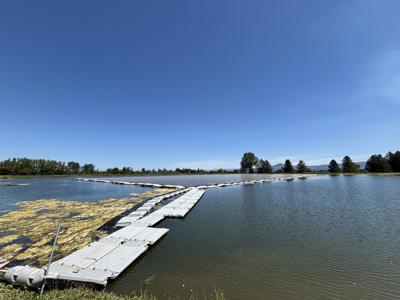
This unique project is one of Oregon’s first floating solar installations, featuring 1,776 solar panels on a reservoir in the Medford Irrigation District. By covering about 1.8 acres of water, the project will:
- Generate local, renewable energy for the community
- Improve water quality by shading the reservoir and reducing algae growth
- Reduce water loss from evaporation
60 residential subscriptions will be available for households in the Medford area, giving local families the chance to save on energy costs while supporting innovation in clean energy.
The project is expected to begin operation in Summer 2026.
Be part of this exciting milestone for Oregon — reserve your spot today and power your home with clean, local solar energy.
Medford Irrigation District Community Solar Subscription Example:
- Subscription Size: 5 kW
- Expected 1st year subscription generation: 7,545 kWh
- Expected Bill Credit: $782
- Expected Subscription Fee: $717
Expected First-year Net Savings: $65
Who’s Eligible?
To be eligible for the MID Community Solar Project Subscription, you must:
- Live within the Medford Irrigation District territory.
- Be a customer of Pacific Power.
Low-Income Subscribers
10% of the project’s energy is reserved for low-income households = low-income households can subscribe!
If you qualify, you’ll get special benefits and protections as a subscriber. You’ll have:
- no upfront costs
- no termination fees
- discounts on your subscription, and
- guaranteed savings on your energy bill.
Community solar is a large solar system that members of the community can join to share the benefits of the solar energy that’s generated. This is great for people who don’t want to install their own rooftop solar or who rent or live in apartments or condominiums. The energy generated by the Medford Irrigation District goes to the utility energy grid, and the value of that energy is shared by all subscribers in the form of credits on your utility bill. So you can feel good about supporting clean, renewable energy without paying the upfront costs of your own rooftop solar panels.
𝙉𝙊𝙒 𝙃𝙄𝙍𝙄𝙉𝙂: Customer Service Representative (CSR) for Rural Metro Fire – Josephine County in Grants Pass
𝗪𝗲𝗿𝗲 𝘆𝗼𝘂 𝗶𝗺𝗽𝗮𝗰𝘁𝗲𝗱 𝗯𝘆 𝘁𝗵𝗲 𝟮𝟬𝟮𝟬 𝗳𝗶𝗿𝗲𝘀? 𝗖𝗵𝗲𝗰𝗸 𝘆𝗼𝘂𝗿 𝗲𝗹𝗶𝗴𝗶𝗯𝗶𝗹𝗶𝘁𝘆 𝗳𝗼𝗿 𝗿𝗲𝗻𝘁𝗮𝗹 𝗮𝘀𝘀𝗶𝘀𝘁𝗮𝗻𝗰𝗲 – 𝘁𝗵𝗲 𝗱𝗲𝗮𝗱𝗹𝗶𝗻𝗲 𝗶𝘀 𝗝𝘂𝗻𝗲 𝟯𝟬𝘁𝗵!!
 If you are recovering from the 2020 fires and need housing that supports you or your multigenerational family, help may be available through ReOregon housing recovery programs. ACCESS is an official intake center for Oregon Housing & Community Services (OHCS) fire recovery programs. Our team can help determine which option may work best for you. Programs include:
 𝗜𝗳 𝘆𝗼𝘂 𝗮𝗽𝗽𝗹𝗶𝗲𝗱 𝗳𝗼𝗿 𝗳𝗶𝗿𝗲 𝘀𝘂𝗿𝘃𝗶𝘃𝗼𝗿 𝘀𝗲𝗿𝘃𝗶𝗰𝗲𝘀 𝗶𝗻 𝘁𝗵𝗲 𝗽𝗮𝘀𝘁 𝗯𝘂𝘁 𝘄𝗲𝗿𝗲 𝗻𝗼𝘁 𝗲𝗹𝗶𝗴𝗶𝗯𝗹𝗲, 𝘄𝗲 𝗲𝗻𝗰𝗼𝘂𝗿𝗮𝗴𝗲 𝘆𝗼𝘂 𝘁𝗼 𝗿𝗲𝗰𝗼𝗻𝗻𝗲𝗰𝘁 𝘄𝗶𝘁𝗵 𝗼𝘂𝗿 𝘁𝗲𝗮𝗺.
 Contact the ACCESS Center for Community Resilience to check your eligibility:
 ccr@accesshelps.org
City of Roseburg Government — Wondering where to get the facts about City projects, plans, decisions, events and upcoming meetings?
𝗙𝗲𝗮𝘁𝘂𝗿𝗲𝗱 𝗙𝗼𝗼𝗱 𝗣𝗮𝗻𝘁𝗿𝘆: 𝗦𝗮𝗹𝘃𝗮𝘁𝗶𝗼𝗻 𝗔𝗿𝗺𝘆 𝗣𝗮𝗻𝘁𝗿𝘆 



Rogue Valley Humane Society
Our Community Food Bank exists to help folks who need an extra helping hand during a difficult month to feed their pets. Our program has a limited budget and so we rely on generous members of our community to donate some of these goods to continue to help assist our community. In 2023 we fed an average of 700 pets a month!
This equates to approximately 70 – 40lb bags of food each month! Many pets have benefited from the community’s generosity, and we can’t thank you enough for your kindness.
CSO Case 24-4928 PROSPECT, Ore. – Jackson County Sheriff’s Office (JCSO) detectives and Search and Rescue (SAR) personnel continue to search for a woman missing out of Prospect, Ore. since September 2024.
Deenah Padgett, 69, was reported missing on Sunday, September 8, 2024. She was last seen camping in the Prospect area on September 4, 2024.
She is described as a white woman with brownish-red, partially gray hair, standing 4’8” tall and weighing 90-100 lbs. JCSO detectives and SAR personnel have searched the area extensively and are looking for the public’s help. If you see Deenah or know her whereabouts, immediately call ECSO Dispatch at (541) 776-7206 and reference case 24-4928.
If you have any information that might help the investigation, call Detective Friend at (541) 864-8774.
The Jackson County Sheriff’s Office (JCSO) is asking for help identifying the owner a motorhome. It could be associated with a missing person from the Prospect area. JCSO says 68-year-old Deenah Padgett has been missing since August 30 from Prospect, described as a white woman, 4’ 8” tall, weighing approximately 95 pounds with brownish red/greying hair. JCSO issued an advisory this weekend asking anyone with information about the owner of the pictured motor home or Padgett’s whereabouts to call Emergency Communications of Southern Oregon (ECSO) dispatch non-emergency phone number at 541-776-7206.
David Grubbs’ Murder Investigation Remains Active
The Ashland Police Department’s investigation into the murder of David Grubbs on November 19, 2011 remains open and active. Recently two new detectives have been assigned to look into new leads that have come in. This case remains important to David’s family, the community, and the Ashland Police Department. As detectives continue to pursue these new leads, anyone with additional information is encouraged to reach out to the Ashland Police Department at 541-488-2211. The reward for information leading to an arrest on this case remains at over $21,000.
Taking Another Look at What Happened to Fauna Frey
Fauna was grieving the recent death of her brother, Dallas, when she set off from Eugene in June of 2020 heading to Grants Pass on what her family believes was both a healing trip and a mission to deliver gifts, silver coins inherited from Dallas, to a few friends. But somewhere between motel check-ins and checkouts, something went terribly wrong. Her Jeep was found months later. She was never seen again. http://bit.ly/4l63Dle

We will start resharing podcasts and articles. For starters here is a story from Danielle Denham that appeared in the June 29, 2025 edition of That Oregon Life. Ms Denham worked closely with us to insure that the facts she presented were accurate. Check out the nine episodes of the podcast Nowhere to be Found, a comprehensive, in-depth, sensitive treatment of the details surrounding Fauna’s disappearance. Hear from Fauna’s father, John, and her friends. Posted in spring of 2022, Amanda Popineau shares Fauna’s journey and the mystery that surrounds it. Go to Nowhere to be Found Season Two: Episode One “Under A Half-Moon.”
https://podcasts.apple.com/kg/podcast/s2e1-under-a-halfmoon/id1532686678?i=1000512098162
We want to remind people that Fauna’s father is offering a huge reward for information that brings Fauna home. Please if you have any information no matter how big or small let us know by calling the anonymous tip line or emailing. Tipline- 541-359-5638 Email – Helpfindfaunafrey@gmail.com FOLLOW on FACEBOOK GROUP: https://www.facebook.com/groups/341658526970132
Fauna Frey Vanished Without A Trace In Josephine County
 It’s been more than five years since the disappearance of a Lane County Woman, who was last seen in Grants Pass. Back in June of 2020, Fauna Frey disappeared. Police said the 45-year-old left her home in Dexter to drive to Grants Pass to visit her brother’s friend after her brother had recently passed away. The last place she was seen was at the Big 5 in Grants Pass. Investigators said her car was found in the Galice area months later. The circumstances of Fauna’s disappearance remain unclear and her case is currently classified as missing. Her case remains unsolved. Fauna’s disappearance has been featured on multiple investigative podcasts, including Nowhere to be Found, Here One Minute, Gone the Next, and Detective Perspective, each trying to fill the silence left by law enforcement. New listeners continue to discover her story, hoping a fresh set of eyes or a single loose memory might be the key to finding Fauna.
Have Information on Fauna Frey? Please Speak Up!
If you know anything, no matter how small, please contact:
- Josephine County Sheriff’s Office
- Tip line: (541) 359-5638
- Email: FindFaunaFrey@gmail.com
Currrently there is a $50,000 CASH REWARD for information leading to the location of Fauna Frey. LARGE CASH REWARDS are being offered for any other relevant information, such as any objects that could be identified as Fauna’s, i.e. her wallet, keys, or Indian/Buffalo .999 silver bullion coins. Find Fauna Frey Facebook Group: https://www.facebook.com/groups/341658526970132
You can find food in your community at this link
Our network of food banks and pantries provides free food and groceries across Oregon. No proof of income or documentation required.
https://www.oregonfoodbank.org/
If you can’t make it to a food location, someone else can pick up food for you.You will just need to print and fill out the Authorized Representative form at https://lnkd.in/dsskUpkQ, and have them take it with them to the food sites. You can find step-by-step instructions at https://lnkd.in/dVBRxn-A.
Worried about recent changes or losing assistance?
Here are resources that can help: 211Info: Dial 2-1-1 or visit the211Info food webpagefor information and referrals to more than 1,500 food resources across Oregon. Oregon Food Bank: Use the Oregon Food Bank’s Food Finder Map to find over 100 food pantries, free food markets or hot meal programs near you. Aging and Disability Resource Connection of Oregon (ADRC): Call 855-673-2372 or visit theADRC food webpage to find local meal programs and food boxes in your area.
Summer EBT is back to help feed Oregon children during summer break
The Oregon Summer Electronic Benefits (Summer EBT) program is returning in 2026 to help families buy groceries for school-aged children during summer break when they don’t have easy access to healthy meals.
Eligible families can receive a one-time payment of $120 for each child on an Oregon EBT card to buy food. Unused benefits can expire 122 days after they are issued.
Families will get benefits automatically on their Oregon EBT card if they have children between the ages of 6-18 and received one of the following at any time during the 2025-26 school year:
- Supplemental Nutrition Assistance Program (SNAP) food benefits
- Temporary Assistance for Needy Families (TANF) cash assistance
- Medicaid, if household income is below 185 percent of the federal poverty level
- Foster care services
Families also may automatically receive benefits if they have children who:
- Were determined by their school to have a status as migrant, houseless or runaway.
- Took part in the Food Distribution Program on Indian Reservations.
- Attended a Head Start program that was part of the National School Lunch Program or School Breakfast Program.
Families may need to apply if:
- Their household meets income requirements for free or reduced-price school meals.
- Their child attends a school that was part of the National School Lunch Program (NSLP) or School Breakfast Program (SBP).
Important Summer EBT dates:
- June 1, 2026 – The Summer EBT call center opens. Families can call 833-673-7328 weekdays from 8 a.m. to 5 p.m.
- June 4, 2026 – Benefits are expected to begin issuing to families who are automatically eligible.
- June 5, 2026 – The online application opens and applications begin processing.
- Sept. 1, 2026 – Application deadline.
- Sept. 25, 2026 – The Summer EBT call center closes.
The Summer EBT program is administered by the Oregon Department of Human Services (ODHS) and Oregon Department of Education (ODE).
Children cannot receive 2026 Summer EBT benefits in multiple states. The program invites families to apply if they have children living in Oregon during the 2025-26 school year.
Families can learn more about Summer EBT, find application information and get updates by visiting the website at sebt.oregon.gov.

6/29/2026 — Gas Prices in Oregon Today
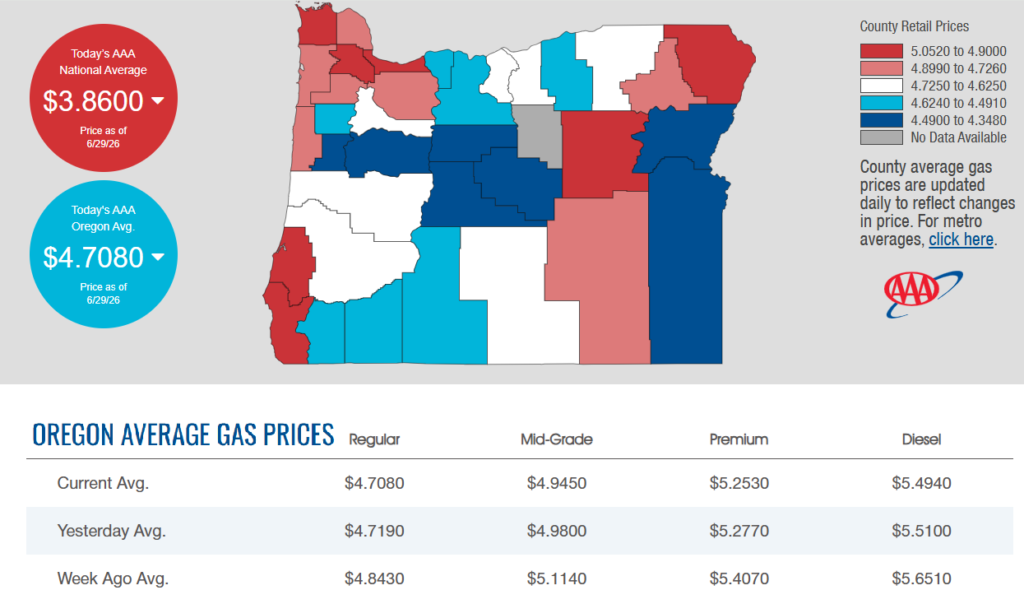
Statewide fire restrictions remain in place on all BLM-managed lands in Oregon and Washington. Fireworks, exploding targets, tracer ammunition, sky lanterns, and other fire-starting devices remain prohibited. Officials are also urging motorists to avoid parking vehicles on dry grass, as hot exhaust systems and catalytic converters can quickly ignite vegetation.
Drivers towing trailers should make sure safety chains are secured to prevent sparks from dragging on roadways. Anyone planning outdoor activities should check local restrictions before heading out, as rules can vary by location. More information is available at blm.gov.
Rare American Flag Displayed at Full Size at the Oregon Historical Society for First Time Following Conservation

Portland, OR — This July Fourth, visitors to the Oregon Historical Society (OHS) will have a rare opportunity to see what is believed to be the first U.S. flag raised in Portland following Oregon’s statehood. Hand-sewn in 1861 by Portland resident Ann Elizabeth Bills, the 9-by-6-foot flag is displayed at full size for the first time after undergoing conservation work earlier this year.
“One of the most cherished objects in our museum collection, the “Bills flag” connects us to a pivotal moment in Oregon history,” said OHS Boyle Family Executive Director Kerry Tymchuk. “Displaying it at full size allows visitors to appreciate both the original craftsmanship of Ann Bills and the careful conservation that will allow the flag to be shared for generations to come.”
Preserved in OHS’s museum collection since 1911, the Bills flag has been displayed several times folded within a case to protect the fragile materials. In preparation for Oregon’s America 250 commemoration, the flag underwent conservation so it can now be safely exhibited at its full dimensions for visitors to experience as it would have appeared more than 165 years ago.
Accompanying the display are three rare historical documents on loan from collector Bill Leslie. A document printed in 1774 details the proceedings of the First Continental Congress, while two maps from around 1817 illustrate how the young United States envisioned its expanding boundaries and territories. Together, these materials place the Bills flag within the broader story of the nation’s founding and expansion.
This special America 250 Oregon display is on view at the Oregon Historical Society’s museum in downtown Portland now through July 6, 2026. Museum hours are 10am to 5pm Monday through Saturday and 12pm to 5pm on Sunday. Admission is free every day for youth 17 and under, OHS members, and Multnomah County residents, who provide crucial operational support through the Oregon Historical Society levy. Learn more and plan your visit at ohs.org/visit.
About the Oregon Historical Society — For more than 125 years, the Oregon Historical Society has served as the state’s collective memory, preserving a vast collection of objects, photographs, maps, manuscript materials, books, films, and oral histories. Our research library, museum, digital platforms, educational programming, and historical journal make Oregon’s history open and accessible to all. We exist because history is powerful, and because a history as deep and complex as Oregon’s cannot be contained within a single story or point of view.

The National Weather Service says there is no tsunami threat following a magnitude 5.5 earthquake off the Oregon coast by Bandon this morning
A magnitude 5.5 earthquake struck along the Blanco transform fault on June 29, 2026, about 135 miles off the coast of Bandon, Oregon. The event registered at a shallow depth of roughly 6 miles.
The U.S. Geological Survey says the quake struck at 4:35 a.m. – Seismological and hazard agencies confirmed key details about this specific event:
- Tsunami Threat: None. The National Tsunami Warning Center confirmed there was no tsunami danger to the coastlines of Oregon, Washington, or California.
- Impact: Although light tremors were reported to the USGS by a handful of people, the distance from the coast mitigated the shaking, and no damage was reported.
- Regional Context: The Blanco Fracture Zone is a highly active transform/strike-slip fault system where tectonic plates slide horizontally past one another. It is entirely separate from the Cascadia megathrust subduction zone.
- Historical Precedent: Seismologists note that this fracture zone is historically the most active fault system near North America, generating hundreds of smaller quakes every year, none of which typically trigger catastrophic events or portend “The Big One”.
The earthquake occurred in the Blanco Fracture Zone, a seismically active area where hundreds of earthquakes occur each year. The Blanco fault is a highly active fault zone that runs from a point about 100 miles from Oregon’s westernmost point to another point about 300 miles from Newport.

Leave fireworks at home when visiting Oregon State Parks and the ocean shore
Oregon State Parks encourages parkgoers to leave the fireworks to the professionals for Fourth of July celebrations. Fireworks and explosives are strictly prohibited within Oregon State Parks and the entire ocean shore. However, from the coast to the Snake River, nearby cities and towns have local celebrations and fireworks shows to attend.
Fireworks pose a significant danger to visitors, wildlife, structures and the natural landscape particularly in crowded areas where high winds and flammable vegetation increase the inherent risks of fireworks.
“Just one rogue spark can create a wildfire,” said OPRD Emergency Manager Jamen Lee. “We work closely with our local partners to minimize the risk of fires and ask that visitors follow any fire restrictions.”
Each year, volunteers collect trash following the Fourth of July resulting in thousands of pounds of debris. One volunteer group alone collected 231 pounds of trash from just four beaches around Lincoln City – that’s nearly 60 pound per beach!
“We ask that visitors respect fireworks restrictions and clean up after their celebrations to protect Oregon State Parks and the ocean shore,” said Laurel Hillmann, ocean shore resource coordinator at Oregon Parks and Recreation Department.
While education remains the primary focus for rule enforcement at Oregon State Parks, rangers do have the authority to issue citations. Staff at Oregon State Parks ask that visitors enjoy the holiday responsibly and leave fireworks and explosives at home.
OPRD also encourages visitors to know before they go when it comes to fire restrictions during this wildfire season. Fire restrictions are coordinated with local and state fire districts. Certain parts of the coast also do not allow fires on beaches. Learn more on our website.
Resources:
- OPRD beach safety web page.
- OPRD beach fire safety video (YouTube).
- Fourth of July celebrations and fireworks:
Oregon marks five years of Fire Adapted Oregon and Response Ready Oregon

– Five years after Senate Bill 762, Oregon is celebrating the progress and impact of Fire Adapted Oregon and Response Ready Oregon.
These statewide programs, created by the Department of the State Fire Marshal, built a stronger foundation for wildfire risk reduction and response at a time when the state’s wildfire exposure continues to intensify.
Fire Adapted Oregon was created to help communities understand and reduce wildfire risk through education, defensible space, home hardening, grants, partnerships, and regional support. Over the past five years, the program trained 502 defensible space assessors from 94 agencies, completing 6,539 assessments across the state.
Fire Adapted Oregon has advanced guidance on defensible space, including the importance of the first five feet around homes and structures, strengthened partnerships like the collaboration with the Insurance Institute for Business and Home Safety, and expanded statewide mitigation and home hardening investments through grants. Regional delivery across nine districts ensures support reaches communities where it is needed most and in a way that best reflects each community’s needs.
Response Ready Oregon was established to modernize and expand the fire service’s ability to respond quickly and effectively when wildfires ignite. The Engine Program delivered 76 new engines and tactical water tenders to local fire agencies, supported seasonal staffing, expanded the immediate response and pre‑positioning programs, and strengthened the three all-hazard incident management teams within the Oregon Fire Mutual Aid System. Regional mobilization coordinators connect local chiefs to resources and support. These investments help firefighters stop fires while they are small, reducing loss and protecting communities.
Oregon’s wildfire exposure has increased significantly. The Rowena Fire in 2025 resulted in the loss of 56 homes, a trend consistent with the western U.S. The West has experienced a 246% increase in homes and structures destroyed by wildfire between 1999–2009 and 2010–2020, according to a study published in PNAS Nexus. Fire Adapted Oregon and Response Ready Oregon provide coordinated statewide systems that help communities prepare for these changing conditions and give fire agencies the tools they need to respond quickly and safely.
Over the next five years, Fire Adapted Oregon will strengthen home hardening grant programs, advance data collection and integration, and continue building strategies that support vulnerable communities and structure loss reduction. Response Ready Oregon will continue investments in staffing grants, immediate response, and pre‑positioning. Long-term and stable funding will be essential as wildfire seasons intensify. Planned improvements include modernizing the fire defense board system, enhancing technology and communications systems, developing emerging tools for situational awareness, and building additional agreements with other states to support surge capacity.
About the Department of the State Fire Marshal – Since 1917, the Oregon State Fire Marshal has been dedicated to protecting people, property, and the environment from fire and hazardous materials. The agency works with local fire agencies, communities, and other partners to strengthen fire prevention, preparedness, and response statewide. Please note: the Oregon State Fire Marshal is no longer an office after becoming an independent state agency in 2023.
Oregon PUC approves wildfire mitigation plans for Idaho Power, Pacific Power, and PGE
– The Oregon Public Utility Commission (PUC) today approved the 2026–2028 Wildfire Mitigation Plans for Idaho Power (UM 2209), Portland General Electric (UM 2208), and Pacific Power (UM 2207).
These plans detail how utilities will reduce utility wildfire risk, strengthen system resilience, and protect communities during increasingly severe wildfire seasons as risk models evolve in urban and rural areas to reflect changing conditions.
The Commission also adopted the PUC staff recommendations for additional improvement across the utilities’ programs to support greater transparency, stronger modeling practices, and further demonstration of cost-effective mitigation investments.
Each approved plan includes enhanced vegetation management, inspection and maintenance programs, system hardening, situational awareness tools, increased community outreach, and Public Safety Power Shutoff (PSPS) procedures. PSPS events remain a last resort to reduce the risk of utility equipment igniting wildfires in hazardous weather conditions.
The wildfire mitigation plans are required under Senate Bill 762 (2021), which directs electric utilities in Oregon to identify areas of heightened wildfire risk within their service territories, develop measures to reduce ignition risks, and outline PSPS protocols during dangerous conditions.
“Today’s approval reflects the Commission’s continued commitment to ensuring Oregon’s electric utilities are planning responsibly, transparently, and proactively in the face of escalating wildfire risk,” said PUC Chair Letha Tawney. “These plans help keep communities safer, and we encourage all Oregonians to take steps now to prepare for extreme weather and potential outages.”
Preparing for the 2026 wildfire season and potential PSPS events
- Register for emergency alerts from local and state authorities and sign up for outage notifications from your electric utility.
- Develop a household emergency plan and make sure all family members understand evacuation procedures.
- Create defensible space around your home by reducing vegetation and other fuels.
- Be two-week ready with essential supplies, including food, water, medications, batteries, and pet needs.
- Keep phones and medical devices fully charged ahead of high-risk weather.
- Ensure your utility account information is up to date so you can receive emergency notifications.
- Customers who rely on electricity for medical needs should contact their utility about medical certification programs and consider backup power options.
During an outage or PSPS event:
- Report outages to your utility and stay far away from downed power lines.
- Use flashlights instead of candles and operate generators outdoors and away from buildings.
- Unplug appliances except refrigerators and freezers to protect against power surge damage.
- Check on neighbors, especially older adults or individuals with access or functional needs.
- Stay cool by keeping blinds closed, staying hydrated, and accessing community cooling spaces if needed.
PUC Vegetation Management Program
In addition to reviewing wildfire mitigation plans, the PUC conducts independent inspections of utility infrastructure and vegetation management practices in high fire risk areas. The PUC evaluates whether electric utilities are maintaining proper vegetation clearances, addressing hazards promptly, and meeting statewide and national safety standards. These inspections ensure accountability and contribute to reducing wildfire ignition risk. — Learn more about wildfire preparedness at wildfire.oregon.gov.
Here’s how Oregon is celebrating America’s 250th year of independence
From Bigfoot to time capsules, the America 250 Oregon Commission awarded 80 grants across Oregon to support local history, culture and art

Bigfoot is officially helping Oregon celebrate the country’s 250th birthday.
This September, the Dallas Area Visitors Center will host its second annual Bigfootstock, a one-day festival rooted in local folklore and the town’s rural identity that brings together educators, agritourism businesses and tribal partners.
“Through storytelling, cultural exchange, and educational experiences and of course music, the festival highlights the voices and traditions that shape our region and reflect the broader American story,” said Sarrah McMaster, treasurer of the Dallas Area Visitors Center.
The quirky, family-friendly event is one of 80 projects across Oregon that received a grant from the America 250 Oregon Commission, which over the course of four rounds awarded nearly $250,000 to groups highlighting the state’s unique traditions, cultures and history ahead of the 250th anniversary of American independence.
Gov. Tina Kotek in 2024 signed a law creating the commission, tasking it with coordinating the state’s celebration of the country’s 250th birthday.
The commission recognized early that there isn’t a single correct way to honor the country’s 250th year of independence.
Instead, it adopted seven broad guidelines to give local organizations the freedom to honor the state’s heritage and culture in their own unique ways, said Kerry Tymchuk, commission chair and executive director of the Oregon Historical Society.
“There’s projects that honor veterans, there are projects that promote civics and history education, there’s projects that honor Oregon’s tribes, of course, who were here long before 1776,” Tymchuk said. “Oregon’s official state motto is, ‘she flies with her own wings,’ and this proves that right. There’s just so many unique ideas that the commission was proud to support.”
A nonpartisan, bipartisan celebration across Oregon
The funding was split equally between rural and urban organizations, Tymchuk said, adding that the commission worked hard to ensure it was a nonpartisan and bipartisan celebration.
In Umatilla County, the Heritage Station Museum is collecting letters from community members to place in a time capsule that will be stored in its climate-controlled collection until 2076.
The museum received $3,000 from the state commission to buy archival paper, marketing materials and boxes to place in local libraries where community members can submit their letters and materials for the time capsule’s closing ceremony in September.
“We’re actually creating an index so that we’ll know who contributed, and that way in 50 years if someone wants to look back and see if their ancestor put anything in there, they’ll be able to look that up,” said museum executive director Shannon Gruenhagen. To see the full list of grant recipients, visit the America 250 Oregon Commission website.
At the Oregon Art Center in Portland, a $3,000 grant will help cover the cost for a curator to put together an exhibit featuring art from its teachers, student artists as well as award-winning artists that have been featured in the gallery before. The grant will also pay for the center’s 100th birthday celebration during a free event on Sept. 3 with live music and catered food.
“Our mission is really to make art accessible, and this grant certainly has helped us make this big milestone for us even more impactful for our community,” Oregon Art Center coexecutive director Emma Wallace told the Capital Chronicle.
Several groups received grants to honor veterans, including the Central Oregon-based nonprofit Warrior Impact. The nonprofit is using its $4,000 America 250 grant to cover the cost of a spot in one of its retreats meant to help veterans and first responders experiencing post-traumatic stress.
Warrior Impact offers free rafting, hiking and horse therapy retreats led by fellow veterans and first responders to help people find purpose and process their trauma. A third of participants come from out of state, said Matt Bassit, the nonprofit’s founder and president.

“We’re completely volunteer based, so we’re very efficient with the dollars we have, but it’s still costly,” Bassitt said. “The more we can raise, the more we can actually build this thing into a world-class organization.”
Other groups are using grant funding to highlight Oregon’s Indigenous community, including the Oregon Children’s Theatre in Portland. The theatre is using its $3,000 grant to support the writing process and hiring of actors for its new musical, “The Mountain & The Raven.”
Native creatives, including play director Jeanette Harrison of the Native Performing Arts Network and Taya Dixon, a resident artist at Hillsboro’s nonprofit theatre company Bag&Baggage Productions, will help develop the musical. Dixon is writing it alongside Oregon Children’s Theatre Producing Artistic Director Jenn Hartman Luck. The musical will premiere in 2028.
“We want to celebrate Native voices and experiences through this project,” Hartman Luck said in an email. “Our goal is to tour this show, ‘The Mountain and the Raven,’ across the state of Oregon, bringing this important story about identity, land, grief, and acceptance, to young people in many communities. Especially to many communities that really don’t have the opportunity to come to Downtown Portland for theatre experiences.”
Upcoming America 250 events at the Oregon State Capitol and Oregon Historical Society
Beginning at 10 a.m. Saturday, the Oregon State Capitol will host a free “A Passport to History and Democracy” event featuring live music, apple pie and the opportunity to explore inside and outside the capitol.
And at 3 p.m. July 8 — the date the Declaration of Independence was first read aloud to citizens — the Oregon Historical Society in Portland will participate in a nationwide, simultaneous reading of the national document. State leaders will take turns reading the document.
The Salem Philharmonia Orchestra will perform a free concert at the Oregon State Capitol State Park at 11 a.m. July 10. — (SOURCE)
Kotek’s prosperity council pushes for lower taxes, fewer regulations
The highly-anticipated proposal came in response to Kotek’s push for more economic development in the state last year

Gov. Tina Kotek speaks to reporters after the release of her prosperity council’s report on July 25, 2026. (Photo by Julia Shumway/Oregon Capital Chronicle)
To jumpstart Oregon’s economic development, the state should cut taxes, eliminate a key state climate program and allocate a quarter of a billion state dollars for business infrastructure needs every two years, according to a new report from Gov. Tina Kotek’s economic advisers.
The numbers Kotek’s prosperity council put forth in its 33-page report and shared in a council meeting Thursday afternoon paint a negative picture of Oregon’s economy: The state is second-to-last in the nation when it comes to increases in employment, 41% of Oregonians live either below the federal poverty level or are unable to afford basic needs, and the state’s unemployment rate is at 5.2%, a figure that has remained above the national average for months. The report comes as U.S. Bureau of Labor Statistics data identified Oregon as the only West Coast state to lose jobs overall since last year.
“We have to chart a better future for everyone,” Kotek said during Thursday afternoon’s meeting. “We are hearing constantly about the challenge for everyday Oregon working hard can’t make ends meet. I also want to make sure that Oregon is one of the best places in the country to have a business, and I think we can achieve that.”
She commended the council for producing recommendations she called “bold” and “practical,” particularly praising charges to identify redundant regulations and reimagine the state’s economic development agency.
But while the report identifies 10 key solutions, it defers to the Oregon Legislature when it comes to changing what it calls a “one-and-a-half-legged stool” system reliant on personal income taxes and property tax to fund state revenues. It’s an issue even the council couldn’t agree on, according to Curtis Robinhold, executive director of the Port of Portland and co-chair of the council.
“We are not equipped to come up with the right answer on the tax code. It deserves a really good look…but boy, it’s complicated, and you know, I think we probably each could imagine a system that would be better,” he told the Capital Chronicle. “What we really need is the governor and the Legislature to get their heads together on what will get us the outcomes we want.”
Another major suggestion: The report argues the state should adapt a cap-and-trade program to push polluters to pay for their emissions, like exist in California and Washington, then repeal Oregon’s Climate Protection Program. Former Gov. Kate Brown spearheaded the program, which allows state environmental regulators to set declining emissions caps, after quorum-denying Republican walkouts in 2019 and 2020 quashed legislative efforts to pass a cap-and-trade program.
The report stressed that the below changes to Oregon’s tax code should be revenue neutral:
- Expand Oregon’s Research & Development tax credit through incentives such as a 15% credit for company-led research and development and 2% for projects within Oregon universities.
- Increase the estate tax exemption threshold from $1 million to $3 to $5 million.
- Increase the filing and taxability threshold for Oregon’s Corporate Activity Tax, which now applies to businesses with $1 million in Oregon commercial activity. Businesses now pay $250 plus 0.57% of their Oregon taxable commercial activity above $1 million. The prosperity council urged raising that threshold to $2 million and allowing businesses to completely deduct the cost of creating or providing a service or product.
- Reconnect the state tax code to a portion of the federal 2025 tax law that allows non-corporate investors to exempt their small business stock sales from capital gains tax. Disconnecting from this exemption saved Oregon nearly $40 million in revenue for the current two-year budget cycle.
- Establish a work group that can by 2029 deliver a long-term proposal to the governor addressing issues such as expiring federal state and local tax provisions, the corporate activity tax, local government funding and reducing the burden of personal income taxes.
“I would like us to be targeted in making sure we have a tax structure that and takes care of all Oregonians,” Kotek said. “We have a tax system right now that we hope can be as progressive as possible, by making sure that people who pay taxes have the ability to pay them and what we have from this report is we probably need a longer-term conversation about what our tax system looks like.”
Revisiting such issues would likely leave state lawmakers figuring out how to balance state revenues while changing the systems that fund hundreds of millions of dollars in state revenue at a time when political capital for tax increases is low. Oregonians at the ballot box in May sharply rejected transportation tax increases passed by Democrats last year, but state lawmakers also unsuccessfully attempted to increase the exemption threshold for the estate tax in Oregon this year.
“Every single one of these recommendations is in the context of ‘What do other people do? How are we different? Are we better? Are we worse?’” said Renée James, founder of semiconductor company Ampere Computing and council co-chair.
Kotek established the prosperity council last year amid concern about the state’s economic development climate hampering her reelection campaign. Her Republican opponent, state Sen. Christine Drazan of Canby, acknowledged that political reality in a brief statement praising the recommendations.
“We all know this council was an election-year gimmick, but these recommendations are a meaningful start and deserve strong bipartisan support,” Drazan said. “Let’s build on the ideas that create jobs, fix our economy and make Oregon more affordable. That includes bold tax cuts for families and businesses. I’m ready to get to work.”
The left-leaning Oregon Center for Public Policy panned the recommendations for failing to meet the moment, saying the state must focus on protecting health care and food assistance in the wake of federal cuts.
“The Council’s recommendations respond to this dire challenge by cutting taxes for millionaires and by prioritizing corporate handouts over direct investment in the success of working families across our state,” the center’s deputy director, Daniel Hauser, said in an email. “Oregon cannot chart a path towards shared prosperity by cutting taxes on the few who are prosperous.”
Competing factions within the council sparred over how far the state should go when it comes to slashing taxes to incentivize business development.
A key point of contention was her decision to tap former Senate Republican Leader Tim Knopp as her chief prosperity officer. Some council members also disagreed over the extent to which the state should replicate federal tax cuts.
Prosperity council leaders acknowledged that disconnect legislation fueled disagreement among the council, but they said that they did find a “supermajority” of consensus on every issue aside from taxes. Missing from the report are detailed recommendations on improving the state’s K-12 education outcomes, an issue that council leaders said was outside the scope of their duties.
“I think there’s a misnomer in the dialogue that it’s all about rich people wanting tax cuts,” Robinhold said. “And I want to make sure, because this is super important for the Legislature to hear in this report, we need to holistically look at our tax code, because we are hurting, we’re hurting our middle- and lower-income Oregonians just as much, if not more.”
The report also acknowledges similar disagreements, noting that two council members “disagreed with some of the short-term tax changes and expressed concerns about the necessity of broader business incentives and their long-term impacts to the state.” It’s a likely nod to when two labor-affiliated members of the council in April issued a public rebuke of business groups in the state and argued that tax breaks would only harm Oregon’s economic development further.
“They agree that Oregon must strengthen its long-term competitiveness but believe increasing investments in talent and quality of life is more effective for enhancing the state’s economy,” the report reads.
Other recommendations include:
- Transform Oregon’s economic development agency, Business Oregon, into the Oregon Commerce Authority. It would be governed by business and innovation leaders alongside the governor.
- Establish statewide permitting timelines and guardrails by requiring agencies to approve or deny applications within clear timelines.
- Reduce regulatory and administrative burdens by 20% by 2029 by removing old and excessive regulations.
- Create a dedicated site readiness and infrastructure fund of $250 million, likely through lottery bonds, for each two-year budget cycle. Robinhold said the council heard from businesses including Daimler that they wanted to expand in Oregon but didn’t have available and ready land.
- Create a Governor’s Cabinet of Economic & Talent Development to lead a strategy to attract talent to the state and promote its competitiveness.
- Align Oregon with other West Coast states’ higher education funding policies and commit $20 million to a fund for innovative university research.
Capital Chronicle editor-in-chief Julia Shumway contributed to this report. https://oregoncapitalchronicle.com/2026/06/25/koteks-prosperity-council-pushes-oregon-lawmakers-to-revisit-tax-cuts-leaves-details-up-in-air/
Typically, landlords must compete to attract renters by offering lower prices, discounts and amenities. However, those using RealPage shared sensitive rental data to train the company’s pricing algorithm.
This software then uses that data to recommend rental rates, effectively allowing landlords to keep prices artificially high, according to the lawsuit.LivCor managed nearly 1,650 Oregon properties using this rent-fixing software, according to the Oregon Department of Justice.Read more at https://www.oregonlive.com/…/property-management.

Census data places Oregon at nationwide bottom
Data from the U.S. Census Bureau released in May, meanwhile, places Oregon as one of the worst states in the nation when it comes to access to air conditioning, though states such as California, Wyoming, Washington and Montana all had lower rates of reported access. In Oregon, more than 18% of the state’s households are estimated to not have any access to a form of air conditioning.
The federal data relies upon estimates from 2023, but it shows that the state’s coast and Northeast areas have significantly low rates of access to air conditioning, some with less than half of households in the county. That’s often because the coastal areas of the state can rely on the ocean breeze instead of paying for cooling systems.
Jennifer Kalez, a spokesperson for the Oregon Department of Energy, distanced the federal data from the state’s own 2023 study.
“The Cooling Needs Study looked specifically at low-income and at-risk households in the state and differentiated between permanent cooling equipment, and broken and temporary equipment, while the (federal) data is statewide or county wide, and did not differentiate between types of cooling equipment,” she wrote in an email.
It’s up to lawmakers to decide whether to fund more of the program. In the meantime, there are also federally-funded programs for rental homes, new construction and homeowners that the state administers, such as the Heat Pump Purchase Program, which provides $2,000 for installations of heat pumps to state-approved contractors.
Brian Stewart, co-founder of Electrify Now, a volunteer-run advocacy group that promotes building electrification, said Oregon has in the past enjoyed cooler summers, which explains the federal data showing rates of air conditioning lower than other parts of the nation. With hotter Oregon summers, he said that’s changing and people are “getting the news that a heat pump is better.”
Stewart said Oregon lawmakers could also provide incentives to convert low quality air conditioners to heat pumps, particularly in light of the low-income families reliant upon Portland General Electric who have reported that high rates of energy use correspond with bills that cost nearly $300 more.
These homes could require deeper technical fixes and repairs, he said, and the price of installing a heat pump can vary thousands of dollars depending on the size of the home and type of the system, such as a solar or geothermal-powered heat pump.
“This is why incentives are so important. They reduce these kinds of barriers that people see when they’re trying to make decisions about what to do in their homes and enable them to get products that are going to be better for them in the long term,” he said. “It’s really hard to overcome ‘Wow, it’s thousands of dollars more up front, right?’ And if someone is telling you, well, you’re going to save a bunch of money in the long-term, that’s a hard argument when you’re strapped to just make the initial payment.” (SOURCE)
All Oregon Department of Forestry (ODF) districts are in fire season. This means that to reduce the risk of human-caused wildfires, fire restrictions may be in place where you live or at a destination you plan to visit or recreate.

“Looking at the current conditions and projections for the summer, ODF is prepared to have another busy fire season,” said Michael Curran, Oregon Department of Forestry’s Fire Protection Division Chief. “Oregonians need to be practicing wildfire prevention and emergency preparedness NOW.”
Now is the time to brush up on your wildfire prevention knowledge. Tips include:
- Know before you go. Campfires may be banned or only allowed in approved campgrounds.
- Make sure your campfire is cool to the touch before going to sleep or leaving your site. Don’t forget to Drown, Stir, Repeat.
- Forests and fireworks don’t mix. Private use of fireworks is not allowed on forest land, which includes all private lands protected by ODF and all other state and federal forest lands in Oregon. Remember to check any additional city and county firework restrictions as well.
- Backyard debris burning either requires a burn permit during fire season or is prohibited altogether. If you burned earlier this spring, go back and check on your debris burn site to make sure nothing reignites due to the heat.
- Don’t flick a cigarette onto the ground. It may be just enough to start a fire.
- Don’t park or idle over dried grass.
- Don’t drag tow chains.
- Check local restrictions and fire danger levels.
Curran said, “Prevention is our number one tool to reduce property loss, firefighting costs, and risk to the lives of our firefighters. We can’t prevent lightning fires, but we can prevent human-caused fires.”
ODF protects over 16 million acres of private, county, state, and federal land in Oregon from wildfire. Fire season is declared at the local level when conditions reach a point where the risk of a fire starting and spreading becomes clear. This year, the Central Oregon district was the first to declare on May 8, and the Northwest Oregon Area was the last to declare on June 15. For more information on how you can help prevent wildfires, visit keeporegongreen.org.
Webinar series to honor 36 years of disability civil rights kicks off July 7
— The public is invited to a series of free webinars featuring conversations with disabilities advocates and experts who will share the latest information on disability supports, emergency management systems and digital accessibility.
Topics by date are:
- July 7: Exploring Cross-Disability Experiences and Support Needs
- July 14: Building Inclusive and Accessible Emergency Management Systems
- July 21: ADA: How Far We’ve Come and What Comes Next
- July 28: Understanding the Department of Justice’s (DOJ) Ruling on Digital Accessibility
The free weekly webinar series is being hosted by Oregon Disabilities Commission (ODC), Oregon Department of Human Services, Northwest ADA Center and Disability Rights Oregon in recognition and celebration of the 36th anniversary of the Americans with Disabilities Act (ADA).
“As we reflect on the legacy of the Americans with Disabilities Act, we’re also looking closely at the work ahead such as understanding diverse experiences and support needs, strengthening inclusive and accessible systems, and advancing digital accessibility,” said Mark King, Chair of ODC. “We’re grateful to our co-hosts for joining us in presenting this series, which helps us continue educating and advocating for equity, independence and full participation for people with disabilities.”
The series will take place on Tuesdays throughout July, from 11:30 a.m. to 1 p.m. Pacific Time, beginning July 7. The sessions are open to the public, and registration is now available through the event webpage on Zoom.
The series will be accessible to people with disabilities and will be translated into Spanish. Captioning and American Sign Language interpretation will also be provided. For questions about accessibility for the webinar series, or to request an accommodation, contact OregonDisabilities.Commission@odhsoha.oregon.gov.
More information about the series, including presenter biographies, will be shared on the Oregon Department of Human Services ADA event webpage.
About the Oregon Disabilities Commission: The Oregon Disabilities Commission is charged by state statute to advise the Oregon Department of Human Services, the Governor, the Legislative Assembly and appropriate state agency administrators on issues related to achieving the full economic, social, legal and political equity of individuals with disabilities. ODC also acts as a coordinating link between and among public and private organizations serving individuals with disabilities.
New Minimum Wage Rates Start July 1 2026
New minimum wage rates announced Commissioner Stephenson has announced specifics on upcoming changes to Oregons minimum wage.
For hours worked July 1st and forward, Oregons minimum wage rates will increase based on year-over-year inflation to: Standard Minimum Wage: $15.55 per hour Portland Metro Minimum Wage: $16.80 per hour Non-Urban Minimum Wage: $14.55 per hour The current standard minimum wage rate is $15.05.
Based on an increase in the CPI of 3.3% from March 2025 to March 2026, the new standard minimum rate will be: $15.05 X 1.033 = $15.55 (rounded to the nearest five cents) By statute, the Portland metro minimum wage is $1.25 more than the standard minimum wage, and the non-urban minimum wage is $1.00 less than the standard minimum wage.
Oregon employers are required to post minimum wage posters. Individual posters reflecting the new minimum wage rates as of July 1, 2026 will be available for download on the BOLI website free of charge by June 15, 2026.
Golfer struck by lightning in West Linn
A golfer was hospitalized after reportedly being struck by lightning Saturday afternoon. Tualatin Valley Fire & Rescue confirmed that they rescued a golfer, who was struck by lightning but was able to call for help and was transported to a hospital.
Tualatin Valley Fire & Rescue confirmed the incident, saying the golfer was alone and outside his golf cart at The Oregon Gold Club on Pete’s Mountain Road when the storm rolled in. He was hit by lightning but regained consciousness and was able to call for help, the agency said. The golfer was transported via ambulance to the Emmanuel Burn Center; he is reported to be in stable condition.
State Agencies Release Water Conservation Communications Toolkit

— The Oregon Department of Emergency Management (OEM) and the Oregon Water Resources Department (WRD) have jointly released the 2026 Water Conservation Communications Toolkit, a comprehensive collection of customizable outreach materials designed to help communities communicate effectively about water conservation during Oregon’s ongoing drought conditions.
The toolkit provides agencies, local governments, community organizations and partners with ready-to-use key messages, sample news releases, social media templates, Frequently Asked Questions, and water‑saving tips to support consistent statewide communication. It emphasizes practical, low‑cost steps Oregonians can take to conserve water at home, including checking for leaks, watering during cooler hours, adjusting irrigation based on weather, and installing water‑efficient fixtures.
“Oregon is facing challenging drought conditions this year, and clear, consistent communication is essential in helping communities take action,” said Ivan Gall, Director of the Oregon Water Resources Department. “Every Oregonian can play a part in reducing water use and protecting our shared water resources.”
In addition to public messaging tools, the toolkit directs Oregonians to important resources such as WRD’s biweekly Drought & Water Supply Conditions Report, local watering guidance, drought declaration information, and options for reporting drought impacts including dry wells and local conditions.
The 2026 Water Conservation Communications Toolkit is available to all partners and the public. Agencies and organizations are encouraged to adapt the materials to meet local needs while supporting consistent statewide messaging.
OWRD and OEM thank the Regional Water Providers Consortium for sharing their research on water conservation and offering information on saving water in six languages.
Water Conservation Resources:
- OWRD Water Conservation: info/savewater
- Drought Declarations: info/droughtdeclarations
- Regional Water Providers Consortium: org/water-conservation
- Drought & Water Supply Conditions Report Email sign-up: info/getdroughtupdate
- Current and previous Drought & Water Supply Conditions Reports: owrd.info/droughtupdates
It is the mission of the Oregon Department of Emergency Management (OEM) to lead collaborative, statewide efforts to support Oregon’s communities before, during and after emergencies, with a vision to create a ready and resilient Oregon. OEM prioritizes an equitable and inclusive culture of preparedness that empowers all Oregonians to thrive in times in crisis. For more information about OEM, visit oregon.gov/oem. You can get this document in other languages, large print, braille, or a format you prefer. For assistance, email OEM_PublicInfo@oem.oregon.gov. We accept all relay calls, or you can dial 711.
The Oregon Lottery is showcasing the state’s natural beauty through its new “Discover Oregon State Parks” Scratch-it ticket.

This ticket, available in three distinct colors, features a clean and minimalist design that captures the geographic diversity found within Oregon’s state parks.
Designed by the Oregon Lottery team to resonate with outdoor enthusiasts, these $5 tickets include icons representing various landmarks and wildlife, with a top prize of $40,000.
They can be purchased at Lottery retailers throughout the state. The proceeds from lottery game play contribute significantly to the maintenance and enhancement of state parks, with over $1 billion allocated to Oregon State Parks since 1999. This initiative marks the fifth consecutive year that the Lottery has collaborated with State Parks to introduce a themed ticket.
Weekend Train Rides Return to the Oregon Rail Heritage Center for the 2026 Season
PORTLAND, Ore. — The Oregon Rail Heritage Center is excited to announce the return of its popular weekend train rides. Running every Saturday and Sunday through October 11, 2026, these family-friendly excursions offer passengers a memorable rail adventure through the heart of Portland aboard historic diesel locomotive BNSF 3613.

Train tickets include admission to the Oregon Rail Heritage Center—making it the perfect outing for train lovers, families, and visitors of all ages.
Perfect for families, visitors, and train enthusiasts of all ages, the scenic rides provide a unique opportunity to experience Portland from the rails. Guests can choose between riding in an open-air car or relaxing in a vintage air-conditioned coach while enjoying views of Portland’s skyline, the Willamette River, local wildlife, and the timeless charm of Oaks Park.
Each train ticket also includes admission to the Oregon Rail Heritage Center, where visitors can explore Portland’s rich railroad history and get an up-close look at historic locomotives and rail equipment.
Event Details:
- When: Saturdays & Sundays, May 23 – October 11, 2026
- Where: Oregon Rail Heritage Center, 2250 SE Water Ave., Portland, OR 97214
- Train Departure Times: 1:00pm, 2:00pm, 3:00pm, 4:00pm
- Tickets Prices:
- Adults (14+) – $17
- Seniors (65+) – $15
- Military (with ID) – $15
- Children (3-13) – $12
- Infants (Under 3) – Free
- Family Pass (2 Adults & 2 Children) – $50
- Tickets & Registration: https://orhf.org/
About Oregon Rail Heritage Center:
The Oregon Rail Heritage Center (ORHC) provides for the preservation, operation and public enjoyment of Portland’s historic locomotives, railroad equipment, and artifacts, and educates the public about Oregon’s rich and diverse railroad history. ORHC is open to the public on Thursdays-Sundays from 1:00pm-5:00pm. Seasonal train excursions are offered most weekends. For additional information, visit https://orhf.org/. Follow us on Facebook and Instagram.
BLM Brings Oregon Folklife Programming to National Historic Oregon Trail Interpretive Center
BAKER CITY, Ore. – The Bureau of Land Management invites the public to explore Oregon’s living cultural traditions through a new interpretive folklife series at the National Historic Oregon Trail Interpretive Center beginning this week.
The series aligns with America’s 250th anniversary by highlighting the people, traditions, and cultural knowledge that have shaped the nation over time. Visitors can experience firsthand how traditional arts connect past and present while supporting the BLM’s mission.
From April through October, visitors will have interactive opportunities that represent Native American, ranching, and rural lifeways. Presentations will take place daily at 11 a.m., 1 p.m., and 3 p.m. Pacific Time, offering deeper insight into each artist’s craft and cultural background.
April 23-25, Sara Barton, traditional basket maker of Mono Lake Paiute and Yosemite Miwuk ancestry works closely with Burns Paiute weavers
May 7-9, Kathy Moss, cowboy poet, buckaroo, horse trainer, and rancher from Prairie City
June 18-20, Roberta Kirk, regalia maker, food gatherer, and bead and dentalium artist from Warm Springs, Tenino and Wasq’u
July 9-11, Cheryl Newhouse, spinner and weaver from Richland
August 13-15, Mildred Quaempts, dentalium artist from the Confederated Tribes of Umatilla
September 24-26, Clair Kehrberg, saddle and gear maker and leatherworker from John Day
October 15-17, Katie Harris Murphy and Mary Harris, regalia and beadwork artists from the Wallowa Band Nimiipuu, Cayuse, Umatilla, and Karuk Tribes
“This interpretive outreach brings people face-to-face with the traditions that continue to shape communities across Oregon,” said Robert Reis, acting manager for the Interpretive Center. “These demonstrations create a meaningful connection to the past through the skills and knowledge that are still practiced today.”
This series is designed to build long-term, high-quality cultural programming at the Interpretive Center, ensuring visitors can engage with authentic traditions and perspectives for years to come.
The National Historic Oregon Trail Interpretive Center is located at 22267 Highway 86 in Baker City and is open daily from 10 a.m. to 5 p.m. PT. Admission fees apply. For more information, visit the National Historic Oregon Trail Interpretive Center website or call 541-523-1843.
Oregon Department of Veterans’ Affairs
No veteran should be without a place to call home, and the Oregon Department of Veterans’ Affairs is committed to ending veteran homelessness in our state. The new ODVA Houseless Veterans Program collaborates with federal, state, county, and Tribal agencies, veteran services offices, and community homeless service providers to meet the urgent and unique needs of Oregon’s diverse veteran communities challenged with housing stability. In addition to advocating for Oregon veterans experiencing or at risk for houselessness, the program provides direct service to veterans and their families seeking federal and state veterans’ benefits, including access to local VA health care, documentation of service, as well as other available state benefits, and local homeless services organizations and low-income assistance programs. If you or a veteran you know is dealing with homelessness, contact the ODVA Houseless Veterans Coordinator today at houselessvets@odva.oregon.gov or visit https://ow.ly/V4EH50VnL93 to learn more.
Staying Informed During a Communications Outage: Best Practices for the Public
Disasters can damage critical infrastructure, leading to temporary outages in cell service, internet, and power. When communication systems go down, it’s vital to be prepared with alternate ways to get emergency information and stay connected. Here’s how you can prepare and respond:
Have a Battery-Powered or Hand-Crank Emergency Weather Radio
- Why it matters: Emergency radios can receive Emergency Alert System (EAS) broadcasts via AM/FM or NOAA Weather Radio frequencies—even when cell towers and the internet are down.
- Note: Emergency radios do not receive Wireless Emergency Alerts (WEA) like cell phones do. Tip: Pre-tune your radio to your local emergency broadcast station (e.g., OPB in Oregon or NOAA frequencies).
Turn On WEA Alerts on Your Phone
- Make sure Wireless Emergency Alerts (WEA) are enabled in your phone’s settings. These alerts include evacuation orders, severe weather warnings, and other urgent notifications.
- WEA messages are sent through cell towers—if cell service is out, WEA alerts will not be delivered. This is why having backup methods like a radio is essential.
Charge Everything in Advance and Have Backup Power
- Charge phones, power banks, laptops, and rechargeable flashlights before fire weather conditions worsen.
- Consider solar-powered chargers or car chargers as backups.
- If you are sheltering in place, a generator (solar or gas powered) is helpful.
Know Your Evacuation Routes in Advance
- Save printed or downloaded evacuation maps in case you can’t access GPS or navigation apps.
- Most mapping services (like Google Maps or Apple Maps) offer the ability to “Make maps available offline.” Download your area in advance so you can navigate even if cell towers or internet access are down.
- When in doubt, call 511 or visit the TripCheck.com website if you have cell service.
- Don’t wait for a notification—if you feel unsafe, evacuate early.
Print or Write Down Critical Contacts and Info
- Phone numbers of family, neighbors, and local emergency contacts.
- Address of evacuation shelters, veterinary services (for pets/livestock), and medical facilities.
- Your own emergency plan, including meeting locations.
- Have copies of vital documents in your go-bag and take video of your property (inside and out) for insurance claims later.
If Calling 9-1-1 Over Wi-Fi or Satellite, Check Your Location Settings
If you call 9-1-1 using Wi-Fi calling or a satellite-connected phone (like an iPhone or Android), your location might not be automatically visible to dispatch. Instead, it may rely on the emergency address saved in your phone’s settings.
- Update this emergency address when you travel or relocate—especially in evacuation zones or rural areas.
- Most importantly, always tell the dispatcher exactly where you are—include your address, landmarks, road names, or mile markers to help first responders reach you quickly.
Sign Up for Alerts Before There’s an Outage
- Register for OR-Alert and your county’s local alert system.
- Follow your local emergency management officials’ and bookmark resources like: wildfire.oregon.gov.
Prepare for Alert Delays or Gaps
- Know the three levels of evacuation:
- Level 1 – Be Ready
- Level 2 – Be Set
- Level 3 – GO NOW
- If you hear a siren, see a neighbor evacuating, or witness fire behavior increasing—take action even if you haven’t received an alert.
Be Your Own Info Network
- Check on neighbors, especially seniors or those with disabilities.
- Post printed signs with updates for those passing by.
In rural areas, community bulletin boards or fire stations may serve as local information points. Support and Restoration in Progress To help maintain emergency communications during this incident, OEM deployed eight Starlink terminals under the guidance of ESF 2 and the Statewide Interoperability Coordinator (SWIC). A Communications Technician (Jeff Perkins) was also deployed to assess connectivity needs on the ground. These Starlink terminals have been providing service to the Lake County Emergency Operations Center (EOC), Oregon State Police (OSP), Warner Creek Correctional Facility, and will soon support the town of Lakeview, the Bureau of Land Management (BLM), and the Lakeview Ranger Station. OEM’s Regional Coordinator (Stacey) is also on-site supporting the Lake County EOC. Coordination has been strong across local, state, and private sector partners. *** Update: As of 7/10/25 at 1:47 PM, fiber service has been restored.
Reconnect When Service Returns
- Once communications are restored, check official websites:
- Oregon.gov/oem
- Your county emergency management page
- TripCheck.com for road conditions
- Share verified info—not rumors—on social media or community pages.
Prepare for Delays in Restoration
- Communication may come back in phases. Damage to fiber lines or cell towers can take time to repair.
- Continue using backup methods and stay alert for updates via radio or in-person notices.
Final Tip:
In an emergency, CALL 9-1-1 to report life-threatening danger, not for general information. Use local non-emergency numbers or go to physical information points if needed. You can find more tips for preparing in OEM’s Be2Weeks Ready toolkit.

Oregon’s Missing Persons
Many times you’ll see postings without case numbers or police contact. There is rarely a nefarious reason why (the nefarious ones are pretty obvious). Usually the loved one tried to call to report their missing person and they are either refused or told to wait a day or two by people who are unaware of SB 351 and the laws that they are bound to when answering the phone. Many people don’t bother calling LE if their loved one is homeless or in transition because they believe LE won’t care. The biggest myth is the 24 hour rule.
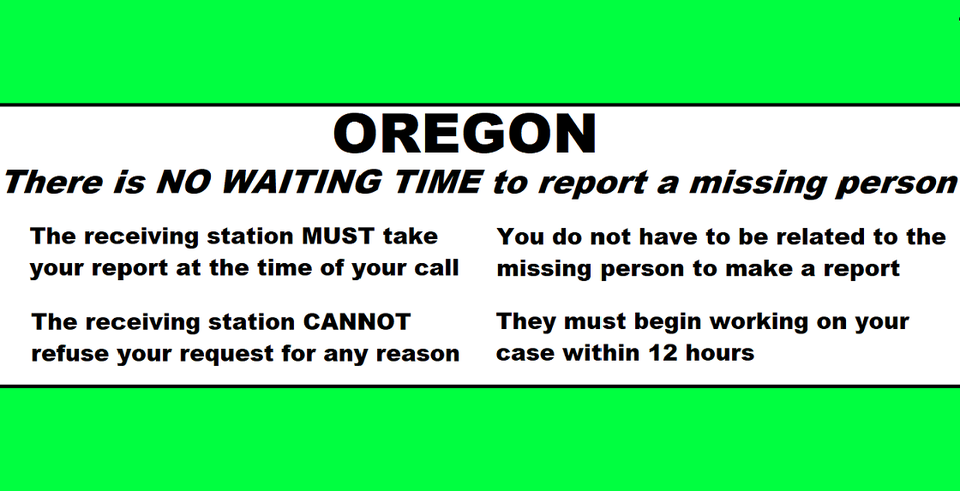
In Oregon we don’t have those rules and an officer or person answering the phone is not allowed to decide. The law decides. We have Senate Bill 351 and it states that the police CANNOT refuse a request for any reason and they must begin working on it within 12 hours. The person making the report does not have to be related to missing person either. Here is SB 351 written by families of the missing here in Oregon in conjunction with Oregon law enforcement officers. This should be common knowledge, please make it this way. https://olis.oregonlegislature.gov/…/SB351/Introduced
Find the mental health support you need

Click to see all resources https://oregonhealthnews.oregon.gov/find-the-mental-health-support-you-need/?utm_medium=email&utm_source=govdelivery

 Oregon State Police are reminding parents and students of the SafeOregon hotline. It takes reports of potential threats against students and schools. The tips can be made anonymously. They can include safety threats, fights, drugs, weapons on campus, cyberbullying and students considering self-harm or suicide. A technician reviews the reports and assigns them either to police or school administrators. Tips can be made by phone, text, email or on the website https://www.safeoregon.com
  Call us at 5 41-363-7503 Or email us at Info@RogueValleyMagazine.coms Theatres in Grants Pass!

From June 1st through July 1st, we’ll be collecting:
 New, unwrapped toys
 Coin donations
 Support for local children and families in need this holiday season Donation Location:
Coming Attractions Theatres
1625 SW Ringuette St
Grants Pass, OR 97526
Every toy donated helps bring joy, hope, and smiles to children right here in our community. Every coin collected helps us continue making Christmas possible for families who may otherwise go without.
A huge thank you to Coming Attractions Theatres for partnering with Toys for Tots and helping us spread the magic of giving throughout Grants Pass!


Public comment period opens for Forest Management Plan for western Oregon state forest lands – Public comments on the proposed rule will be accepted from June 1 to June 30 at 11:55 p.m. A virtual rulemaking hearing will be held on June 25 at 3 p.m.
– The Oregon Department of Forestry (ODF) has filed a Notice of Proposed Rulemaking for a proposed rule change to adopt a new Forest Management Plan (FMP) for western Oregon state forest lands managed by the department.
The proposed change to this rule will replace the three current FMPs (Northwest Oregon, Southwest Oregon, and Elliott) with a single FMP for these forest lands. The State Forests Division is pursuing an alternative method for compliance with the federal Endangered Species Act by applying for incidental take permits from the U. S. Fish and Wildlife Service and National Oceanic and Atmospheric Administration – Fisheries. The incidental take permits will require the division to manage Oregon state forest lands in compliance with a habitat conservation plan.
The Western Oregon State Forests Management Plan contains guiding principles, goals, and strategies that are compatible with the Western Oregon State Forests Habitat Conservation Plan. The Western Oregon State Forests Management Plan provides management direction for all Board of Forestry Lands and Common School Forest Lands managed by the Oregon Department of Forestry west of the crest of the Cascade Range.
The Board of Forestry may review, modify, or terminate a plan at any time; however, the BOF will review the plan no less than every 10 years. The current Southwest and Northwest FMPs were last revised in 2010, while the Elliott FMP was last revised in 2011. More information about State Forests Management Plans can be found here.
Public comments on the proposed rule will be accepted from June 1 to June 30 at 11:55 p.m. A virtual rulemaking hearing will be held on June 25 at 3 p.m. The Notice of Proposed Rulemaking contains the link to register to attend or provide comment at the hearing. The notice also includes important details including but not limited to the proposed rule text and instructions for submitting public comments and participating in the hearings.
More information on this rulemaking effort and ongoing updates can be found on the Rulemaking activity page of the ODF website.
The deadline for Intermediate Housing Assistance (IHA) for survivors of the 2020 Labor Day wildfires and straight-line winds is coming soon. Oregon Housing and Community Services (OHCS) administers IHA, which provides temporary rent and utility assistance for renters who lived in the disaster-affected counties of Clackamas, Douglas, Jackson, Klamath, Lane, Lincoln, Linn, or Marion at the time of the wildfires and have a verified loss.
Survivors have until June 30 to apply for the program, which has expanded eligibility, including higher incomes, so more households can get help. Assistance may last for up to 24 months or until the program’s funding is fully spent.
OHCS encourages any interested folks to reach out to a local community action agency to find out more and get started on an application.
“IHA provides a vital need for renters who are also wildfire survivors to help keep them stably housed as they figure out their permanent housing solution,” said Shannon Marheine, director of Disaster Recovery and Resilience at OHCS. “We encourage anyone who is eligible and hasn’t yet applied to do so as soon as possible. If you know someone might benefit from this program, please spread the word.”
IHA is part of a suite of wildfire recovery programs called ReOregon intended for survivors of the 2020 Labor Day Disasters and is funded by a $422 million Community Development Block Grant Disaster Recovery to support long-term recovery and rebuilding efforts.
So far, OHCS and its partners have successfully served 401 households with the IHA program.
To learn more about IHA and other ReOregon programs, visit OHCS’ website.
About Oregon Housing and Community Services – OHCS is Oregon’s housing finance agency. The state agency provides financial and program support to create and preserve opportunities for quality, affordable housing for Oregonians of low and moderate income. OHCS administers programs that provide housing stabilization. OHCS delivers these programs primarily through grants, contracts, and loan agreements with local partners and community-based providers. For more information, please visit: oregon.gov/ohcs.
Residents in Medford will soon receive energy generated by Oregon’s first floating solar panels through the state’s Community Solar Program.
More than 1,700 panels on floating platforms atop a Medford Irrigation District reservoir will generate power intended to cut costs for the district, the city and about 60 homes in Jackson County. Kyle Petrocine, program manager at the Energy Trust of Oregon, one of the administrators of Oregon’s Community Solar Program, said people can subscribe online to community solar projects across the state.
Customers pay for a subscription and receive credits on their utility bills, lowering overall costs. Petrocine said low-income subscribers can get discounted subscription rates and save up to 40% on their power bills. He said several similar projects are being considered in the Rogue Valley and other parts of Oregon.
A new 800 kW Community Solar Project is coming to Central Point, Oregon, in partnership with BEF and the Medford Irrigation District.
This unique project is one of Oregon’s first floating solar installations, featuring 1,776 solar panels on a reservoir in the Medford Irrigation District. By covering about 1.8 acres of water, the project will:
- Generate local, renewable energy for the community
- Improve water quality by shading the reservoir and reducing algae growth
- Reduce water loss from evaporation
60 residential subscriptions will be available for households in the Medford area, giving local families the chance to save on energy costs while supporting innovation in clean energy.
The project is expected to begin operation in Summer 2026.
Be part of this exciting milestone for Oregon — reserve your spot today and power your home with clean, local solar energy.
Medford Irrigation District Community Solar Subscription Example:
- Subscription Size: 5 kW
- Expected 1st year subscription generation: 7,545 kWh
- Expected Bill Credit: $782
- Expected Subscription Fee: $717
Expected First-year Net Savings: $65
Who’s Eligible?
To be eligible for the MID Community Solar Project Subscription, you must:
- Live within the Medford Irrigation District territory.
- Be a customer of Pacific Power.
Low-Income Subscribers
10% of the project’s energy is reserved for low-income households = low-income households can subscribe!
If you qualify, you’ll get special benefits and protections as a subscriber. You’ll have:
- no upfront costs
- no termination fees
- discounts on your subscription, and
- guaranteed savings on your energy bill.
Community solar is a large solar system that members of the community can join to share the benefits of the solar energy that’s generated. This is great for people who don’t want to install their own rooftop solar or who rent or live in apartments or condominiums. The energy generated by the Medford Irrigation District goes to the utility energy grid, and the value of that energy is shared by all subscribers in the form of credits on your utility bill. So you can feel good about supporting clean, renewable energy without paying the upfront costs of your own rooftop solar panels.
𝙉𝙊𝙒 𝙃𝙄𝙍𝙄𝙉𝙂: Customer Service Representative (CSR) for Rural Metro Fire – Josephine County in Grants Pass
𝗪𝗲𝗿𝗲 𝘆𝗼𝘂 𝗶𝗺𝗽𝗮𝗰𝘁𝗲𝗱 𝗯𝘆 𝘁𝗵𝗲 𝟮𝟬𝟮𝟬 𝗳𝗶𝗿𝗲𝘀? 𝗖𝗵𝗲𝗰𝗸 𝘆𝗼𝘂𝗿 𝗲𝗹𝗶𝗴𝗶𝗯𝗶𝗹𝗶𝘁𝘆 𝗳𝗼𝗿 𝗿𝗲𝗻𝘁𝗮𝗹 𝗮𝘀𝘀𝗶𝘀𝘁𝗮𝗻𝗰𝗲 – 𝘁𝗵𝗲 𝗱𝗲𝗮𝗱𝗹𝗶𝗻𝗲 𝗶𝘀 𝗝𝘂𝗻𝗲 𝟯𝟬𝘁𝗵!!
If you are recovering from the 2020 fires and need housing that supports you or your multigenerational family, help may be available through ReOregon housing recovery programs. ACCESS is an official intake center for Oregon Housing & Community Services (OHCS) fire recovery programs. Our team can help determine which option may work best for you. Programs include: 𝗜𝗳 𝘆𝗼𝘂 𝗮𝗽𝗽𝗹𝗶𝗲𝗱 𝗳𝗼𝗿 𝗳𝗶𝗿𝗲 𝘀𝘂𝗿𝘃𝗶𝘃𝗼𝗿 𝘀𝗲𝗿𝘃𝗶𝗰𝗲𝘀 𝗶𝗻 𝘁𝗵𝗲 𝗽𝗮𝘀𝘁 𝗯𝘂𝘁 𝘄𝗲𝗿𝗲 𝗻𝗼𝘁 𝗲𝗹𝗶𝗴𝗶𝗯𝗹𝗲, 𝘄𝗲 𝗲𝗻𝗰𝗼𝘂𝗿𝗮𝗴𝗲 𝘆𝗼𝘂 𝘁𝗼 𝗿𝗲𝗰𝗼𝗻𝗻𝗲𝗰𝘁 𝘄𝗶𝘁𝗵 𝗼𝘂𝗿 𝘁𝗲𝗮𝗺. Contact the ACCESS Center for Community Resilience to check your eligibility: ccr@accesshelps.org
City of Roseburg Government — Wondering where to get the facts about City projects, plans, decisions, events and upcoming meetings?
𝗙𝗲𝗮𝘁𝘂𝗿𝗲𝗱 𝗙𝗼𝗼𝗱 𝗣𝗮𝗻𝘁𝗿𝘆: 𝗦𝗮𝗹𝘃𝗮𝘁𝗶𝗼𝗻 𝗔𝗿𝗺𝘆 𝗣𝗮𝗻𝘁𝗿𝘆
Rogue Valley Humane Society
Our Community Food Bank exists to help folks who need an extra helping hand during a difficult month to feed their pets. Our program has a limited budget and so we rely on generous members of our community to donate some of these goods to continue to help assist our community. In 2023 we fed an average of 700 pets a month!
This equates to approximately 70 – 40lb bags of food each month! Many pets have benefited from the community’s generosity, and we can’t thank you enough for your kindness.
CSO Case 24-4928 PROSPECT, Ore. – Jackson County Sheriff’s Office (JCSO) detectives and Search and Rescue (SAR) personnel continue to search for a woman missing out of Prospect, Ore. since September 2024.
Deenah Padgett, 69, was reported missing on Sunday, September 8, 2024. She was last seen camping in the Prospect area on September 4, 2024.
She is described as a white woman with brownish-red, partially gray hair, standing 4’8” tall and weighing 90-100 lbs. JCSO detectives and SAR personnel have searched the area extensively and are looking for the public’s help. If you see Deenah or know her whereabouts, immediately call ECSO Dispatch at (541) 776-7206 and reference case 24-4928.
If you have any information that might help the investigation, call Detective Friend at (541) 864-8774.
The Jackson County Sheriff’s Office (JCSO) is asking for help identifying the owner a motorhome. It could be associated with a missing person from the Prospect area. JCSO says 68-year-old Deenah Padgett has been missing since August 30 from Prospect, described as a white woman, 4’ 8” tall, weighing approximately 95 pounds with brownish red/greying hair. JCSO issued an advisory this weekend asking anyone with information about the owner of the pictured motor home or Padgett’s whereabouts to call Emergency Communications of Southern Oregon (ECSO) dispatch non-emergency phone number at 541-776-7206.
David Grubbs’ Murder Investigation Remains Active
The Ashland Police Department’s investigation into the murder of David Grubbs on November 19, 2011 remains open and active. Recently two new detectives have been assigned to look into new leads that have come in. This case remains important to David’s family, the community, and the Ashland Police Department. As detectives continue to pursue these new leads, anyone with additional information is encouraged to reach out to the Ashland Police Department at 541-488-2211. The reward for information leading to an arrest on this case remains at over $21,000.
Taking Another Look at What Happened to Fauna Frey
Fauna was grieving the recent death of her brother, Dallas, when she set off from Eugene in June of 2020 heading to Grants Pass on what her family believes was both a healing trip and a mission to deliver gifts, silver coins inherited from Dallas, to a few friends. But somewhere between motel check-ins and checkouts, something went terribly wrong. Her Jeep was found months later. She was never seen again. http://bit.ly/4l63Dle
We will start resharing podcasts and articles. For starters here is a story from Danielle Denham that appeared in the June 29, 2025 edition of That Oregon Life. Ms Denham worked closely with us to insure that the facts she presented were accurate. Check out the nine episodes of the podcast Nowhere to be Found, a comprehensive, in-depth, sensitive treatment of the details surrounding Fauna’s disappearance. Hear from Fauna’s father, John, and her friends. Posted in spring of 2022, Amanda Popineau shares Fauna’s journey and the mystery that surrounds it. Go to Nowhere to be Found Season Two: Episode One “Under A Half-Moon.”
https://podcasts.apple.com/kg/podcast/s2e1-under-a-halfmoon/id1532686678?i=1000512098162
We want to remind people that Fauna’s father is offering a huge reward for information that brings Fauna home. Please if you have any information no matter how big or small let us know by calling the anonymous tip line or emailing. Tipline- 541-359-5638 Email – Helpfindfaunafrey@gmail.com FOLLOW on FACEBOOK GROUP: https://www.facebook.com/groups/341658526970132
Fauna Frey Vanished Without A Trace In Josephine County
It’s been more than five years since the disappearance of a Lane County Woman, who was last seen in Grants Pass. Back in June of 2020, Fauna Frey disappeared. Police said the 45-year-old left her home in Dexter to drive to Grants Pass to visit her brother’s friend after her brother had recently passed away. The last place she was seen was at the Big 5 in Grants Pass. Investigators said her car was found in the Galice area months later. The circumstances of Fauna’s disappearance remain unclear and her case is currently classified as missing. Her case remains unsolved. Fauna’s disappearance has been featured on multiple investigative podcasts, including Nowhere to be Found, Here One Minute, Gone the Next, and Detective Perspective, each trying to fill the silence left by law enforcement. New listeners continue to discover her story, hoping a fresh set of eyes or a single loose memory might be the key to finding Fauna.
Have Information on Fauna Frey? Please Speak Up!
If you know anything, no matter how small, please contact:
- Josephine County Sheriff’s Office
- Tip line: (541) 359-5638
- Email: FindFaunaFrey@gmail.com
Currrently there is a $50,000 CASH REWARD for information leading to the location of Fauna Frey. LARGE CASH REWARDS are being offered for any other relevant information, such as any objects that could be identified as Fauna’s, i.e. her wallet, keys, or Indian/Buffalo .999 silver bullion coins. Find Fauna Frey Facebook Group: https://www.facebook.com/groups/341658526970132
You can find food in your community at this link
Our network of food banks and pantries provides free food and groceries across Oregon. No proof of income or documentation required.
https://www.oregonfoodbank.org/
If you can’t make it to a food location, someone else can pick up food for you.You will just need to print and fill out the Authorized Representative form at https://lnkd.in/dsskUpkQ, and have them take it with them to the food sites. You can find step-by-step instructions at https://lnkd.in/dVBRxn-A.
Worried about recent changes or losing assistance?
Here are resources that can help: 211Info: Dial 2-1-1 or visit the211Info food webpagefor information and referrals to more than 1,500 food resources across Oregon. Oregon Food Bank: Use the Oregon Food Bank’s Food Finder Map to find over 100 food pantries, free food markets or hot meal programs near you. Aging and Disability Resource Connection of Oregon (ADRC): Call 855-673-2372 or visit theADRC food webpage to find local meal programs and food boxes in your area.
Summer EBT is back to help feed Oregon children during summer break
The Oregon Summer Electronic Benefits (Summer EBT) program is returning in 2026 to help families buy groceries for school-aged children during summer break when they don’t have easy access to healthy meals.
Eligible families can receive a one-time payment of $120 for each child on an Oregon EBT card to buy food. Unused benefits can expire 122 days after they are issued.
Families will get benefits automatically on their Oregon EBT card if they have children between the ages of 6-18 and received one of the following at any time during the 2025-26 school year:
- Supplemental Nutrition Assistance Program (SNAP) food benefits
- Temporary Assistance for Needy Families (TANF) cash assistance
- Medicaid, if household income is below 185 percent of the federal poverty level
- Foster care services
Families also may automatically receive benefits if they have children who:
- Were determined by their school to have a status as migrant, houseless or runaway.
- Took part in the Food Distribution Program on Indian Reservations.
- Attended a Head Start program that was part of the National School Lunch Program or School Breakfast Program.
Families may need to apply if:
- Their household meets income requirements for free or reduced-price school meals.
- Their child attends a school that was part of the National School Lunch Program (NSLP) or School Breakfast Program (SBP).
Important Summer EBT dates:
- June 1, 2026 – The Summer EBT call center opens. Families can call 833-673-7328 weekdays from 8 a.m. to 5 p.m.
- June 4, 2026 – Benefits are expected to begin issuing to families who are automatically eligible.
- June 5, 2026 – The online application opens and applications begin processing.
- Sept. 1, 2026 – Application deadline.
- Sept. 25, 2026 – The Summer EBT call center closes.
The Summer EBT program is administered by the Oregon Department of Human Services (ODHS) and Oregon Department of Education (ODE).
Children cannot receive 2026 Summer EBT benefits in multiple states. The program invites families to apply if they have children living in Oregon during the 2025-26 school year.
Families can learn more about Summer EBT, find application information and get updates by visiting the website at sebt.oregon.gov.
6/29/2026 — Gas Prices in Oregon Today
Statewide fire restrictions remain in place on all BLM-managed lands in Oregon and Washington. Fireworks, exploding targets, tracer ammunition, sky lanterns, and other fire-starting devices remain prohibited. Officials are also urging motorists to avoid parking vehicles on dry grass, as hot exhaust systems and catalytic converters can quickly ignite vegetation.
Drivers towing trailers should make sure safety chains are secured to prevent sparks from dragging on roadways. Anyone planning outdoor activities should check local restrictions before heading out, as rules can vary by location. More information is available at blm.gov.
Rare American Flag Displayed at Full Size at the Oregon Historical Society for First Time Following Conservation
Portland, OR — This July Fourth, visitors to the Oregon Historical Society (OHS) will have a rare opportunity to see what is believed to be the first U.S. flag raised in Portland following Oregon’s statehood. Hand-sewn in 1861 by Portland resident Ann Elizabeth Bills, the 9-by-6-foot flag is displayed at full size for the first time after undergoing conservation work earlier this year.
“One of the most cherished objects in our museum collection, the “Bills flag” connects us to a pivotal moment in Oregon history,” said OHS Boyle Family Executive Director Kerry Tymchuk. “Displaying it at full size allows visitors to appreciate both the original craftsmanship of Ann Bills and the careful conservation that will allow the flag to be shared for generations to come.”
Preserved in OHS’s museum collection since 1911, the Bills flag has been displayed several times folded within a case to protect the fragile materials. In preparation for Oregon’s America 250 commemoration, the flag underwent conservation so it can now be safely exhibited at its full dimensions for visitors to experience as it would have appeared more than 165 years ago.
Accompanying the display are three rare historical documents on loan from collector Bill Leslie. A document printed in 1774 details the proceedings of the First Continental Congress, while two maps from around 1817 illustrate how the young United States envisioned its expanding boundaries and territories. Together, these materials place the Bills flag within the broader story of the nation’s founding and expansion.
This special America 250 Oregon display is on view at the Oregon Historical Society’s museum in downtown Portland now through July 6, 2026. Museum hours are 10am to 5pm Monday through Saturday and 12pm to 5pm on Sunday. Admission is free every day for youth 17 and under, OHS members, and Multnomah County residents, who provide crucial operational support through the Oregon Historical Society levy. Learn more and plan your visit at ohs.org/visit.
About the Oregon Historical Society — For more than 125 years, the Oregon Historical Society has served as the state’s collective memory, preserving a vast collection of objects, photographs, maps, manuscript materials, books, films, and oral histories. Our research library, museum, digital platforms, educational programming, and historical journal make Oregon’s history open and accessible to all. We exist because history is powerful, and because a history as deep and complex as Oregon’s cannot be contained within a single story or point of view.
The National Weather Service says there is no tsunami threat following a magnitude 5.5 earthquake off the Oregon coast by Bandon this morning
A magnitude 5.5 earthquake struck along the Blanco transform fault on June 29, 2026, about 135 miles off the coast of Bandon, Oregon. The event registered at a shallow depth of roughly 6 miles.
The U.S. Geological Survey says the quake struck at 4:35 a.m. – Seismological and hazard agencies confirmed key details about this specific event:
- Tsunami Threat: None. The National Tsunami Warning Center confirmed there was no tsunami danger to the coastlines of Oregon, Washington, or California.
- Impact: Although light tremors were reported to the USGS by a handful of people, the distance from the coast mitigated the shaking, and no damage was reported.
- Regional Context: The Blanco Fracture Zone is a highly active transform/strike-slip fault system where tectonic plates slide horizontally past one another. It is entirely separate from the Cascadia megathrust subduction zone.
- Historical Precedent: Seismologists note that this fracture zone is historically the most active fault system near North America, generating hundreds of smaller quakes every year, none of which typically trigger catastrophic events or portend “The Big One”.
The earthquake occurred in the Blanco Fracture Zone, a seismically active area where hundreds of earthquakes occur each year. The Blanco fault is a highly active fault zone that runs from a point about 100 miles from Oregon’s westernmost point to another point about 300 miles from Newport.
Leave fireworks at home when visiting Oregon State Parks and the ocean shore
Oregon State Parks encourages parkgoers to leave the fireworks to the professionals for Fourth of July celebrations. Fireworks and explosives are strictly prohibited within Oregon State Parks and the entire ocean shore. However, from the coast to the Snake River, nearby cities and towns have local celebrations and fireworks shows to attend.
Fireworks pose a significant danger to visitors, wildlife, structures and the natural landscape particularly in crowded areas where high winds and flammable vegetation increase the inherent risks of fireworks.
“Just one rogue spark can create a wildfire,” said OPRD Emergency Manager Jamen Lee. “We work closely with our local partners to minimize the risk of fires and ask that visitors follow any fire restrictions.”
Each year, volunteers collect trash following the Fourth of July resulting in thousands of pounds of debris. One volunteer group alone collected 231 pounds of trash from just four beaches around Lincoln City – that’s nearly 60 pound per beach!
“We ask that visitors respect fireworks restrictions and clean up after their celebrations to protect Oregon State Parks and the ocean shore,” said Laurel Hillmann, ocean shore resource coordinator at Oregon Parks and Recreation Department.
While education remains the primary focus for rule enforcement at Oregon State Parks, rangers do have the authority to issue citations. Staff at Oregon State Parks ask that visitors enjoy the holiday responsibly and leave fireworks and explosives at home.
OPRD also encourages visitors to know before they go when it comes to fire restrictions during this wildfire season. Fire restrictions are coordinated with local and state fire districts. Certain parts of the coast also do not allow fires on beaches. Learn more on our website.
Resources:
- OPRD beach safety web page.
- OPRD beach fire safety video (YouTube).
- Fourth of July celebrations and fireworks:
Oregon marks five years of Fire Adapted Oregon and Response Ready Oregon
– Five years after Senate Bill 762, Oregon is celebrating the progress and impact of Fire Adapted Oregon and Response Ready Oregon.
These statewide programs, created by the Department of the State Fire Marshal, built a stronger foundation for wildfire risk reduction and response at a time when the state’s wildfire exposure continues to intensify.
Fire Adapted Oregon was created to help communities understand and reduce wildfire risk through education, defensible space, home hardening, grants, partnerships, and regional support. Over the past five years, the program trained 502 defensible space assessors from 94 agencies, completing 6,539 assessments across the state.
Fire Adapted Oregon has advanced guidance on defensible space, including the importance of the first five feet around homes and structures, strengthened partnerships like the collaboration with the Insurance Institute for Business and Home Safety, and expanded statewide mitigation and home hardening investments through grants. Regional delivery across nine districts ensures support reaches communities where it is needed most and in a way that best reflects each community’s needs.
Response Ready Oregon was established to modernize and expand the fire service’s ability to respond quickly and effectively when wildfires ignite. The Engine Program delivered 76 new engines and tactical water tenders to local fire agencies, supported seasonal staffing, expanded the immediate response and pre‑positioning programs, and strengthened the three all-hazard incident management teams within the Oregon Fire Mutual Aid System. Regional mobilization coordinators connect local chiefs to resources and support. These investments help firefighters stop fires while they are small, reducing loss and protecting communities.
Oregon’s wildfire exposure has increased significantly. The Rowena Fire in 2025 resulted in the loss of 56 homes, a trend consistent with the western U.S. The West has experienced a 246% increase in homes and structures destroyed by wildfire between 1999–2009 and 2010–2020, according to a study published in PNAS Nexus. Fire Adapted Oregon and Response Ready Oregon provide coordinated statewide systems that help communities prepare for these changing conditions and give fire agencies the tools they need to respond quickly and safely.
Over the next five years, Fire Adapted Oregon will strengthen home hardening grant programs, advance data collection and integration, and continue building strategies that support vulnerable communities and structure loss reduction. Response Ready Oregon will continue investments in staffing grants, immediate response, and pre‑positioning. Long-term and stable funding will be essential as wildfire seasons intensify. Planned improvements include modernizing the fire defense board system, enhancing technology and communications systems, developing emerging tools for situational awareness, and building additional agreements with other states to support surge capacity.
About the Department of the State Fire Marshal – Since 1917, the Oregon State Fire Marshal has been dedicated to protecting people, property, and the environment from fire and hazardous materials. The agency works with local fire agencies, communities, and other partners to strengthen fire prevention, preparedness, and response statewide. Please note: the Oregon State Fire Marshal is no longer an office after becoming an independent state agency in 2023.
Oregon PUC approves wildfire mitigation plans for Idaho Power, Pacific Power, and PGE
– The Oregon Public Utility Commission (PUC) today approved the 2026–2028 Wildfire Mitigation Plans for Idaho Power (UM 2209), Portland General Electric (UM 2208), and Pacific Power (UM 2207).
These plans detail how utilities will reduce utility wildfire risk, strengthen system resilience, and protect communities during increasingly severe wildfire seasons as risk models evolve in urban and rural areas to reflect changing conditions.
The Commission also adopted the PUC staff recommendations for additional improvement across the utilities’ programs to support greater transparency, stronger modeling practices, and further demonstration of cost-effective mitigation investments.
Each approved plan includes enhanced vegetation management, inspection and maintenance programs, system hardening, situational awareness tools, increased community outreach, and Public Safety Power Shutoff (PSPS) procedures. PSPS events remain a last resort to reduce the risk of utility equipment igniting wildfires in hazardous weather conditions.
The wildfire mitigation plans are required under Senate Bill 762 (2021), which directs electric utilities in Oregon to identify areas of heightened wildfire risk within their service territories, develop measures to reduce ignition risks, and outline PSPS protocols during dangerous conditions.
“Today’s approval reflects the Commission’s continued commitment to ensuring Oregon’s electric utilities are planning responsibly, transparently, and proactively in the face of escalating wildfire risk,” said PUC Chair Letha Tawney. “These plans help keep communities safer, and we encourage all Oregonians to take steps now to prepare for extreme weather and potential outages.”
Preparing for the 2026 wildfire season and potential PSPS events
- Register for emergency alerts from local and state authorities and sign up for outage notifications from your electric utility.
- Develop a household emergency plan and make sure all family members understand evacuation procedures.
- Create defensible space around your home by reducing vegetation and other fuels.
- Be two-week ready with essential supplies, including food, water, medications, batteries, and pet needs.
- Keep phones and medical devices fully charged ahead of high-risk weather.
- Ensure your utility account information is up to date so you can receive emergency notifications.
- Customers who rely on electricity for medical needs should contact their utility about medical certification programs and consider backup power options.
During an outage or PSPS event:
- Report outages to your utility and stay far away from downed power lines.
- Use flashlights instead of candles and operate generators outdoors and away from buildings.
- Unplug appliances except refrigerators and freezers to protect against power surge damage.
- Check on neighbors, especially older adults or individuals with access or functional needs.
- Stay cool by keeping blinds closed, staying hydrated, and accessing community cooling spaces if needed.
PUC Vegetation Management Program
In addition to reviewing wildfire mitigation plans, the PUC conducts independent inspections of utility infrastructure and vegetation management practices in high fire risk areas. The PUC evaluates whether electric utilities are maintaining proper vegetation clearances, addressing hazards promptly, and meeting statewide and national safety standards. These inspections ensure accountability and contribute to reducing wildfire ignition risk. — Learn more about wildfire preparedness at wildfire.oregon.gov.
Here’s how Oregon is celebrating America’s 250th year of independence
From Bigfoot to time capsules, the America 250 Oregon Commission awarded 80 grants across Oregon to support local history, culture and art
Bigfoot is officially helping Oregon celebrate the country’s 250th birthday.
This September, the Dallas Area Visitors Center will host its second annual Bigfootstock, a one-day festival rooted in local folklore and the town’s rural identity that brings together educators, agritourism businesses and tribal partners.
“Through storytelling, cultural exchange, and educational experiences and of course music, the festival highlights the voices and traditions that shape our region and reflect the broader American story,” said Sarrah McMaster, treasurer of the Dallas Area Visitors Center.
The quirky, family-friendly event is one of 80 projects across Oregon that received a grant from the America 250 Oregon Commission, which over the course of four rounds awarded nearly $250,000 to groups highlighting the state’s unique traditions, cultures and history ahead of the 250th anniversary of American independence.
Gov. Tina Kotek in 2024 signed a law creating the commission, tasking it with coordinating the state’s celebration of the country’s 250th birthday.
The commission recognized early that there isn’t a single correct way to honor the country’s 250th year of independence.
Instead, it adopted seven broad guidelines to give local organizations the freedom to honor the state’s heritage and culture in their own unique ways, said Kerry Tymchuk, commission chair and executive director of the Oregon Historical Society.
“There’s projects that honor veterans, there are projects that promote civics and history education, there’s projects that honor Oregon’s tribes, of course, who were here long before 1776,” Tymchuk said. “Oregon’s official state motto is, ‘she flies with her own wings,’ and this proves that right. There’s just so many unique ideas that the commission was proud to support.”
A nonpartisan, bipartisan celebration across Oregon
The funding was split equally between rural and urban organizations, Tymchuk said, adding that the commission worked hard to ensure it was a nonpartisan and bipartisan celebration.
In Umatilla County, the Heritage Station Museum is collecting letters from community members to place in a time capsule that will be stored in its climate-controlled collection until 2076.
The museum received $3,000 from the state commission to buy archival paper, marketing materials and boxes to place in local libraries where community members can submit their letters and materials for the time capsule’s closing ceremony in September.
“We’re actually creating an index so that we’ll know who contributed, and that way in 50 years if someone wants to look back and see if their ancestor put anything in there, they’ll be able to look that up,” said museum executive director Shannon Gruenhagen. To see the full list of grant recipients, visit the America 250 Oregon Commission website.
At the Oregon Art Center in Portland, a $3,000 grant will help cover the cost for a curator to put together an exhibit featuring art from its teachers, student artists as well as award-winning artists that have been featured in the gallery before. The grant will also pay for the center’s 100th birthday celebration during a free event on Sept. 3 with live music and catered food.
“Our mission is really to make art accessible, and this grant certainly has helped us make this big milestone for us even more impactful for our community,” Oregon Art Center coexecutive director Emma Wallace told the Capital Chronicle.
Several groups received grants to honor veterans, including the Central Oregon-based nonprofit Warrior Impact. The nonprofit is using its $4,000 America 250 grant to cover the cost of a spot in one of its retreats meant to help veterans and first responders experiencing post-traumatic stress.
Warrior Impact offers free rafting, hiking and horse therapy retreats led by fellow veterans and first responders to help people find purpose and process their trauma. A third of participants come from out of state, said Matt Bassit, the nonprofit’s founder and president.
“We’re completely volunteer based, so we’re very efficient with the dollars we have, but it’s still costly,” Bassitt said. “The more we can raise, the more we can actually build this thing into a world-class organization.”
Other groups are using grant funding to highlight Oregon’s Indigenous community, including the Oregon Children’s Theatre in Portland. The theatre is using its $3,000 grant to support the writing process and hiring of actors for its new musical, “The Mountain & The Raven.”
Native creatives, including play director Jeanette Harrison of the Native Performing Arts Network and Taya Dixon, a resident artist at Hillsboro’s nonprofit theatre company Bag&Baggage Productions, will help develop the musical. Dixon is writing it alongside Oregon Children’s Theatre Producing Artistic Director Jenn Hartman Luck. The musical will premiere in 2028.
“We want to celebrate Native voices and experiences through this project,” Hartman Luck said in an email. “Our goal is to tour this show, ‘The Mountain and the Raven,’ across the state of Oregon, bringing this important story about identity, land, grief, and acceptance, to young people in many communities. Especially to many communities that really don’t have the opportunity to come to Downtown Portland for theatre experiences.”
Upcoming America 250 events at the Oregon State Capitol and Oregon Historical Society
Beginning at 10 a.m. Saturday, the Oregon State Capitol will host a free “A Passport to History and Democracy” event featuring live music, apple pie and the opportunity to explore inside and outside the capitol.
And at 3 p.m. July 8 — the date the Declaration of Independence was first read aloud to citizens — the Oregon Historical Society in Portland will participate in a nationwide, simultaneous reading of the national document. State leaders will take turns reading the document.
The Salem Philharmonia Orchestra will perform a free concert at the Oregon State Capitol State Park at 11 a.m. July 10. — (SOURCE)
Kotek’s prosperity council pushes for lower taxes, fewer regulations
The highly-anticipated proposal came in response to Kotek’s push for more economic development in the state last year
Gov. Tina Kotek speaks to reporters after the release of her prosperity council’s report on July 25, 2026. (Photo by Julia Shumway/Oregon Capital Chronicle)
To jumpstart Oregon’s economic development, the state should cut taxes, eliminate a key state climate program and allocate a quarter of a billion state dollars for business infrastructure needs every two years, according to a new report from Gov. Tina Kotek’s economic advisers.
The numbers Kotek’s prosperity council put forth in its 33-page report and shared in a council meeting Thursday afternoon paint a negative picture of Oregon’s economy: The state is second-to-last in the nation when it comes to increases in employment, 41% of Oregonians live either below the federal poverty level or are unable to afford basic needs, and the state’s unemployment rate is at 5.2%, a figure that has remained above the national average for months. The report comes as U.S. Bureau of Labor Statistics data identified Oregon as the only West Coast state to lose jobs overall since last year.
“We have to chart a better future for everyone,” Kotek said during Thursday afternoon’s meeting. “We are hearing constantly about the challenge for everyday Oregon working hard can’t make ends meet. I also want to make sure that Oregon is one of the best places in the country to have a business, and I think we can achieve that.”
She commended the council for producing recommendations she called “bold” and “practical,” particularly praising charges to identify redundant regulations and reimagine the state’s economic development agency.
But while the report identifies 10 key solutions, it defers to the Oregon Legislature when it comes to changing what it calls a “one-and-a-half-legged stool” system reliant on personal income taxes and property tax to fund state revenues. It’s an issue even the council couldn’t agree on, according to Curtis Robinhold, executive director of the Port of Portland and co-chair of the council.
“We are not equipped to come up with the right answer on the tax code. It deserves a really good look…but boy, it’s complicated, and you know, I think we probably each could imagine a system that would be better,” he told the Capital Chronicle. “What we really need is the governor and the Legislature to get their heads together on what will get us the outcomes we want.”
Another major suggestion: The report argues the state should adapt a cap-and-trade program to push polluters to pay for their emissions, like exist in California and Washington, then repeal Oregon’s Climate Protection Program. Former Gov. Kate Brown spearheaded the program, which allows state environmental regulators to set declining emissions caps, after quorum-denying Republican walkouts in 2019 and 2020 quashed legislative efforts to pass a cap-and-trade program.
The report stressed that the below changes to Oregon’s tax code should be revenue neutral:
- Expand Oregon’s Research & Development tax credit through incentives such as a 15% credit for company-led research and development and 2% for projects within Oregon universities.
- Increase the estate tax exemption threshold from $1 million to $3 to $5 million.
- Increase the filing and taxability threshold for Oregon’s Corporate Activity Tax, which now applies to businesses with $1 million in Oregon commercial activity. Businesses now pay $250 plus 0.57% of their Oregon taxable commercial activity above $1 million. The prosperity council urged raising that threshold to $2 million and allowing businesses to completely deduct the cost of creating or providing a service or product.
- Reconnect the state tax code to a portion of the federal 2025 tax law that allows non-corporate investors to exempt their small business stock sales from capital gains tax. Disconnecting from this exemption saved Oregon nearly $40 million in revenue for the current two-year budget cycle.
- Establish a work group that can by 2029 deliver a long-term proposal to the governor addressing issues such as expiring federal state and local tax provisions, the corporate activity tax, local government funding and reducing the burden of personal income taxes.
“I would like us to be targeted in making sure we have a tax structure that and takes care of all Oregonians,” Kotek said. “We have a tax system right now that we hope can be as progressive as possible, by making sure that people who pay taxes have the ability to pay them and what we have from this report is we probably need a longer-term conversation about what our tax system looks like.”
Revisiting such issues would likely leave state lawmakers figuring out how to balance state revenues while changing the systems that fund hundreds of millions of dollars in state revenue at a time when political capital for tax increases is low. Oregonians at the ballot box in May sharply rejected transportation tax increases passed by Democrats last year, but state lawmakers also unsuccessfully attempted to increase the exemption threshold for the estate tax in Oregon this year.
“Every single one of these recommendations is in the context of ‘What do other people do? How are we different? Are we better? Are we worse?’” said Renée James, founder of semiconductor company Ampere Computing and council co-chair.
Kotek established the prosperity council last year amid concern about the state’s economic development climate hampering her reelection campaign. Her Republican opponent, state Sen. Christine Drazan of Canby, acknowledged that political reality in a brief statement praising the recommendations.
“We all know this council was an election-year gimmick, but these recommendations are a meaningful start and deserve strong bipartisan support,” Drazan said. “Let’s build on the ideas that create jobs, fix our economy and make Oregon more affordable. That includes bold tax cuts for families and businesses. I’m ready to get to work.”
The left-leaning Oregon Center for Public Policy panned the recommendations for failing to meet the moment, saying the state must focus on protecting health care and food assistance in the wake of federal cuts.
“The Council’s recommendations respond to this dire challenge by cutting taxes for millionaires and by prioritizing corporate handouts over direct investment in the success of working families across our state,” the center’s deputy director, Daniel Hauser, said in an email. “Oregon cannot chart a path towards shared prosperity by cutting taxes on the few who are prosperous.”
Competing factions within the council sparred over how far the state should go when it comes to slashing taxes to incentivize business development.
A key point of contention was her decision to tap former Senate Republican Leader Tim Knopp as her chief prosperity officer. Some council members also disagreed over the extent to which the state should replicate federal tax cuts.
Prosperity council leaders acknowledged that disconnect legislation fueled disagreement among the council, but they said that they did find a “supermajority” of consensus on every issue aside from taxes. Missing from the report are detailed recommendations on improving the state’s K-12 education outcomes, an issue that council leaders said was outside the scope of their duties.
“I think there’s a misnomer in the dialogue that it’s all about rich people wanting tax cuts,” Robinhold said. “And I want to make sure, because this is super important for the Legislature to hear in this report, we need to holistically look at our tax code, because we are hurting, we’re hurting our middle- and lower-income Oregonians just as much, if not more.”
The report also acknowledges similar disagreements, noting that two council members “disagreed with some of the short-term tax changes and expressed concerns about the necessity of broader business incentives and their long-term impacts to the state.” It’s a likely nod to when two labor-affiliated members of the council in April issued a public rebuke of business groups in the state and argued that tax breaks would only harm Oregon’s economic development further.
“They agree that Oregon must strengthen its long-term competitiveness but believe increasing investments in talent and quality of life is more effective for enhancing the state’s economy,” the report reads.
Other recommendations include:
- Transform Oregon’s economic development agency, Business Oregon, into the Oregon Commerce Authority. It would be governed by business and innovation leaders alongside the governor.
- Establish statewide permitting timelines and guardrails by requiring agencies to approve or deny applications within clear timelines.
- Reduce regulatory and administrative burdens by 20% by 2029 by removing old and excessive regulations.
- Create a dedicated site readiness and infrastructure fund of $250 million, likely through lottery bonds, for each two-year budget cycle. Robinhold said the council heard from businesses including Daimler that they wanted to expand in Oregon but didn’t have available and ready land.
- Create a Governor’s Cabinet of Economic & Talent Development to lead a strategy to attract talent to the state and promote its competitiveness.
- Align Oregon with other West Coast states’ higher education funding policies and commit $20 million to a fund for innovative university research.
Capital Chronicle editor-in-chief Julia Shumway contributed to this report. https://oregoncapitalchronicle.com/2026/06/25/koteks-prosperity-council-pushes-oregon-lawmakers-to-revisit-tax-cuts-leaves-details-up-in-air/
Typically, landlords must compete to attract renters by offering lower prices, discounts and amenities. However, those using RealPage shared sensitive rental data to train the company’s pricing algorithm.
This software then uses that data to recommend rental rates, effectively allowing landlords to keep prices artificially high, according to the lawsuit.LivCor managed nearly 1,650 Oregon properties using this rent-fixing software, according to the Oregon Department of Justice.Read more at https://www.oregonlive.com/…/property-management.
Census data places Oregon at nationwide bottom
Data from the U.S. Census Bureau released in May, meanwhile, places Oregon as one of the worst states in the nation when it comes to access to air conditioning, though states such as California, Wyoming, Washington and Montana all had lower rates of reported access. In Oregon, more than 18% of the state’s households are estimated to not have any access to a form of air conditioning.
The federal data relies upon estimates from 2023, but it shows that the state’s coast and Northeast areas have significantly low rates of access to air conditioning, some with less than half of households in the county. That’s often because the coastal areas of the state can rely on the ocean breeze instead of paying for cooling systems.
Jennifer Kalez, a spokesperson for the Oregon Department of Energy, distanced the federal data from the state’s own 2023 study.
“The Cooling Needs Study looked specifically at low-income and at-risk households in the state and differentiated between permanent cooling equipment, and broken and temporary equipment, while the (federal) data is statewide or county wide, and did not differentiate between types of cooling equipment,” she wrote in an email.
It’s up to lawmakers to decide whether to fund more of the program. In the meantime, there are also federally-funded programs for rental homes, new construction and homeowners that the state administers, such as the Heat Pump Purchase Program, which provides $2,000 for installations of heat pumps to state-approved contractors.
Brian Stewart, co-founder of Electrify Now, a volunteer-run advocacy group that promotes building electrification, said Oregon has in the past enjoyed cooler summers, which explains the federal data showing rates of air conditioning lower than other parts of the nation. With hotter Oregon summers, he said that’s changing and people are “getting the news that a heat pump is better.”
Stewart said Oregon lawmakers could also provide incentives to convert low quality air conditioners to heat pumps, particularly in light of the low-income families reliant upon Portland General Electric who have reported that high rates of energy use correspond with bills that cost nearly $300 more.
These homes could require deeper technical fixes and repairs, he said, and the price of installing a heat pump can vary thousands of dollars depending on the size of the home and type of the system, such as a solar or geothermal-powered heat pump.
“This is why incentives are so important. They reduce these kinds of barriers that people see when they’re trying to make decisions about what to do in their homes and enable them to get products that are going to be better for them in the long term,” he said. “It’s really hard to overcome ‘Wow, it’s thousands of dollars more up front, right?’ And if someone is telling you, well, you’re going to save a bunch of money in the long-term, that’s a hard argument when you’re strapped to just make the initial payment.” (SOURCE)
All Oregon Department of Forestry (ODF) districts are in fire season. This means that to reduce the risk of human-caused wildfires, fire restrictions may be in place where you live or at a destination you plan to visit or recreate.
“Looking at the current conditions and projections for the summer, ODF is prepared to have another busy fire season,” said Michael Curran, Oregon Department of Forestry’s Fire Protection Division Chief. “Oregonians need to be practicing wildfire prevention and emergency preparedness NOW.”
Now is the time to brush up on your wildfire prevention knowledge. Tips include:
- Know before you go. Campfires may be banned or only allowed in approved campgrounds.
- Make sure your campfire is cool to the touch before going to sleep or leaving your site. Don’t forget to Drown, Stir, Repeat.
- Forests and fireworks don’t mix. Private use of fireworks is not allowed on forest land, which includes all private lands protected by ODF and all other state and federal forest lands in Oregon. Remember to check any additional city and county firework restrictions as well.
- Backyard debris burning either requires a burn permit during fire season or is prohibited altogether. If you burned earlier this spring, go back and check on your debris burn site to make sure nothing reignites due to the heat.
- Don’t flick a cigarette onto the ground. It may be just enough to start a fire.
- Don’t park or idle over dried grass.
- Don’t drag tow chains.
- Check local restrictions and fire danger levels.
Curran said, “Prevention is our number one tool to reduce property loss, firefighting costs, and risk to the lives of our firefighters. We can’t prevent lightning fires, but we can prevent human-caused fires.”
ODF protects over 16 million acres of private, county, state, and federal land in Oregon from wildfire. Fire season is declared at the local level when conditions reach a point where the risk of a fire starting and spreading becomes clear. This year, the Central Oregon district was the first to declare on May 8, and the Northwest Oregon Area was the last to declare on June 15. For more information on how you can help prevent wildfires, visit keeporegongreen.org.
Webinar series to honor 36 years of disability civil rights kicks off July 7
— The public is invited to a series of free webinars featuring conversations with disabilities advocates and experts who will share the latest information on disability supports, emergency management systems and digital accessibility.
Topics by date are:
- July 7: Exploring Cross-Disability Experiences and Support Needs
- July 14: Building Inclusive and Accessible Emergency Management Systems
- July 21: ADA: How Far We’ve Come and What Comes Next
- July 28: Understanding the Department of Justice’s (DOJ) Ruling on Digital Accessibility
The free weekly webinar series is being hosted by Oregon Disabilities Commission (ODC), Oregon Department of Human Services, Northwest ADA Center and Disability Rights Oregon in recognition and celebration of the 36th anniversary of the Americans with Disabilities Act (ADA).
“As we reflect on the legacy of the Americans with Disabilities Act, we’re also looking closely at the work ahead such as understanding diverse experiences and support needs, strengthening inclusive and accessible systems, and advancing digital accessibility,” said Mark King, Chair of ODC. “We’re grateful to our co-hosts for joining us in presenting this series, which helps us continue educating and advocating for equity, independence and full participation for people with disabilities.”
The series will take place on Tuesdays throughout July, from 11:30 a.m. to 1 p.m. Pacific Time, beginning July 7. The sessions are open to the public, and registration is now available through the event webpage on Zoom.
The series will be accessible to people with disabilities and will be translated into Spanish. Captioning and American Sign Language interpretation will also be provided. For questions about accessibility for the webinar series, or to request an accommodation, contact OregonDisabilities.Commission@odhsoha.oregon.gov.
More information about the series, including presenter biographies, will be shared on the Oregon Department of Human Services ADA event webpage.
About the Oregon Disabilities Commission: The Oregon Disabilities Commission is charged by state statute to advise the Oregon Department of Human Services, the Governor, the Legislative Assembly and appropriate state agency administrators on issues related to achieving the full economic, social, legal and political equity of individuals with disabilities. ODC also acts as a coordinating link between and among public and private organizations serving individuals with disabilities.
New Minimum Wage Rates Start July 1 2026
New minimum wage rates announced Commissioner Stephenson has announced specifics on upcoming changes to Oregons minimum wage.
For hours worked July 1st and forward, Oregons minimum wage rates will increase based on year-over-year inflation to: Standard Minimum Wage: $15.55 per hour Portland Metro Minimum Wage: $16.80 per hour Non-Urban Minimum Wage: $14.55 per hour The current standard minimum wage rate is $15.05.
Based on an increase in the CPI of 3.3% from March 2025 to March 2026, the new standard minimum rate will be: $15.05 X 1.033 = $15.55 (rounded to the nearest five cents) By statute, the Portland metro minimum wage is $1.25 more than the standard minimum wage, and the non-urban minimum wage is $1.00 less than the standard minimum wage.
Oregon employers are required to post minimum wage posters. Individual posters reflecting the new minimum wage rates as of July 1, 2026 will be available for download on the BOLI website free of charge by June 15, 2026.
Golfer struck by lightning in West Linn
A golfer was hospitalized after reportedly being struck by lightning Saturday afternoon. Tualatin Valley Fire & Rescue confirmed that they rescued a golfer, who was struck by lightning but was able to call for help and was transported to a hospital.
Tualatin Valley Fire & Rescue confirmed the incident, saying the golfer was alone and outside his golf cart at The Oregon Gold Club on Pete’s Mountain Road when the storm rolled in. He was hit by lightning but regained consciousness and was able to call for help, the agency said. The golfer was transported via ambulance to the Emmanuel Burn Center; he is reported to be in stable condition.
State Agencies Release Water Conservation Communications Toolkit
— The Oregon Department of Emergency Management (OEM) and the Oregon Water Resources Department (WRD) have jointly released the 2026 Water Conservation Communications Toolkit, a comprehensive collection of customizable outreach materials designed to help communities communicate effectively about water conservation during Oregon’s ongoing drought conditions.
The toolkit provides agencies, local governments, community organizations and partners with ready-to-use key messages, sample news releases, social media templates, Frequently Asked Questions, and water‑saving tips to support consistent statewide communication. It emphasizes practical, low‑cost steps Oregonians can take to conserve water at home, including checking for leaks, watering during cooler hours, adjusting irrigation based on weather, and installing water‑efficient fixtures.
“Oregon is facing challenging drought conditions this year, and clear, consistent communication is essential in helping communities take action,” said Ivan Gall, Director of the Oregon Water Resources Department. “Every Oregonian can play a part in reducing water use and protecting our shared water resources.”
In addition to public messaging tools, the toolkit directs Oregonians to important resources such as WRD’s biweekly Drought & Water Supply Conditions Report, local watering guidance, drought declaration information, and options for reporting drought impacts including dry wells and local conditions.
The 2026 Water Conservation Communications Toolkit is available to all partners and the public. Agencies and organizations are encouraged to adapt the materials to meet local needs while supporting consistent statewide messaging.
OWRD and OEM thank the Regional Water Providers Consortium for sharing their research on water conservation and offering information on saving water in six languages.
Water Conservation Resources:
- OWRD Water Conservation: info/savewater
- Drought Declarations: info/droughtdeclarations
- Regional Water Providers Consortium: org/water-conservation
- Drought & Water Supply Conditions Report Email sign-up: info/getdroughtupdate
- Current and previous Drought & Water Supply Conditions Reports: owrd.info/droughtupdates
It is the mission of the Oregon Department of Emergency Management (OEM) to lead collaborative, statewide efforts to support Oregon’s communities before, during and after emergencies, with a vision to create a ready and resilient Oregon. OEM prioritizes an equitable and inclusive culture of preparedness that empowers all Oregonians to thrive in times in crisis. For more information about OEM, visit oregon.gov/oem. You can get this document in other languages, large print, braille, or a format you prefer. For assistance, email OEM_PublicInfo@oem.oregon.gov. We accept all relay calls, or you can dial 711.
The Oregon Lottery is showcasing the state’s natural beauty through its new “Discover Oregon State Parks” Scratch-it ticket.
This ticket, available in three distinct colors, features a clean and minimalist design that captures the geographic diversity found within Oregon’s state parks.
Designed by the Oregon Lottery team to resonate with outdoor enthusiasts, these $5 tickets include icons representing various landmarks and wildlife, with a top prize of $40,000.
They can be purchased at Lottery retailers throughout the state. The proceeds from lottery game play contribute significantly to the maintenance and enhancement of state parks, with over $1 billion allocated to Oregon State Parks since 1999. This initiative marks the fifth consecutive year that the Lottery has collaborated with State Parks to introduce a themed ticket.
Weekend Train Rides Return to the Oregon Rail Heritage Center for the 2026 Season
PORTLAND, Ore. — The Oregon Rail Heritage Center is excited to announce the return of its popular weekend train rides. Running every Saturday and Sunday through October 11, 2026, these family-friendly excursions offer passengers a memorable rail adventure through the heart of Portland aboard historic diesel locomotive BNSF 3613.
Train tickets include admission to the Oregon Rail Heritage Center—making it the perfect outing for train lovers, families, and visitors of all ages.
Perfect for families, visitors, and train enthusiasts of all ages, the scenic rides provide a unique opportunity to experience Portland from the rails. Guests can choose between riding in an open-air car or relaxing in a vintage air-conditioned coach while enjoying views of Portland’s skyline, the Willamette River, local wildlife, and the timeless charm of Oaks Park.
Each train ticket also includes admission to the Oregon Rail Heritage Center, where visitors can explore Portland’s rich railroad history and get an up-close look at historic locomotives and rail equipment.
Event Details:
- When: Saturdays & Sundays, May 23 – October 11, 2026
- Where: Oregon Rail Heritage Center, 2250 SE Water Ave., Portland, OR 97214
- Train Departure Times: 1:00pm, 2:00pm, 3:00pm, 4:00pm
- Tickets Prices:
- Adults (14+) – $17
- Seniors (65+) – $15
- Military (with ID) – $15
- Children (3-13) – $12
- Infants (Under 3) – Free
- Family Pass (2 Adults & 2 Children) – $50
- Tickets & Registration: https://orhf.org/
About Oregon Rail Heritage Center:
The Oregon Rail Heritage Center (ORHC) provides for the preservation, operation and public enjoyment of Portland’s historic locomotives, railroad equipment, and artifacts, and educates the public about Oregon’s rich and diverse railroad history. ORHC is open to the public on Thursdays-Sundays from 1:00pm-5:00pm. Seasonal train excursions are offered most weekends. For additional information, visit https://orhf.org/. Follow us on Facebook and Instagram.
BLM Brings Oregon Folklife Programming to National Historic Oregon Trail Interpretive Center
BAKER CITY, Ore. – The Bureau of Land Management invites the public to explore Oregon’s living cultural traditions through a new interpretive folklife series at the National Historic Oregon Trail Interpretive Center beginning this week.
The series aligns with America’s 250th anniversary by highlighting the people, traditions, and cultural knowledge that have shaped the nation over time. Visitors can experience firsthand how traditional arts connect past and present while supporting the BLM’s mission.
From April through October, visitors will have interactive opportunities that represent Native American, ranching, and rural lifeways. Presentations will take place daily at 11 a.m., 1 p.m., and 3 p.m. Pacific Time, offering deeper insight into each artist’s craft and cultural background.
April 23-25, Sara Barton, traditional basket maker of Mono Lake Paiute and Yosemite Miwuk ancestry works closely with Burns Paiute weavers
May 7-9, Kathy Moss, cowboy poet, buckaroo, horse trainer, and rancher from Prairie City
June 18-20, Roberta Kirk, regalia maker, food gatherer, and bead and dentalium artist from Warm Springs, Tenino and Wasq’u
July 9-11, Cheryl Newhouse, spinner and weaver from Richland
August 13-15, Mildred Quaempts, dentalium artist from the Confederated Tribes of Umatilla
September 24-26, Clair Kehrberg, saddle and gear maker and leatherworker from John Day
October 15-17, Katie Harris Murphy and Mary Harris, regalia and beadwork artists from the Wallowa Band Nimiipuu, Cayuse, Umatilla, and Karuk Tribes
“This interpretive outreach brings people face-to-face with the traditions that continue to shape communities across Oregon,” said Robert Reis, acting manager for the Interpretive Center. “These demonstrations create a meaningful connection to the past through the skills and knowledge that are still practiced today.”
This series is designed to build long-term, high-quality cultural programming at the Interpretive Center, ensuring visitors can engage with authentic traditions and perspectives for years to come.
The National Historic Oregon Trail Interpretive Center is located at 22267 Highway 86 in Baker City and is open daily from 10 a.m. to 5 p.m. PT. Admission fees apply. For more information, visit the National Historic Oregon Trail Interpretive Center website or call 541-523-1843.
Oregon Department of Veterans’ Affairs
No veteran should be without a place to call home, and the Oregon Department of Veterans’ Affairs is committed to ending veteran homelessness in our state. The new ODVA Houseless Veterans Program collaborates with federal, state, county, and Tribal agencies, veteran services offices, and community homeless service providers to meet the urgent and unique needs of Oregon’s diverse veteran communities challenged with housing stability. In addition to advocating for Oregon veterans experiencing or at risk for houselessness, the program provides direct service to veterans and their families seeking federal and state veterans’ benefits, including access to local VA health care, documentation of service, as well as other available state benefits, and local homeless services organizations and low-income assistance programs. If you or a veteran you know is dealing with homelessness, contact the ODVA Houseless Veterans Coordinator today at houselessvets@odva.oregon.gov or visit https://ow.ly/V4EH50VnL93 to learn more.
Staying Informed During a Communications Outage: Best Practices for the Public
Disasters can damage critical infrastructure, leading to temporary outages in cell service, internet, and power. When communication systems go down, it’s vital to be prepared with alternate ways to get emergency information and stay connected. Here’s how you can prepare and respond:
Have a Battery-Powered or Hand-Crank Emergency Weather Radio
- Why it matters: Emergency radios can receive Emergency Alert System (EAS) broadcasts via AM/FM or NOAA Weather Radio frequencies—even when cell towers and the internet are down.
- Note: Emergency radios do not receive Wireless Emergency Alerts (WEA) like cell phones do. Tip: Pre-tune your radio to your local emergency broadcast station (e.g., OPB in Oregon or NOAA frequencies).
Turn On WEA Alerts on Your Phone
- Make sure Wireless Emergency Alerts (WEA) are enabled in your phone’s settings. These alerts include evacuation orders, severe weather warnings, and other urgent notifications.
- WEA messages are sent through cell towers—if cell service is out, WEA alerts will not be delivered. This is why having backup methods like a radio is essential.
Charge Everything in Advance and Have Backup Power
- Charge phones, power banks, laptops, and rechargeable flashlights before fire weather conditions worsen.
- Consider solar-powered chargers or car chargers as backups.
- If you are sheltering in place, a generator (solar or gas powered) is helpful.
Know Your Evacuation Routes in Advance
- Save printed or downloaded evacuation maps in case you can’t access GPS or navigation apps.
- Most mapping services (like Google Maps or Apple Maps) offer the ability to “Make maps available offline.” Download your area in advance so you can navigate even if cell towers or internet access are down.
- When in doubt, call 511 or visit the TripCheck.com website if you have cell service.
- Don’t wait for a notification—if you feel unsafe, evacuate early.
Print or Write Down Critical Contacts and Info
- Phone numbers of family, neighbors, and local emergency contacts.
- Address of evacuation shelters, veterinary services (for pets/livestock), and medical facilities.
- Your own emergency plan, including meeting locations.
- Have copies of vital documents in your go-bag and take video of your property (inside and out) for insurance claims later.
If Calling 9-1-1 Over Wi-Fi or Satellite, Check Your Location Settings
If you call 9-1-1 using Wi-Fi calling or a satellite-connected phone (like an iPhone or Android), your location might not be automatically visible to dispatch. Instead, it may rely on the emergency address saved in your phone’s settings.
- Update this emergency address when you travel or relocate—especially in evacuation zones or rural areas.
- Most importantly, always tell the dispatcher exactly where you are—include your address, landmarks, road names, or mile markers to help first responders reach you quickly.
Sign Up for Alerts Before There’s an Outage
- Register for OR-Alert and your county’s local alert system.
- Follow your local emergency management officials’ and bookmark resources like: wildfire.oregon.gov.
Prepare for Alert Delays or Gaps
- Know the three levels of evacuation:
- Level 1 – Be Ready
- Level 2 – Be Set
- Level 3 – GO NOW
- If you hear a siren, see a neighbor evacuating, or witness fire behavior increasing—take action even if you haven’t received an alert.
Be Your Own Info Network
- Check on neighbors, especially seniors or those with disabilities.
- Post printed signs with updates for those passing by.
In rural areas, community bulletin boards or fire stations may serve as local information points. Support and Restoration in Progress To help maintain emergency communications during this incident, OEM deployed eight Starlink terminals under the guidance of ESF 2 and the Statewide Interoperability Coordinator (SWIC). A Communications Technician (Jeff Perkins) was also deployed to assess connectivity needs on the ground. These Starlink terminals have been providing service to the Lake County Emergency Operations Center (EOC), Oregon State Police (OSP), Warner Creek Correctional Facility, and will soon support the town of Lakeview, the Bureau of Land Management (BLM), and the Lakeview Ranger Station. OEM’s Regional Coordinator (Stacey) is also on-site supporting the Lake County EOC. Coordination has been strong across local, state, and private sector partners. *** Update: As of 7/10/25 at 1:47 PM, fiber service has been restored.
Reconnect When Service Returns
- Once communications are restored, check official websites:
- Oregon.gov/oem
- Your county emergency management page
- TripCheck.com for road conditions
- Share verified info—not rumors—on social media or community pages.
Prepare for Delays in Restoration
- Communication may come back in phases. Damage to fiber lines or cell towers can take time to repair.
- Continue using backup methods and stay alert for updates via radio or in-person notices.
Final Tip:
In an emergency, CALL 9-1-1 to report life-threatening danger, not for general information. Use local non-emergency numbers or go to physical information points if needed. You can find more tips for preparing in OEM’s Be2Weeks Ready toolkit.
Oregon’s Missing Persons
Many times you’ll see postings without case numbers or police contact. There is rarely a nefarious reason why (the nefarious ones are pretty obvious). Usually the loved one tried to call to report their missing person and they are either refused or told to wait a day or two by people who are unaware of SB 351 and the laws that they are bound to when answering the phone. Many people don’t bother calling LE if their loved one is homeless or in transition because they believe LE won’t care. The biggest myth is the 24 hour rule.
In Oregon we don’t have those rules and an officer or person answering the phone is not allowed to decide. The law decides. We have Senate Bill 351 and it states that the police CANNOT refuse a request for any reason and they must begin working on it within 12 hours. The person making the report does not have to be related to missing person either. Here is SB 351 written by families of the missing here in Oregon in conjunction with Oregon law enforcement officers. This should be common knowledge, please make it this way. https://olis.oregonlegislature.gov/…/SB351/Introduced
Find the mental health support you need
Click to see all resources https://oregonhealthnews.oregon.gov/find-the-mental-health-support-you-need/?utm_medium=email&utm_source=govdelivery
Oregon State Police are reminding parents and students of the SafeOregon hotline. It takes reports of potential threats against students and schools. The tips can be made anonymously. They can include safety threats, fights, drugs, weapons on campus, cyberbullying and students considering self-harm or suicide. A technician reviews the reports and assigns them either to police or school administrators. Tips can be made by phone, text, email or on the website https://www.safeoregon.com Call us at 5 41-363-7503 Or email us at Info@RogueValleyMagazine.com