
The latest news stories of interest in the Rogue Valley and the state of Oregon from the digital home of Southern Oregon, Wynne Broadcasting’s RogueValleyMagazine.com
Monday, July 6, 2026
Rogue Valley Weather

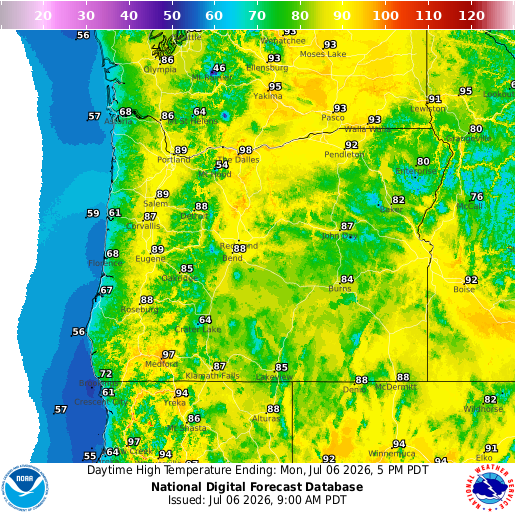
https://graphical.weather.gov/sectors/oregon.php
 https://graphical.weather.gov/sectors/oregon.php

Southern Oregon Celebrated The Fourth of July Weekend With Great Community Events Across The Rogue Valley
- Central Point: Hosted BoomFest 2026 at the Jackson County Expo, featuring free parking, public launch zones, and a massive fireworks show at dusk.
- Ashland: Thousands lined the streets for the morning parade led by the Ashland City Band, alongside patriotic tributes in Lithia Park.
- Medford: Hosted the “Red, White & Pool” open house at Rogue X with free open swimming, family games, and live music.
- Eagle Point: Held its 67th annual parade, an 8:00 AM Fun Run, a “Star Spangled Everything” vendor fair, and stadium fireworks at Eagle Point High School.
Ashland’s Historic America 250 Parade


Celebrating America’s 250th birthday at Eagle Point during the July 4th parade


Freedom Fest 2026 in Central Point
The celebration included live performances, dozens of booths from local businesses and organizations, and a pie-and-watermelon-eating competition.

Organizers estimated that over 20,000 people came out to see the parade and hang out at Freedom Fest throughout the day.
The Crater Lake Trolley season has officially commenced, and reservations are now open for guided, interactive tours around Oregon’s sole national park, Crater Lake.

Each tour accommodates up to 18 individuals, with the option for an additional six to eight walk-up guests. Ticket prices are set at $44 for adults, with discounts available for seniors, military personnel, and children, while those aged six and under can ride for free.
Group rates may also be offered. There are six tours scheduled daily, each lasting two hours, operating seven days a week from 10 a.m. to 3 p.m.
Guests are encouraged to arrive one hour prior to their scheduled time for check-in and boarding. The interactive nature of the tour includes a knowledgeable guide who provides insights into the park’s history, making it suitable for all ages. The trolley makes approximately six stops at scenic overlooks, allowing guests to take selfies, capture family portraits, or explore the surroundings.
According to TripAdvisor, these trolley tours are rated as the top attraction at the park, boasting an impressive 4.6-star rating based on 149 reviews.
Mountain Mike’s Pizza franchise operator has filed for Chapter 11 bankruptcy as the pizza industry continues to face financial challenges.

Rogue Fare LLC has commenced bankruptcy proceedings. The company currently operates as a franchise operator of Medford, Oregon-based pizza chain called Mountain Mike’s Pizza.
The latest move comes as the broader pizza industry struggles to maintain a foothold amid declining sales, rising expenses, and other troubles.
Rogue Fare LLC has commenced bankruptcy proceedings. The company currently operates as a franchise operator of Medford, Oregon-based pizza chain called Mountain Mike’s Pizza.
.
Message from Sheriff Sickler on Jail Basement Closure

Dear Community,
Jackson County Sheriff’s Office (JCSO) is making changes to jail operations due to the rising costs of providing public safety services. As part of these changes, the Jackson County Jail basement housing unit will close beginning July 1, reducing the jail’s operational capacity from approximately 292 to 230 beds.
This decision is the result of a difficult financial reality facing our agency. Over the past several years, expenses have increased across nearly every area of our operation. Jail medical costs alone have doubled to more than $3 million per year, while personnel, equipment, and operational costs continue to rise significantly faster than available funding.
At the same time, JCSO has very limited ability to generate additional funding to offset these increasing expenses. To balance our budget, we have been forced to make difficult decisions about staffing, services, and operations, while remaining committed to protecting and serving the people of Jackson County.
Over the past three years, JCSO has eliminated more than 25 full-time positions. While we have worked hard to minimize impacts, these reductions have now affected the Corrections Bureau, making it difficult to operate the jail without significantly cutting other services we provide, such as patrol and detectives. I believe closing a portion of the jail is the least harmful option to our county long term.
With fewer jail beds available, some individuals arrested for lower-level offenses and subject to immediate mandatory release by Oregon Senate Bill 48 may no longer be lodged in the jail and instead may be cited and released. Despite this change we will remain committed to public safety and will be reviewing our practices regularly to ensure we are utilizing our resources in the best way possible.
Unfortunately, budget projections suggest these changes may remain in place for the foreseeable future. Even so, we remain committed to working with the Board of Commissioners, County leadership, community stakeholders, and our public safety partners to identify long-term solutions and advocate for the resources needed to meet the growing demands placed on our criminal justice system.
While jail capacity will be reduced, our commitment to protecting Jackson County remains unchanged.
Deputies will continue responding to calls, investigating crimes, protecting life, and working closely with our criminal justice partners to hold offenders accountable.
The men and women of JCSO remain dedicated to serving and protecting our community. We appreciate your understanding and support as we work through these challenges together.
Sincerely,
Sheriff Nate Sickler
Belle Fiore Estate Winery and Chateau, one of Ashland’s most visible wine-country properties, has been listed for sale for the first time, putting a high-profile Rogue Valley winery, event venue, vineyard and private residence on the market as the region’s wine industry continues to navigate a changed post-pandemic economy.
The property, located off Dead Indian Memorial Road at 100 and 200 Belle Fiore Lane, is being marketed by Cascade Hasson Sotheby’s International Realty. The listing agents are Hunter Blackwell and Ryan Lamanna. Public listing information shows the combined estate being marketed at $26 million, though some online real estate feeds also show the commercial winery parcel separately.
The offering includes the winery and event property at 100 Belle Fiore Lane, with a 32-acre producing vineyard, a winery building of more than 27,000 square feet, tasting rooms, restaurant space, a ceremonial barrel room, ballroom, outdoor dining areas and commercial production facilities. Marketing materials also describe the property as having refrigerated wine storage and infrastructure for larger-scale winery operations.
The estate comes on the market at a time when winery properties are being evaluated in a more complicated business climate than the one that existed when Belle Fiore was developed. Rogue Valley wineries have benefited from the region’s growing reputation for diverse varietals and wine tourism. But they also have faced rising costs, changing consumer habits, wildfire smoke, labor pressures and a tasting-room business that has not fully returned to pre-pandemic patterns. READ MORE: https://ashland.news/belle-fiore-winery-and-estate-listed-for-sale/
Health officials are warning people to avoid contact with four creeks in the Bear Creek Basin after routine water quality tests found bacteria levels above state safety standards.
The affected waterways are Walker Creek at Dead Indian Memorial Road, Bear Creek at Wranglers Arena in South Talent, Bear Creek between Suncrest Road and Table Rock Road, and Jackson Creek at Beall Lane.
The Rogue Valley Council of Governments said the warning applies only to these specific creeks and does not cover all waterways in Jackson County or the Bear Creek Watershed.
Officials are asking residents to use caution when in contact with any waterways. They said people should avoid swallowing the water, which may cause illness, and keep it away from open wounds, which may cause infection. Very young children should be fully supervised when playing in the water to prevent them from swallowing it.
RVCOG said contact with any body of water carries some level of risk. The bacteria could come from pet waste, livestock waste, wild animals, leaking septic systems, illegal dumping from portable toilets or RVs, or any other activity that results in fecal matter entering creeks or storm drains. More information is available on RVCOG’s website.
Southern Oregon Healthcare Workers Demand Asante Stop Wasting Money on L.A. Lawyers and Meet to Bargain a Fair Contract
Asante appeals federal government’s order in its latest attempt to avoid recognizing healthcare workers or addressing its care crisis
(MEDFORD)– Local community members who work at Asante Rogue Regional Medical Center are demanding Asante executives stop stalling, follow federal law, and begin bargaining a fair contract to improve patient care and support Rogue Valley caregivers.
On June 3, the National Labor Relations Board (NLRB) ordered Asante to immediately recognize local healthcare workers’ union vote at Asante and begin bargaining with workers upon request. Healthcare workers followed up with a certified letter calling on Asante to begin contract negotiations June 11.
However, Asante’s out-of-state executives announced they are refusing to honor the government’s decision and will continue refusing to meet with local workers. Instead, Asante is appealing the decision again to the District of Columbia’s federal circuit court. Despite wasting three years and countless dollars on legal fees and consultants already—money which should be used to improve local healthcare—Asante executives are doubling down on actions the federal government ruled were illegal.
“Asante acted as if they were above the law. Now after repeated NLRB rulings, it’s time for Asante to recognize workers’ union and come to the table to reach a fair contract agreement,” said Fred Katz, RN, ONA’s registered nurse (RN) bargaining unit chair at Asante Rogue Regional. “Local techs are ready to meet anywhere, anytime to expand patients’ access to care, improve working conditions, and raise healthcare standards for everyone in the Rogue Valley. It’s time for Asante executives to stop hiding behind their L.A. lawyers and meet with Oregon workers so we can improve our community’s healthcare.”
The more than 250 frontline healthcare technicians and licensed practical nurses (LPNs) at Rogue Regional overwhelmingly voted to join the Oregon Nurses Association (ONA) on June 9, 2023. They have been waiting for three years to meet with Asante executives and bargain a contract that provides for safe staffing, affordable healthcare, fair pay and benefits, and a voice in local healthcare decisions.
The NLRB is an independent federal agency which oversees union elections, protects workers’ rights and decides unfair labor practices. During its investigation into Asante, it found Asante had committed multiple unfair labor practices by refusing to recognize and bargain with local workers. In its final decision June 3, it ordered Asante to stop its illegal activities and begin bargaining with workers upon request, provide workers with requested information, and publicly post a notice stating Asante broke the law.
Asante executives are facing additional allegations that Asante unlawfully interfered with workers’ rights to organize, threatened workers about the consequences of voting for a union, disciplined an employee for speaking about patient safety with local journalists, and prevented union representatives from visiting the hospital. All actions that are illegal under federal law.
Asante executives have also come under fire for closing maternity and inpatient services at Ashland’s only hospital; racking up more than $1 million in state fines for violating Oregon’s safe staffing law; outsourcing local doctors and healthcare workers; and leading repeated mass layoffs affecting hundreds of caregivers, their families and patients throughout Southern Oregon.
Local healthcare workers including radiologic technologists, licensed practical nurses (LPNs), respiratory therapists, physical therapy assistants, occupational therapy assistants and surgical technicians organized in 2023 to have a voice in local healthcare decisions and fight for safe staffing, affordable healthcare, fair pay and reasonable working conditions. They are represented by the Oregon Nurses Association (ONA).
ONA also represents a separate bargaining unit of more than 1,200 frontline registered nurses (RNs) at Rogue Regional Medical Center.
###The Oregon Nurses Association (ONA) represents a diverse community of more than 25,000 nurses and healthcare professionals throughout Oregon. Together, we use our collective power to advocate for critical issues impacting patients, nurses and healthcare professionals including a more effective, affordable and accessible healthcare system; better working conditions for all healthcare professionals; and healthier communities. For more information visit www.OregonRN.org.
Schofield trial delayed after judge approves defense motion

MEDFORD – A former Asante nurse, Dani Schofield, facing 44 counts of assault in Medford, will not go to trial in September as planned. The trial delayed after judge approves defense motion.
The defense filed a motion June 22 stating they need access to necessary evidence they won’t have in time for the September trial. The cancellation follows an argument between the state and the defense last week. The judge and the defense will meet Aug. 3 for a pretrial conference.
All of Schofield’s previously scheduled court dates have been canceled, including her pretrial readiness, status hearing and her eight-week, 12-person jury trial.
Medford City Council approved a plan to pay $11 million for three years of salary increases in a unanimous vote last Wednesday.
On July 1, workers with the AFSCME union will receive a 6% salary increase. Non-union and executive workers will receive a 3% increase.
Increases for 2027 and 2028 were also approved, with union workers receiving a 2% raise in July 2027. Union, non-union, and executive workers will receive a 3% to 5% cost of living increase in July 2027 and 2028.
Meanwhile, single-family residential customers in Medford will see an increase of $9.38 on their utility bills. The City of Medford has announced an annual utility adjustment going into effect July 1. The monthly utility rate will increase from $76.53 to $85.91 a month.
The city says the increase will go toward street maintenance, storm drainage, sewer treatment, public safety, and parks. A portion will also support upgrades to the Regional Wastewater Reclamation Facility to keep up with updated environmental regulations.
Illinois Valley Fire District Receives Oregon State Fire Marshal 2026 Wildland Fire Season Staffing Grant

The Illinois Valley Fire District is proud to announce that we have once again been awarded the Oregon State Fire Marshal’s Wildland Fire Season Staffing Grant in the amount of $35,000.
This marks the 4th consecutive year that IVFD has received this important funding, allowing us to provide additional staffing at Station 2 (Selma) during the 2026 wildfire season.
Established in 2022, the Wildland Fire Season Staffing Grant helps local fire agencies increase firefighter staffing during the most critical months of the year. The goal is simple: keep wildfires small and away from our communities. By providing additional personnel, agencies can respond quickly to emerging fires before they become larger, more costly incidents.
Beyond wildfire response, these staffing resources help ensure firefighters are available to respond to medical emergencies, traffic accidents, structure fires, and other emergencies throughout our district—ultimately helping save lives and protect property.
We would like to thank the Oregon State Fire Marshal’s Office for their continued investment in local fire protection and community safety. This funding strengthens our ability to protect the residents and visitors of the Illinois Valley during the height of wildfire season.
Together, we are building a safer and more resilient Illinois Valley.
Fire Chief Holmes
ODF Southwest Oregon District – 𝙋𝙐𝘽𝙇𝙄𝘾 𝙐𝙎𝙀 𝙍𝙀𝙎𝙏𝙍𝙄𝘾𝙏𝙄𝙊𝙉𝙎 𝘿𝙐𝙍𝙄𝙉𝙂 𝙁𝙄𝙍𝙀 𝙎𝙀𝘼𝙎𝙊𝙉
All Oregon Department of Forestry (ODF) districts are in fire season. This means that to reduce the risk of human-caused wildfires, fire restrictions may be in place where you live or at a destination you plan to visit or recreate.
40 Modular Homes to Be Built in Phoenix to Replace Homes Lost in Almeda Fire
Oregon Housing and Community Services selected five projects to build 117 affordable homes using factory-produced housing methods across the state.
AGE+ and Blazer Modular Construction plan to use the funding to build 40 fully accessible, affordable homes for older adults in Phoenix. The project, Phoenix Commons, will replace housing lost in the Almeda Fire. The modular construction will reduce per-unit costs and cut the construction schedule by several months.
The initiative comes from House Bill 3145 passed in the 2025 Legislative Session. It will fund up to five factory-produced housing projects with Local Innovation and Fast Track set-aside funds totaling $25 million. Factory-produced housing, like modular homes, offers an alternative to traditional construction and can produce homes faster and at lower costs.
SOU To Eliminate 66 Positions and 3 Majors
Southern Oregon University has released a provisional financial recovery plan that would eliminate three academic majors, reduce the equivalent of nearly 66 positions and reorganize much of the institution in an effort to avoid running out of cash next year.
The proposed Vitality Plan, released Monday, outlines more than $20 million in reductions. Nearly $12 million would come from the new proposals, with the remaining savings coming from cuts already underway since last fall. University officials say the changes are needed to put SOU on a sustainable financial path and qualify for $15 million in state support.
The plan proposes eliminating bachelor’s degree programs in human service, music industry and production and financial mathematics.
Academic programs would be reorganized around six “academic cornerstones,” including health and civic engagement. The university also plans to streamline degree offerings and expand stackable credentials to make it easier for students to complete programs.
The proposal would reduce the equivalent of about 23 faculty positions and nearly 43 staff positions. Proposed staff reductions include eight positions in business services, five in information technology and four dean positions.
Athletics would absorb $454,000 in cuts, including the elimination of an assistant football coach position and reductions to preseason meals and housing. Under the proposal, all athletic programs would be required to become fully self-supporting by 2029.
The SOU Farm would have to be self-sustaining by the end of this calendar year and suffer the loss of two employees.
The SOU Board of Trustees is scheduled to review the proposal during a special meeting Tuesday evening before voting on it on Thursday. The university also hosted a campus conversation at 1 p.m. Tuesday to answer questions about the proposal.
If approved, the changes would be implemented by June 2027, when university officials project SOU would otherwise run out of cash.
The university must adopt a long-term plan for financial sustainability to receive $15 million from the state legislature, which would help support SOU over the next fiscal year. The state’s emergency board is scheduled to review the request for the first half of that funding on Wednesday. (SOURCE)
 𝗘𝘅𝗰𝗶𝘁𝗶𝗻𝗴 𝗻𝗲𝘄𝘀 𝗳𝗼𝗿 𝘁𝗵𝗲 𝗧𝗮𝗹𝗲𝗻𝘁 𝗰𝗼𝗺𝗺𝘂𝗻𝗶𝘁𝘆! ACCESS is proud to announce the NEW location of the Talent Food Pantry at the 𝗧𝗮𝗹𝗲𝗻𝘁 𝗛𝗲𝗮𝗹𝘁𝗵 𝗖𝗲𝗻𝘁𝗲𝗿, located at 49 Talent Ave. in Talent.
Residents in Medford will soon receive energy generated by Oregon’s first floating solar panels through the state’s Community Solar Program.
More than 1,700 panels on floating platforms atop a Medford Irrigation District reservoir will generate power intended to cut costs for the district, the city and about 60 homes in Jackson County. Kyle Petrocine, program manager at the Energy Trust of Oregon, one of the administrators of Oregon’s Community Solar Program, said people can subscribe online to community solar projects across the state.
Customers pay for a subscription and receive credits on their utility bills, lowering overall costs. Petrocine said low-income subscribers can get discounted subscription rates and save up to 40% on their power bills. He said several similar projects are being considered in the Rogue Valley and other parts of Oregon.
A new 800 kW Community Solar Project is coming to Central Point, Oregon, in partnership with BEF and the Medford Irrigation District.
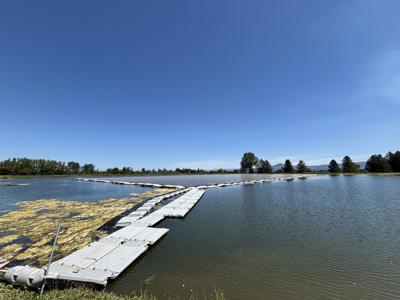
This unique project is one of Oregon’s first floating solar installations, featuring 1,776 solar panels on a reservoir in the Medford Irrigation District. By covering about 1.8 acres of water, the project will:
- Generate local, renewable energy for the community
- Improve water quality by shading the reservoir and reducing algae growth
- Reduce water loss from evaporation
60 residential subscriptions will be available for households in the Medford area, giving local families the chance to save on energy costs while supporting innovation in clean energy.
The project is expected to begin operation in Summer 2026.
Be part of this exciting milestone for Oregon — reserve your spot today and power your home with clean, local solar energy.
Medford Irrigation District Community Solar Subscription Example:
- Subscription Size: 5 kW
- Expected 1st year subscription generation: 7,545 kWh
- Expected Bill Credit: $782
- Expected Subscription Fee: $717
Expected First-year Net Savings: $65
Who’s Eligible?
To be eligible for the MID Community Solar Project Subscription, you must:
- Live within the Medford Irrigation District territory.
- Be a customer of Pacific Power.
Low-Income Subscribers
10% of the project’s energy is reserved for low-income households = low-income households can subscribe!
If you qualify, you’ll get special benefits and protections as a subscriber. You’ll have:
- no upfront costs
- no termination fees
- discounts on your subscription, and
- guaranteed savings on your energy bill.
Community solar is a large solar system that members of the community can join to share the benefits of the solar energy that’s generated. This is great for people who don’t want to install their own rooftop solar or who rent or live in apartments or condominiums. The energy generated by the Medford Irrigation District goes to the utility energy grid, and the value of that energy is shared by all subscribers in the form of credits on your utility bill. So you can feel good about supporting clean, renewable energy without paying the upfront costs of your own rooftop solar panels.
𝙉𝙊𝙒 𝙃𝙄𝙍𝙄𝙉𝙂: Customer Service Representative (CSR) for Rural Metro Fire – Josephine County in Grants Pass
City of Roseburg Government — Wondering where to get the facts about City projects, plans, decisions, events and upcoming meetings?
𝗙𝗲𝗮𝘁𝘂𝗿𝗲𝗱 𝗙𝗼𝗼𝗱 𝗣𝗮𝗻𝘁𝗿𝘆: 𝗦𝗮𝗹𝘃𝗮𝘁𝗶𝗼𝗻 𝗔𝗿𝗺𝘆 𝗣𝗮𝗻𝘁𝗿𝘆 



Rogue Valley Humane Society
Our Community Food Bank exists to help folks who need an extra helping hand during a difficult month to feed their pets. Our program has a limited budget and so we rely on generous members of our community to donate some of these goods to continue to help assist our community. In 2023 we fed an average of 700 pets a month!
This equates to approximately 70 – 40lb bags of food each month! Many pets have benefited from the community’s generosity, and we can’t thank you enough for your kindness.
CSO Case 24-4928 PROSPECT, Ore. – Jackson County Sheriff’s Office (JCSO) detectives and Search and Rescue (SAR) personnel continue to search for a woman missing out of Prospect, Ore. since September 2024.
Deenah Padgett, 69, was reported missing on Sunday, September 8, 2024. She was last seen camping in the Prospect area on September 4, 2024.
She is described as a white woman with brownish-red, partially gray hair, standing 4’8” tall and weighing 90-100 lbs. JCSO detectives and SAR personnel have searched the area extensively and are looking for the public’s help. If you see Deenah or know her whereabouts, immediately call ECSO Dispatch at (541) 776-7206 and reference case 24-4928.
If you have any information that might help the investigation, call Detective Friend at (541) 864-8774.
The Jackson County Sheriff’s Office (JCSO) is asking for help identifying the owner a motorhome. It could be associated with a missing person from the Prospect area. JCSO says 68-year-old Deenah Padgett has been missing since August 30 from Prospect, described as a white woman, 4’ 8” tall, weighing approximately 95 pounds with brownish red/greying hair. JCSO issued an advisory this weekend asking anyone with information about the owner of the pictured motor home or Padgett’s whereabouts to call Emergency Communications of Southern Oregon (ECSO) dispatch non-emergency phone number at 541-776-7206.
David Grubbs’ Murder Investigation Remains Active
The Ashland Police Department’s investigation into the murder of David Grubbs on November 19, 2011 remains open and active. Recently two new detectives have been assigned to look into new leads that have come in. This case remains important to David’s family, the community, and the Ashland Police Department. As detectives continue to pursue these new leads, anyone with additional information is encouraged to reach out to the Ashland Police Department at 541-488-2211. The reward for information leading to an arrest on this case remains at over $21,000.
Taking Another Look at What Happened to Fauna Frey
Fauna was grieving the recent death of her brother, Dallas, when she set off from Eugene in June of 2020 heading to Grants Pass on what her family believes was both a healing trip and a mission to deliver gifts, silver coins inherited from Dallas, to a few friends. But somewhere between motel check-ins and checkouts, something went terribly wrong. Her Jeep was found months later. She was never seen again. http://bit.ly/4l63Dle

We will start resharing podcasts and articles. For starters here is a story from Danielle Denham that appeared in the June 29, 2025 edition of That Oregon Life. Ms Denham worked closely with us to insure that the facts she presented were accurate. Check out the nine episodes of the podcast Nowhere to be Found, a comprehensive, in-depth, sensitive treatment of the details surrounding Fauna’s disappearance. Hear from Fauna’s father, John, and her friends. Posted in spring of 2022, Amanda Popineau shares Fauna’s journey and the mystery that surrounds it. Go to Nowhere to be Found Season Two: Episode One “Under A Half-Moon.”
https://podcasts.apple.com/kg/podcast/s2e1-under-a-halfmoon/id1532686678?i=1000512098162
We want to remind people that Fauna’s father is offering a huge reward for information that brings Fauna home. Please if you have any information no matter how big or small let us know by calling the anonymous tip line or emailing. Tipline- 541-359-5638 Email – Helpfindfaunafrey@gmail.com FOLLOW on FACEBOOK GROUP: https://www.facebook.com/groups/341658526970132
Fauna Frey Vanished Without A Trace In Josephine County
 It’s been more than five years since the disappearance of a Lane County Woman, who was last seen in Grants Pass. Back in June of 2020, Fauna Frey disappeared. Police said the 45-year-old left her home in Dexter to drive to Grants Pass to visit her brother’s friend after her brother had recently passed away. The last place she was seen was at the Big 5 in Grants Pass. Investigators said her car was found in the Galice area months later. The circumstances of Fauna’s disappearance remain unclear and her case is currently classified as missing. Her case remains unsolved. Fauna’s disappearance has been featured on multiple investigative podcasts, including Nowhere to be Found, Here One Minute, Gone the Next, and Detective Perspective, each trying to fill the silence left by law enforcement. New listeners continue to discover her story, hoping a fresh set of eyes or a single loose memory might be the key to finding Fauna.
Have Information on Fauna Frey? Please Speak Up!
If you know anything, no matter how small, please contact:
- Josephine County Sheriff’s Office
- Tip line: (541) 359-5638
- Email: FindFaunaFrey@gmail.com
Currrently there is a $50,000 CASH REWARD for information leading to the location of Fauna Frey. LARGE CASH REWARDS are being offered for any other relevant information, such as any objects that could be identified as Fauna’s, i.e. her wallet, keys, or Indian/Buffalo .999 silver bullion coins. Find Fauna Frey Facebook Group: https://www.facebook.com/groups/341658526970132
You can find food in your community at this link
Our network of food banks and pantries provides free food and groceries across Oregon. No proof of income or documentation required.
https://www.oregonfoodbank.org/
If you can’t make it to a food location, someone else can pick up food for you.You will just need to print and fill out the Authorized Representative form at https://lnkd.in/dsskUpkQ, and have them take it with them to the food sites. You can find step-by-step instructions at https://lnkd.in/dVBRxn-A.
Worried about recent changes or losing assistance?
Here are resources that can help: 211Info: Dial 2-1-1 or visit the211Info food webpagefor information and referrals to more than 1,500 food resources across Oregon. Oregon Food Bank: Use the Oregon Food Bank’s Food Finder Map to find over 100 food pantries, free food markets or hot meal programs near you. Aging and Disability Resource Connection of Oregon (ADRC): Call 855-673-2372 or visit theADRC food webpage to find local meal programs and food boxes in your area.
Summer EBT is back to help feed Oregon children during summer break
The Oregon Summer Electronic Benefits (Summer EBT) program is returning in 2026 to help families buy groceries for school-aged children during summer break when they don’t have easy access to healthy meals.
Eligible families can receive a one-time payment of $120 for each child on an Oregon EBT card to buy food. Unused benefits can expire 122 days after they are issued.
Families will get benefits automatically on their Oregon EBT card if they have children between the ages of 6-18 and received one of the following at any time during the 2025-26 school year:
- Supplemental Nutrition Assistance Program (SNAP) food benefits
- Temporary Assistance for Needy Families (TANF) cash assistance
- Medicaid, if household income is below 185 percent of the federal poverty level
- Foster care services
Families also may automatically receive benefits if they have children who:
- Were determined by their school to have a status as migrant, houseless or runaway.
- Took part in the Food Distribution Program on Indian Reservations.
- Attended a Head Start program that was part of the National School Lunch Program or School Breakfast Program.
Families may need to apply if:
- Their household meets income requirements for free or reduced-price school meals.
- Their child attends a school that was part of the National School Lunch Program (NSLP) or School Breakfast Program (SBP).
Important Summer EBT dates:
- June 1, 2026 – The Summer EBT call center opens. Families can call 833-673-7328 weekdays from 8 a.m. to 5 p.m.
- June 4, 2026 – Benefits are expected to begin issuing to families who are automatically eligible.
- June 5, 2026 – The online application opens and applications begin processing.
- Sept. 1, 2026 – Application deadline.
- Sept. 25, 2026 – The Summer EBT call center closes.
The Summer EBT program is administered by the Oregon Department of Human Services (ODHS) and Oregon Department of Education (ODE).
Children cannot receive 2026 Summer EBT benefits in multiple states. The program invites families to apply if they have children living in Oregon during the 2025-26 school year.
Families can learn more about Summer EBT, find application information and get updates by visiting the website at sebt.oregon.gov.

Oregon Department of Veterans’ Affairs
No veteran should be without a place to call home, and the Oregon Department of Veterans’ Affairs is committed to ending veteran homelessness in our state. The new ODVA Houseless Veterans Program collaborates with federal, state, county, and Tribal agencies, veteran services offices, and community homeless service providers to meet the urgent and unique needs of Oregon’s diverse veteran communities challenged with housing stability. In addition to advocating for Oregon veterans experiencing or at risk for houselessness, the program provides direct service to veterans and their families seeking federal and state veterans’ benefits, including access to local VA health care, documentation of service, as well as other available state benefits, and local homeless services organizations and low-income assistance programs. If you or a veteran you know is dealing with homelessness, contact the ODVA Houseless Veterans Coordinator today at houselessvets@odva.oregon.gov or visit https://ow.ly/V4EH50VnL93 to learn more.
Staying Informed During a Communications Outage: Best Practices for the Public
Disasters can damage critical infrastructure, leading to temporary outages in cell service, internet, and power. When communication systems go down, it’s vital to be prepared with alternate ways to get emergency information and stay connected. Here’s how you can prepare and respond:
Have a Battery-Powered or Hand-Crank Emergency Weather Radio
- Why it matters: Emergency radios can receive Emergency Alert System (EAS) broadcasts via AM/FM or NOAA Weather Radio frequencies—even when cell towers and the internet are down.
- Note: Emergency radios do not receive Wireless Emergency Alerts (WEA) like cell phones do. Tip: Pre-tune your radio to your local emergency broadcast station (e.g., OPB in Oregon or NOAA frequencies).
Turn On WEA Alerts on Your Phone
- Make sure Wireless Emergency Alerts (WEA) are enabled in your phone’s settings. These alerts include evacuation orders, severe weather warnings, and other urgent notifications.
- WEA messages are sent through cell towers—if cell service is out, WEA alerts will not be delivered. This is why having backup methods like a radio is essential.
Charge Everything in Advance and Have Backup Power
- Charge phones, power banks, laptops, and rechargeable flashlights before fire weather conditions worsen.
- Consider solar-powered chargers or car chargers as backups.
- If you are sheltering in place, a generator (solar or gas powered) is helpful.
Know Your Evacuation Routes in Advance
- Save printed or downloaded evacuation maps in case you can’t access GPS or navigation apps.
- Most mapping services (like Google Maps or Apple Maps) offer the ability to “Make maps available offline.” Download your area in advance so you can navigate even if cell towers or internet access are down.
- When in doubt, call 511 or visit the TripCheck.com website if you have cell service.
- Don’t wait for a notification—if you feel unsafe, evacuate early.
Print or Write Down Critical Contacts and Info
- Phone numbers of family, neighbors, and local emergency contacts.
- Address of evacuation shelters, veterinary services (for pets/livestock), and medical facilities.
- Your own emergency plan, including meeting locations.
- Have copies of vital documents in your go-bag and take video of your property (inside and out) for insurance claims later.
If Calling 9-1-1 Over Wi-Fi or Satellite, Check Your Location Settings
If you call 9-1-1 using Wi-Fi calling or a satellite-connected phone (like an iPhone or Android), your location might not be automatically visible to dispatch. Instead, it may rely on the emergency address saved in your phone’s settings.
- Update this emergency address when you travel or relocate—especially in evacuation zones or rural areas.
- Most importantly, always tell the dispatcher exactly where you are—include your address, landmarks, road names, or mile markers to help first responders reach you quickly.
Sign Up for Alerts Before There’s an Outage
- Register for OR-Alert and your county’s local alert system.
- Follow your local emergency management officials’ and bookmark resources like: wildfire.oregon.gov.
Prepare for Alert Delays or Gaps
- Know the three levels of evacuation:
- Level 1 – Be Ready
- Level 2 – Be Set
- Level 3 – GO NOW
- If you hear a siren, see a neighbor evacuating, or witness fire behavior increasing—take action even if you haven’t received an alert.
Be Your Own Info Network
- Check on neighbors, especially seniors or those with disabilities.
- Post printed signs with updates for those passing by.
In rural areas, community bulletin boards or fire stations may serve as local information points. Support and Restoration in Progress To help maintain emergency communications during this incident, OEM deployed eight Starlink terminals under the guidance of ESF 2 and the Statewide Interoperability Coordinator (SWIC). A Communications Technician (Jeff Perkins) was also deployed to assess connectivity needs on the ground. These Starlink terminals have been providing service to the Lake County Emergency Operations Center (EOC), Oregon State Police (OSP), Warner Creek Correctional Facility, and will soon support the town of Lakeview, the Bureau of Land Management (BLM), and the Lakeview Ranger Station. OEM’s Regional Coordinator (Stacey) is also on-site supporting the Lake County EOC. Coordination has been strong across local, state, and private sector partners. *** Update: As of 7/10/25 at 1:47 PM, fiber service has been restored.
Reconnect When Service Returns
- Once communications are restored, check official websites:
- Oregon.gov/oem
- Your county emergency management page
- TripCheck.com for road conditions
- Share verified info—not rumors—on social media or community pages.
Prepare for Delays in Restoration
- Communication may come back in phases. Damage to fiber lines or cell towers can take time to repair.
- Continue using backup methods and stay alert for updates via radio or in-person notices.
Final Tip:
In an emergency, CALL 9-1-1 to report life-threatening danger, not for general information. Use local non-emergency numbers or go to physical information points if needed. You can find more tips for preparing in OEM’s Be2Weeks Ready toolkit.

https://www.oregon.gov/osp/missing/pages/missingpersons.aspx
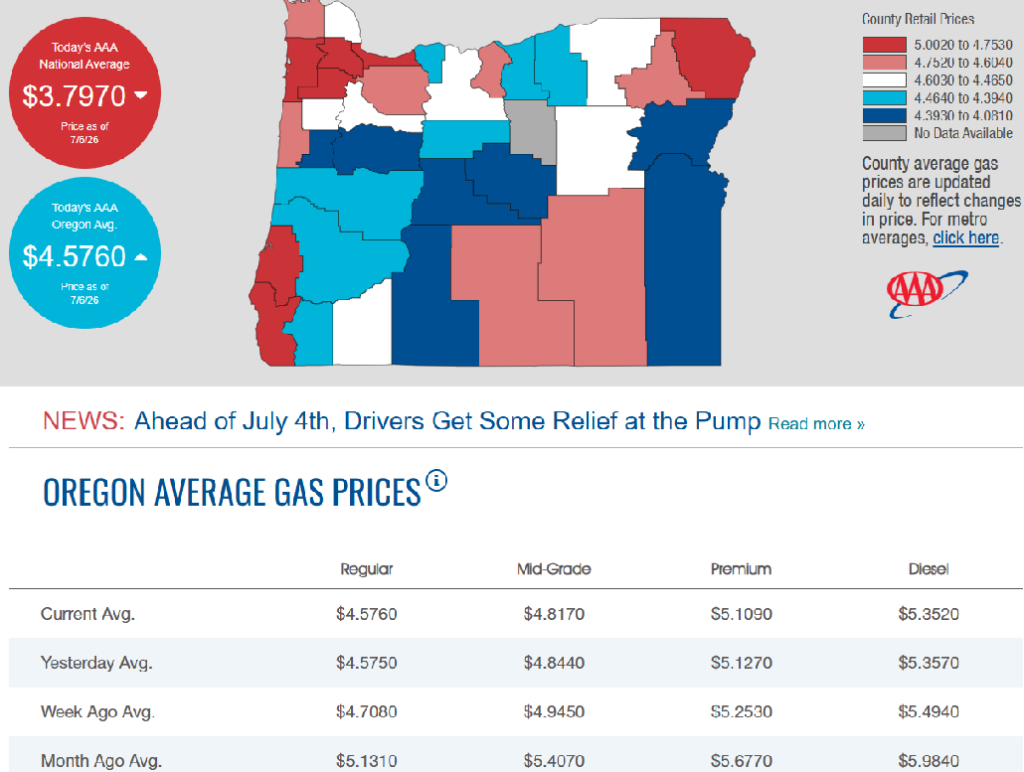
7/6/2026 — Gas Prices in Oregon Today
Police have accused eight people of criminal charges in connection with a brush fire sparked by fireworks in Lincoln City on July Fourth

The Lincoln City Police Department didn’t give an exact time for when the fire started near the 1600 block of SW Coast Avenue, but said in a statement that it began sometime before 10 p.m., and that officers found probable cause to accuse the suspects of criminal charges around 11 p.m. REEL: https://www.facebook.com/reel/1017609657581000
Oregon Foundations, Les Schwab Tire Centers Partner to Provide At Least $1 Million in Wildfire Preparedness Support for Rural Communities
Tires and quick-response grants going to rural fire services and the organizations working to prepare communities for wildfire season
– As Oregon heads into what is forecast to be a severe fire season, a coalition of philanthropic and business partners is helping rural fire services, government agencies and nonprofits to get ready and respond. Oregon Community Foundation, The Ford Family Foundation, the Marie Lamfrom Charitable Foundation and Les Schwab Tire Centers today announced a coordinated package of support totaling at least $1 million in grants, alongside a statewide tire donation program to strengthen rural fire agencies before fire season takes hold.
The initial commitment of at least $1 million from partner foundations and additional anonymous funders will provide quick-response grants to support the nonprofits working to prepare communities and responding when needed.
“Philanthropy doesn’t replace first responders — we work right behind them,” said Kim Koenig, OCF’s Director of Community Programs and Disaster Response.
“When a fire breaks out in a rural community, the volunteers who respond deserve equipment that works and a support system that can move quickly. We know from experience that the road to recovery after a disaster is longer than anyone wants — our Disaster Readiness and Response Fund is built to be there for the long haul, from preparation through the long period of rebuilding.”
Les Schwab Tires in-kind tire donation addresses critical need — Les Schwab Tires will donate $100,000 worth of tires from its Tires for Purpose program to Rangeland Fire Protection Associations statewide, addressing a critical and often overlooked need: fire truck tires are subject to extreme wear and heat stress during wildfire response, and replacing them is a significant operational expense for volunteer departments.
“We are excited to use our Tires for Purpose program to help make sure our Rangeland Fire Protection Associations are well equipped for safety on and off the road ahead of fire season,” said Bill Tester, Les Schwab store manager in Sandy, Oregon. “We’ve grown as a company to more than 600 stores across 15 states, but Oregon is our home. A safe and thriving Oregon matters to us. Our first responders deserve our support.”
The partners made the announcement at Gresham Fire Station #75 in Troutdale at the gateway to the Columbia River Gorge, the site of a massive wildfire in 2017.
Preparing first responders before disaster strikes — Oregon’s rural communities rely heavily on volunteer firefighters and local fire districts that operate with limited budgets and equipment. City departments like Gresham’s must be ready to fight wildfires in the places where rural and urban areas meet.
“Wildfires don’t wait until we’re ready,” said Mike Traeger, Assistant Chief of the Gresham Fire Department. “Every tire, every piece of equipment and every hour of training makes a difference when the call comes. Resources like these mean firefighters can respond faster, work more safely and stay on the fire line longer.”
The July 4 holiday weekend historically marks one of the most dangerous periods of fire season, with dry conditions, wind and human activity combining to heighten risk across the state. Add to that this year’s drought, a record-tying warm winter and low snowpack, and officials are deeply concerned about the coming fire season.
“This year is shaping up to be a bad fire year,” said John Bailey, Professor of Silviculture and Wildland Fire at the Oregon State University College of Forestry. “We can act now to prevent destructive wildfires, and that’s why this investment is so important.”
Supporting communities before, during and long after disaster — OCF’s Disaster Readiness and Response Fund brings donations starting at $25 from across the state into a single funding pool, enabling OCF to quickly deploy grants when disaster strikes. The fund supports emergency response as well as preparation — including fire mitigation, specialized equipment, training and emergency supplies — and long-term recovery.
The foundation partners are members of the Oregon Disaster Funders Network, a partnership of mission-driven organizations working to build a stronger and more resilient Oregon.
“The Marie Lamfrom Charitable Foundation is proud to stand alongside members of the Oregon Disaster Funders Network to support Oregon communities ahead of wildfire season,” said Meghan Campbell, Program Officer at the Marie Lamfrom Charitable Foundation. “Coordinated regional philanthropy has an important role to play in meeting urgent needs before and after disasters, and we are deeply grateful to the first responders who bravely care for and protect our communities.”
“Rural communities often face the greatest risks with the fewest resources, and the impacts of wildfire can last long after the flames are out,” said Kara Inae Carlisle, President and CEO of The Ford Family Foundation. “That’s why we’re coordinating with partners from the Oregon Disaster Funders Network to support rural communities as wildfire season approaches, so we can mobilize resources quickly and stand ready to respond.”
Apply for quick response funds. — Apply for tires. — Donate to the Disaster Readiness and Response Fund at OCF.
About Oregon Community Foundation — Oregon Community Foundation was founded in 1973 with a mission to improve the lives of all Oregonians through the power of philanthropy. In partnership with donors and volunteers, OCF works to strengthen communities in every county in Oregon through research, grantmaking and scholarships. Each year, OCF distributes more than $200 million in grants and scholarships. Individuals, families, businesses and organizations can work with OCF to create charitable funds to support causes important to them. To learn more, please visit oregoncf.org.
About Les Schwab Tire Centers — Les Schwab Tire Centers (www.lesschwab.com) started in 1952 with just one small tire shop in Prineville, Oregon. After more than 70 years of building on our founder’s belief in honesty, service and hard work, Les Schwab Tires is one of the leading independent tire dealers in the United States and the nation’s top-ranked tire retailer by Consumer Reports for 2026. Now, more than 9,000 employees in more than 600 locations across 15 states take pride in doing the right thing every day. That shows up in our unique tires–those we crafted specifically for the roads our customers drive on. It’s in the best tire warranty in America. It’s in how we stand behind the promise to do more for customers and communities, every step of the way.
To view the full 2026 ratings and learn more about this recommendation, visit: https://www.lesschwab.com/consumer-reports
About The Ford Family Foundation — The Ford Family Foundation believes in the power of rural communities. It is a private, nonprofit foundation proudly headquartered in Roseburg, Oregon, serving rural Oregon and Siskiyou County, California. Its investments through grants, scholarships and community building create the conditions so that children have the family, educational and community supports they need to succeed in life.
About Marie Lamfrom Charitable Foundation — The Marie Lamfrom Charitable Foundation honors the life and legacy of Marie Lamfrom by directing strategic philanthropic support — in education, community, arts, creativity, health, and well-being — to those who need it most in Oregon. Guided by values of authenticity, equity, and optimism, the Foundation partners with nonprofits to empower underserved communities, alleviate human suffering, and foster lasting, positive change across the region.
About Oregon Disaster Funders Network — Oregon Disaster Funders Network (ODFN) is a network of PNW grantmakers coordinating across and beyond the philanthropic sector to minimize the economic, social, and environmental impacts of disasters, especially on underserved populations and in disinvested communities. ODFN provides a single entry “starting point” platform for community needs, reaches disaster-impacted communities with resource navigation, and elevates funding requests, opportunities and obstacles to the Network’s 40+ grantmakers. ODFN shares resources, strengthens relationships and mobilizes funding. Learn more at OregonDisasterFundersNetwork.org
Oregon’s top public health official resigns
Oregon Health Authority director Dr. Sejal Hathi will step down effective Aug. 1 — Oregon’s top public health official is stepping down from her role after two and a half years.

Dr. Sejal Hathi, who joined the Oregon Health Authority in January 2024, will leave Aug. 1 to focus on family and personal priorities, the governor’s office announced Thursday.
Hathi, who earns $265,488 per year, joined the Oregon Health Authority after serving as New Jersey’s deputy commissioner for public health services. She previously served as the White House’s senior policy for public health under the Biden administration.
As the state searches for a new director, Gov. Tina Kotek will appoint Fariborz Pakseresht to serve as interim director beginning July 6 to help the agency during the leadership transition. Pakseresht worked for the state of Oregon for 35 years, retiring in the fall after serving as the director of the Oregon Department of Human Services for eight years.
“Oregon remains steadfast in our commitment to expanding access to care, advancing health equity, and strengthening the systems that serve our communities,” Kotek said in a statement. “I am grateful to Dr. Hathi for her service, and I appreciate Fariborz Pakseresht for stepping in to support this critical work as we recruit for a permanent director.”
The Oregon Health Authority is one of the largest state agencies, with a $41.5 billion budget during the 2025-27 budget cycle. The agency oversees programs addressing behavioral health, improving healthcare access and providing Medicaid coverage to more than one in three Oregonians.
New services available statewide for early learning providers to ensure children stay in care
– The Oregon Department of Early Learning and Care (DELC) announces that Every Child Belongs(ECB) services are available statewide to licensed child learning and care providers.

Every Child Belongs, which was created in 2021 through House Bill 2166, supports early childhood educators in building nurturing and responsive environments to ensure children can stay in care. These supportive services align with a new state law created by Senate Bill 236 that takes effect July 1, 2026, which prohibits suspensions and expulsions in early learning settings.
“These laws are an opportunity to build an early learning culture where every child thrives, every family belongs, and every provider has the support they need,” said Alyssa Chatterjee, DELC Director. “We know that early interventions have the greatest impact, yet providers often tell us they struggle to access the resources they need when children in their care are facing challenges. With Every Child Belongs expanding its support statewide, early childhood educators have more help than ever to create safe, caring environments where young children can learn, grow, and succeed.”
Every Child Belongs services launched in 2025 as a pilot in three regions: Washington County, Marion, Polk, and Yamhill Counties, and Central Oregon (Deschutes, Crook and Jefferson Counties), providing strength-based strategies to early learning professionals. DELC worked with system partners to improve with each phase. The final three regions came online in March to complete full statewide coverage in all 15 regions.
“Every Child Belongs is already making a positive difference in Central Oregon,” said Karen Prow, Child Care Resources Director, NeighborImpact. “Early educators across our region are working hard to support children with increasingly complex social and emotional needs, and this program gives providers the training, tools, and confidence to respond effectively. When we invest in growing the skillset of educators, that knowledge stays with them for life—and benefits every child who walks through their door.”
Workers Can Use Paid Leave Oregon to Care for Loved Ones with Alzheimer’s
— During Alzheimer’s & Brain Awareness Month, Paid Leave Oregon is reminding workers they may qualify for paid family leave when they need time away from work to care for a loved one with Alzheimer’s disease.
Alzheimer’s and dementia affect thousands of Oregon families. About 79,000 Oregonians age 65 and older are living with Alzheimer’s, and 188,000 family caregivers provide an estimated 291 million hours of unpaid care across the state each year.
“Caring for a loved one with Alzheimer’s means going to appointments, helping with daily needs, or stepping in when a care plan suddenly changes,” said Andrew R. Stolfi, director of the Oregon Employment Department. “Paid Leave Oregon helps ensure workers do not have to choose between a paycheck and being there for a loved one who needs care.”
Paid Leave Oregon provides paid time off for eligible workers who need to care for a family member with a serious health condition. Alzheimer’s disease is specifically named in Oregon’s administrative rules as an example of a condition that may involve permanent or long-term incapacity. Eligibility depends on the worker, the need for leave, and verification from a health care provider.
“Paid Leave Oregon recognizes that caregiving is not one-size-fits-all,” said Juan Serratos, director of Paid Leave Oregon. “For some families, care may mean taking full weeks away from work. For others, it may mean taking a day at a time for appointments, safety needs, or changes in care. As the disease progresses, care needs change. Paid Leave is designed to help eligible workers take the time they need when a serious health condition affects someone they love.”
Under Oregon’s rules, care can include physical assistance with basic medical, daily living, safety, or nutritional needs; transportation to a health care provider; comfort or reassurance; administrative tasks; or arranging changes in care.
Workers can take Paid Leave in full weeks or one day at a time, allowing Oregonians to tailor their leave to their loved one’s needs. Paid Leave Oregon’s definition of family member includes many relationships, including spouses and domestic partners, children, parents, siblings, grandparents, grandchildren, and any person connected to the worker like a family member.
Workers who think they may need leave should inform their employer, gather documentation from a health care provider, and apply through Frances Online.
To learn more or apply, visit paidleave.oregon.gov.
About Paid Leave Oregon — Paid Leave Oregon provides temporary, paid time away from work so employees can have financial security when experiencing significant life events. Covered events include welcoming a new child, recovering from a serious health condition, caring for a family member with a serious health condition, or addressing issues related to sexual assault, domestic violence, stalking, or harassment. Paid leave benefits help Oregonians stay connected to their jobs and maintain financial stability during these major personal events. Learn more at paidleave.oregon.gov.
The Oregon Employment Department (OED) is an equal opportunity agency. OED provides free help so you can use our services. Some examples are sign language and spoken language interpreters, written materials in other languages, large print, audio, and other formats. To get help, please call 503-947-1444. TTY users call 711. You can also send an email to communications@employ.oregon.gov.
El Departamento de Empleo de Oregon (OED) es una agencia de igualdad de oportunidades. El OED proporciona ayuda gratuita para que usted pueda utilizar nuestros servicios. Algunos ejemplos son intérpretes de lengua de señas e idiomas hablados, materiales escritos en otros idiomas, letra grande, audio y otros formatos. Para obtener ayuda, por favor llame al 503-947-1444. Usuarios de TTY pueden llamar al 711. También puede enviar un correo electrónico a communications@employ.oregon.gov.
Enjoy outdoors, avoid bites: OHA shares summer mosquito prevention reminder
Simple steps can reduce risk of serious mosquito-borne illnesses
—As mosquito activity increases during the summer months, Oregon Health Authority (OHA) is reminding residents and visitors to take precautions against mosquito bites and reduce exposure to West Nile virus, the most common mosquito-borne disease in the state.
Mosquitoes carrying West Nile virus are detected in Oregon every year, primarily in eastern and southern parts of the state, though infected mosquitoes have been found throughout the Pacific Northwest. Public health works closely with local vector control districts to identify areas where the virus is circulating in the mosquito population.
West Nile virus is primarily spread through the bite of an infected mosquito. The virus can infect humans, birds, horses and other animals. Mosquitoes become infected after feeding on infected birds and can then spread the virus through subsequent bites.
“Summer is a great time to enjoy Oregon’s outdoors, but it’s also the time of year when mosquito activity is at its highest,” said Emilio DeBess, D.V.M., public health veterinarian at OHA’s Public Health Division. “Most people infected with West Nile virus may not develop symptoms, but some can become seriously ill, especially those over 50. Taking a few simple precautions can significantly reduce your risk.”
About one in five people infected with West Nile virus develop a fever and flu-like illness that can include headache, body aches, joint pain, vomiting, diarrhea or rash. Adults 50 and older, people with weakened immune systems, and those with certain underlying health conditions are at greater risk for severe illness. In rare cases, the virus can cause severe neurological disease affecting the brain or nervous system.
People experiencing a high fever, severe headache, stiff neck, confusion, muscle weakness, tremors or paralysis should contact a health care provider right away.
Here are tips to reduce breeding sites at home:
- Eliminate standing water around potted plants.
- Empty water from buckets, birdbaths, pet dishes and other containers at least once or twice each week.
- Clean clogged gutters and drainage areas.
- Remove old tires, unused containers and outdoor debris that can collect water.
- Regularly inspect areas under decks and shrubs, and around outbuildings where water may accumulate.
Tips to protect yourself outdoors:
- Use an EPA-registered insect repellent and follow label instructions.
- Wear long-sleeved shirts, long pants and socks when mosquito activity is high.
- Consider limiting outdoor activities during dawn and dusk, when mosquitoes are most active.
- Use mosquito netting over infant carriers and strollers.
- Repair or install window and door screens to keep mosquitoes out of homes and buildings.
Additional information about West Nile virus, mosquito prevention and surveillance activities in Oregon is availableon OHA’s West Nile virus webpage.
Bat confirmed positive for rabies in Benton County

Public health officials from the State of Oregon and the Benton County Health Department have confirmed that a local bat has tested positive for rabies. This is the first positive bat for rabies in Benton County in 2026.
On June 15, Benton County’s Environmental Health program learned that a resident found a bat, which may have had contact with their domestic animals, on their property in Benton County. The resident brought the bat to the Oregon State Veterinary Diagnostic Laboratory for testing. On June 17, the bat was confirmed positive for the rabies virus.
“Rabies is present in the bat population and bats are the primary reservoir of rabies in wild animals for our area of the country,” said Robert Baker of Benton County Environmental Health. “Direct hand contact with bats should always be avoided if possible.”
— Bats play an important role in our ecosystem and are especially helpful to humans by eating a lot of insects considered pests. While most bats do not have rabies and people cannot get rabies from just seeing a bat or having contact with bat guano (feces), it is important not to take unnecessary risk. Infected bats can pass the rabies disease to humans and other animals by biting or scratching, or through saliva contact with eyes, nose, mouth or an open wound.
- Avoid all direct contact with bats, whenever possible.
- If you must handle a bat, use sturdy gloves and/or a tool, like a shovel
- If a bat bites someone, contact Benton County Environmental Health at 541-766-6835 within a 24-hour period. If you can, try to safely capture the bat so we can have it tested for rabies.
- Make sure your pets are vaccinated against rabies
“All pet owners should make certain that their dogs and cats are vaccinated against rabies. Protecting pets from rabies can provide a buffer zone of immune animals between humans and rabid wild animals such as bats,” said Emillio DeBess DVM of the Oregon Health Authority (OHA).
— Rabies is a viral disease that is preventable, but deadly if people don’t receive medical care before symptoms start. Rabies spreads primarily through bites or scratches from an infected animal.
Rabies symptoms in animals can include lethargy, walking in circles, and loss of muscular coordination, convulsions, irritability, aggressiveness, disorientation, excessive drooling and showing no fear of humans. Animals displaying these behaviors should not be approached or handled.
Contact Benton County Environmental Health at 541-766-6835 whenever there has been human or pet contact with bats or any animal that appears to be sick, injured or has bitten a human or pet.
More information about bats and rabies can be found on Benton County’s animal bites webpage, OHA’s rabies webpage, and the Centers for Disease Control’s (CDC) rabies webpage.
Benton County Health Department — The Benton County Health Department is committed to protecting the health and well-being of everyone who lives in, works in, or visits Benton County. The Benton County Health Department focuses on preventing health problems before they occur. Their programs strive to create community conditions that help reduce health disparities, so all people have an equal chance for a long and healthy life.
Wildlife Crossing Projects Gain Momentum Across Oregon

Every year, thousands of deer, elk, bear, and other wildlife attempt to cross busy roadways in search of food, water, and mates. Too often, those crossings end in tragedy for wildlife and sometimes for motorists.
Improving habitat connectivity is one of Oregon Wildlife Foundation’s conservation priorities. Proceeds from the sale and renewal of the Watch for Wildlife specialty license plate are allocated to habitat connectivity and wildlife passage projects throughout Oregon.
The Foundation also serves as the fiscal sponsor for multiple passage projects – providing fiscal administration and fundraising support to these initiatives throughout their development.
“Our participation in wildlife passage work began in 2017 with an undercrossing on Highway 97 in Central Oregon” said Tim Greseth, Executive Director of the Oregon Wildlife Foundation. “This experience deepened our understanding of the impact that wildlife-vehicle collisions are having on many different species and led us to adopt habitat connectivity as an organizational priority.”
Recent project milestones include:
Bend to Suttle Lake Wildlife Passage Initiative (Central Oregon)
This section of Highway 20 experiences the highest frequency of deer and elk collisions in Oregon. The Bend to Suttle Lake Wildlife Passage coalition has completed a Phase I wildlife crossing mitigation study and developed conceptual crossing designs for multiple locations along the corridor.
Following that work, four wildlife overcrossings were identified as the highest priorities for Phase II design and engineering. The coalition has raised more than $850,000 in non-federal matching funds in preparation for the Federal Highway Administration’s Wildlife Crossing Pilot Program, which is slated to open for applications sometime in July or August.
Wallowa County Wildlife Crossing Project (Northeast Oregon)
The Wallowa County Wildlife Crossing Coalition has completed a Phase I study of Highway 82 between Enterprise and Wallowa to determine priority crossing locations and develop conceptual designs to reduce wildlife-vehicle collisions and improve habitat connectivity within this high-risk corridor.
Interstate 84 Wildlife Crossing Project (Northeast Oregon)
Interstate 84 is an almost permanent barrier to wildlife movement. The focus of this project is the completion of a wildlife crossing study and conceptual design for the highest priority locations on I-84 between Pendleton and La Grande. The funding needed to begin this project has been raised, marking an important step in its development.
Wanaket Wildlife Area Wildlife Crossing Project (Northeast Oregon)
In partnership with the Confederated Tribes of the Umatilla, Oregon Wildlife Foundation is providing funding support and serving as the fiscal sponsor for a wildlife crossing study on the Wanaket Wildlife area, which is located along the Columbia River, just east of McNary in northeast Oregon. The wildlife area is bisected by Highway 730 and the incidence of vehicle strikes is high within this section of road.
Assessing Existing Bridges and Culverts Across Oregon (Statewide)
Oregon Wildlife Foundation has retained a consulting team to evaluate existing bridges and culverts throughout Oregon that may already be in use by wildlife or, with modifications, can be improved or made ready for wildlife to use – all in service of keeping animals off busy roads by providing them with safe alternatives.
The consulting team is evaluating existing conditions at culverts and bridges large enough to accommodate deer and elk, documenting evidence of wildlife activity, and recommending cost-effective modifications that may increase use by wildlife.
“Building new wildlife overcrossings and undercrossings can be expensive, so we’re enthusiastic for opportunities to provide safe passage for animals through simpler modifications to the areas around existing bridges and culverts wherever and whenever possible,” said Greseth.
To learn more about Oregon Wildlife Foundation’s wildlife crossing initiatives or to support this work through the Wildlife Movement and Migration fund, visit www.myOWF.org/wildlifemoves. Or donate directly viahttps://secure.givelively.org/donate/oregon-wildlife-foundation/wildlife-migration-and-movement-fund-formerly-known-as-watch-for-wildlife-fund
Check out Oregon State Parks with your library card
Borrow an Oregon State Parks parking permit for free at 82 libraries statewide.

– Oregon Parks and Recreation Department (ORPD) and the State Library of Oregon are partnering to offer free state parks parking permits to Oregon public libraries. There are currently 200 parking permits available at 82 libraries across the state.
“Oregon’s state parks are for everyone,” said OPRD deputy director JR Collier. “As we assess ways to manage our budget responsibly, we also want to uplift equitable access to our parks.”
Each participating library received up to four parking permits. These are the physical hang tags you check out from the library and put in your car. The permit covers parking in all Oregon State Parks day-use areas for one vehicle. Go to the Oregon State Parks website to find participating libraries. All you need to participate is your library card.
“Libraries help make life more affordable for Oregonians. This program leverages the existing borrowing system to help connects folks of all income levels with the beauty and splendor of Oregon’s State Parks,” said Wendy Cornelisen, State Librarian.
Both OPRD and the State Library contributed 100 parking permits to the program to distribute to libraries. The agencies determined how many passes each library would receive based on interest from the library, its proximity to a park charging a day use fee, and the size of the population it serves. The State Library purchased permits with Library Services and Technology Act funds from the federal Institute of Museum and Library Services.
OPRD first distributed parking permits to 28 libraries as part of a year-long pilot program starting in August 2024. Those passes were checked out more than 2,100 times. At the pilot’s conclusion, OPRD evaluated how to best move the program forward in the context of its changing fees. In 2027, OPRD and the State Library will continue to explore options for an expanded long-term program that will serve even more libraries and people in Oregon. Learn more about the OPRD Library Pass Program.
State regulators are seeking steep fee hikes on Oregon’s nascent psilocybin industry, a move that critics say would push the already high price tag of a legal mushroom trip even higher while causing more businesses to close.

The Oregon Health Authority in late June announced proposed fee increases that would affect virtually every corner of the industry, aiming to financially sustain the groundbreaking program. Among the biggest changes would be doubling annual license fees from $10,000 to $20,000 for psilocybin manufacturers and service centers where adults 21 and older take supervised trips.
The potential fee increases come after a wave of service center closures, raising doubts about the viability of Oregon’s legal psilocybin experiment that voters approved in 2020. The state has issued licenses to 39 service centers, about half of which have expired or been surrendered, according to state figures.
“I don’t think the industry can survive this,” said Ryan Reid, the co-founder and operations director of Bendable Therapy, a Bend-based service center. “I think (what) you’re going to see over the next couple years is a major contraction to where there’s just a few people surviving.”
Oregon’s psilocybin program is not supported by taxpayer money and is instead funded through fees, health authority spokesperson Erica Heartquist said in an email. Because revenue has not kept up with rising costs, she continued, “the only option is increasing fees” despite the program’s cost-saving efforts.
Heidi Pendergast, Oregon director of the Healing Advocacy Fund, which advocates for psilocybin access, called the proposed fee increases “unprecedented” and out of line with other licensing costs for the cannabis businesses and health-oriented professions.
An individual psilocybin session can cost between $850 and $3,000, which has meant clients have skewed white and wealthier. Pendergast said she anticipates clients would see higher costs from the fee increases, which would mostly take effect next year.
The uncertainty comes as psilocybin continues gaining acceptance as a mental health treatment and as the state has opened the door to integrating it with the medical system. Pendergast described the program as safe, noting that just a sliver of the estimated 22,000 people who have used legal psilocybin have reported adverse events since service centers opened in 2023.
“This program really deserves to be part of the behavioral health framework in this country,” she said.
One licensed lab — As the head of Rose City Laboratories, Daniel Huson oversees Oregon’s only licensed and accredited psilocybin testing laboratory.
Despite being a linchpin in the state’s psilocybin system, he said the $26,000 his lab made last year from compliance testing didn’t cover all of its costs, including the $10,000 annual licensing fee. Huson continued offering the testing because he’s passionate about how psilocybin can positively change people’s lives.
Regulators are seeking to double the annual laboratory licensing fee starting January 2029, later than the other hikes.
Since the lab began testing psilocybin in 2023, Huson said he’s increased the cost of a compliance test from $250 to $600, which he expects to rise further. Without a regulatory change of course, he said the industry may not be viable over the next two years and his lab will stop offering psilocybin testing in 2029, potentially leaving the state without a psilocybin testing lab.
“There’s no incentive to be a testing laboratory because it’s expensive,” he said. “And they’re going to be in trouble.”
No more discounts — The proposed changes would also eliminate reduced fees for nonprofits, veterans and low-income people. Currently, each pays half the annual fee for a manufacturer or service center license. If regulators’ proposed changes take effect, those license holders would see their licensing fees quadruple to $20,000.
Nearly a third of Oregon’s roughly 400 psilocybin-related licenses qualify for a reduced fee, according to the health authority’s Heartquist.
As a nonprofit service center, Bendable Therapy is focused on accessibility over its margins, said Reid, one of its co-founders. The elimination of reduced fees, he said, would mean increased costs for clients and less money for scholarships to make its services more affordable.
“This is a tight industry, and we’ve done a good job surviving,” he said. “But this is just going to make it that much harder and just really increase the costs and reduce access for our customers.”
Facilitators, who guide clients through psilocybin sessions, would see their annual licensing fees double to $4,000 — with discounts for veterans and low-income applicants eliminated. They typically work part-time as contractors.
Reid said his center will subsidize the licensing costs of the centers’ six facilitators. Plus, regulators’ changes would increase the cost of a permit needed to work in a center from $25 to $200. In total, he expects licensing costs to increase by as much as $50,000.
Campaign promise — The ballot initiative campaign that legalized psilocybin in Oregon promised to make the life-altering substance safe, accessible and affordable — without ongoing costs to taxpayers after a startup period.
However, a health authority budget document states the industry’s slow growth has meant it hasn’t generated enough license fees to cover the program’s cost. The authority blamed local restrictions on psilocybin-related businesses, as well as challenges getting banking and insurance for an industry centered on a federally illegal drug. It also blamed unexpected administrative costs.
Pendergast, of the Healing Advocacy Fund, said it’s common for new programs to require additional funding before they are self-sustaining and called for more budget transparency before the fees increase.
“This is really a matter of how we are right-sizing regulation for this program,” she said.
Dr. Eric Lee started Space Psychedelic Clinic in 2024 on what he called a “shoestring” budget in “not a gorgeous location” in Portland that allows him to charge $925 for an individual session. He expects to weather the fee increase and plans to move into a larger building to accommodate demand.
But he doesn’t think other centers will survive and wants other states considering legal psilocybin to take note of what’s happening in Oregon.
“There is a vast segment of the population that will just never be able to use legal psychedelics because of the price point,” he said, adding, “I don’t think people want that from this law, and I think it’s a huge part of why the business is failing.” (SOURCE: https://oregoncapitalchronicle.com/2026/07/06/i-dont-think-the-industry-can-survive-this-oregon-regulators-propose-steep-psilocybin-fee-hikes/ )
Work Share gives Oregon employers an alternative to layoffs
— Oregon employers considering layoffs can turn to the Oregon Employment Department’s Work Share program to reduce short-term costs and retain skilled employees. When business slows down, participating employers can reduce staff hours but continue to support their employees with partial Unemployment Insurance (UI) benefits to help offset reduced wages.
“Work Share gives employers of all sizes the opportunity to strategize, not downsize,” OED Director Andrew R. Stolfi said. “When times are tough, it offers more options to reduce staffing costs, and that flexibility is a critical tool in any industry. Work Share keeps valuable teams together and helps businesses ramp back up quickly when conditions improve.”
The program protects employees from many of the hardships of a full layoff, including keeping benefits intact despite work hours dropping below full-time. Unlike traditional Unemployment Insurance, Work Share does not require claimants to search for jobs while receiving benefits, but they must remain fully able and available to work for their employer each week.
“Being a specialty surgical practice, we have many ups and downs, and Work Share has helped us avoid multiple layoffs,” said Chelsea Brown of Portland-based Oregon Weight Loss Surgery. “Most of our staff have been here for 10 years or more, so they’re critical to our business. Work Share has helped us keep all of them.”
There are currently more than 500 employers enrolled. To be eligible, employers must have at least three employees who are paid Oregon wages; however, seasonal and temporary workers may not participate. There are no program fees and no obligation to use the program after signing up for Work Share.
“We recommend applying proactively so employers have a plan in place if they need it,” Unemployment Insurance Division Director Lindsi Leahy said. “When business is slow, being able to access the program’s benefits quickly can bring some peace of mind. We want all Oregon employers to know that Work Share is here to provide a viable alternative to layoffs.”
OED hosts a weekly Work Share informational webinar for employers at 10 a.m. on Tuesdays, or employers can call 503-947-1800 to ask questions or schedule a consultation. Once signed up, employers and claimants can also attend weekly webinars for guidance on navigating the program. More information is available on the Work Share website.
About Unemployment Insurance — Oregon’s Unemployment Insurance Program supports people and communities when facing economic uncertainty. For those who are unemployed through no fault of their own, the temporary, partial wage replacement offers financial security while seeking new work. Funded by employer payroll taxes, benefit payments also soften the local economic shock caused by layoffs and help keep skilled workers in their communities. Learn more at unemployment.oregon.gov.
Webinar series to honor 36 years of disability civil rights kicks off July 7
— The public is invited to a series of free webinars featuring conversations with disabilities advocates and experts who will share the latest information on disability supports, emergency management systems and digital accessibility.
Topics by date are:
- July 7: Exploring Cross-Disability Experiences and Support Needs
- July 14: Building Inclusive and Accessible Emergency Management Systems
- July 21: ADA: How Far We’ve Come and What Comes Next
- July 28: Understanding the Department of Justice’s (DOJ) Ruling on Digital Accessibility
The free weekly webinar series is being hosted by Oregon Disabilities Commission (ODC), Oregon Department of Human Services, Northwest ADA Center and Disability Rights Oregon in recognition and celebration of the 36th anniversary of the Americans with Disabilities Act (ADA).
“As we reflect on the legacy of the Americans with Disabilities Act, we’re also looking closely at the work ahead such as understanding diverse experiences and support needs, strengthening inclusive and accessible systems, and advancing digital accessibility,” said Mark King, Chair of ODC. “We’re grateful to our co-hosts for joining us in presenting this series, which helps us continue educating and advocating for equity, independence and full participation for people with disabilities.”
The series will take place on Tuesdays throughout July, from 11:30 a.m. to 1 p.m. Pacific Time, beginning July 7. The sessions are open to the public, and registration is now available through the event webpage on Zoom.
The series will be accessible to people with disabilities and will be translated into Spanish. Captioning and American Sign Language interpretation will also be provided. For questions about accessibility for the webinar series, or to request an accommodation, contact OregonDisabilities.Commission@odhsoha.oregon.gov.
More information about the series, including presenter biographies, will be shared on the Oregon Department of Human Services ADA event webpage.
About the Oregon Disabilities Commission: The Oregon Disabilities Commission is charged by state statute to advise the Oregon Department of Human Services, the Governor, the Legislative Assembly and appropriate state agency administrators on issues related to achieving the full economic, social, legal and political equity of individuals with disabilities. ODC also acts as a coordinating link between and among public and private organizations serving individuals with disabilities.
Need to meet SNAP work rules? Free Oregon program helps people build skills and find jobs

More than half of participants who complete Oregon’s SNAP Employment and Training program are employed shortly afterward.
Salem, Ore. — More than half of SNAP participants who complete Oregon’s SNAP Employment and Training (STEP) program are employed shortly afterward, according to data reported to the U.S. Department of Agriculture Food and Nutrition Administration.
The Oregon Department of Human Services (ODHS) is highlighting the success of these services as more Oregonians seek support navigating federal changes to Supplemental Nutrition Assistance Program (SNAP) work or activity rules.
“Employment and training services can help people achieve more than compliance with a requirement,” said Jessica Amaya Hoffman, Oregon SNAP Director. “They help people build skills, connect with employers and create opportunities that can support them long after they leave SNAP.”
Before connecting with WorkSource Oregon, Isla was facing uncertainty after becoming unemployed while caring for a family member. She had long dreamed of continuing her education but wasn’t sure how she would make it happen. Through the SNAP Employment and Training (STEP) program, she received support, guidance and resources that helped her move forward. Today, she is continuing her education and working toward her goal of starting her own business.
“It has always been a dream of mine to better myself and show my kids you can always go to school and educate yourself no matter the age,” said Isla. “My plans for the future are to have my own company and a great job of my choosing.”
Stories like Isla’s are common among participants in Oregon’s STEP program. According to USDA Food and Nutrition Administration data, 57% of Oregon STEP participants are employed shortly after completing the program, one of the highest rates in the nation.
The STEP program connects SNAP participants with free employment and training services through partnerships between ODHS, STEP providers, the Oregon Employment Department, local workforce development boards and other community organizations throughout Oregon.
Services may include:
- Career coaching and employment planning
- Resume development and interview preparation
- Education and training opportunities
- Job search assistance
- Connections to local employers
- Help addressing barriers that can make it hard to find work or complete training
Many participants use these services to gain new skills, complete training programs, increase earnings or enter a new field.
Federal changes to SNAP work rules have increased the number of Oregonians who may need to meet work or activity rules to maintain food benefits. Employment and training services can help participants meet those requirements while building skills that support long-term employment success.
ODHS is also encouraging people to contact the ODHS ABAWD team (1-833-947-1694 or SNAP.ABAWDTeam@odhsoha.oregon.gov) if they have questions about SNAP work or activity rules. Some people may qualify for an exemption and not realize it. Others may benefit from employment and training services that can help them maintain benefits while working toward their career goals. ODHS provides the referral for people to access these supports.
Since January 2026, more than 25,600 people have lost benefits because they didn’t meet work or activity rules.
“If you think SNAP work or activity rules may apply to you, your best next step is to contact ODHS,” said Hoffman. “We can help you understand your options and connect you with services that support your goals.”
For more information about SNAP work rules and exemptions:
- English: Oregon.gov/snapworkrules
- Spanish: Oregon.gov/snapnormastrabajo
ODHS ABAWD Team:
- Call: 1-833-947-1694
- Email: ABAWDTeam@odhsoha.oregon.gov
For more information about SNAP benefits:
- Online: oregon.gov
- Call the ONE Customer Service Center: 1-800-699-9075
- In person or by phone: at any ODHS office
Weekend Train Rides Return to the Oregon Rail Heritage Center for the 2026 Season

PORTLAND, Ore. — The Oregon Rail Heritage Center is excited to announce the return of its popular weekend train rides. Running every Saturday and Sunday through October 11, 2026, these family-friendly excursions offer passengers a memorable rail adventure through the heart of Portland aboard historic diesel locomotive BNSF 3613.
About Oregon Rail Heritage Center:
The Oregon Rail Heritage Center (ORHC) provides for the preservation, operation and public enjoyment of Portland’s historic locomotives, railroad equipment, and artifacts, and educates the public about Oregon’s rich and diverse railroad history. ORHC is open to the public on Thursdays-Sundays from 1:00pm-5:00pm. Seasonal train excursions are offered most weekends. For additional information, visit https://orhf.org/. Follow us on Facebook and Instagram.
BLM Brings Oregon Folklife Programming to National Historic Oregon Trail Interpretive Center
BAKER CITY, Ore. – The Bureau of Land Management invites the public to explore Oregon’s living cultural traditions through a new interpretive folklife series at the National Historic Oregon Trail Interpretive Center beginning this week.
The series aligns with America’s 250th anniversary by highlighting the people, traditions, and cultural knowledge that have shaped the nation over time. Visitors can experience firsthand how traditional arts connect past and present while supporting the BLM’s mission.
From April through October, visitors will have interactive opportunities that represent Native American, ranching, and rural lifeways. Presentations will take place daily at 11 a.m., 1 p.m., and 3 p.m. Pacific Time, offering deeper insight into each artist’s craft and cultural background.
July 9-11, Cheryl Newhouse, spinner and weaver from Richland
August 13-15, Mildred Quaempts, dentalium artist from the Confederated Tribes of Umatilla
September 24-26, Clair Kehrberg, saddle and gear maker and leatherworker from John Day
October 15-17, Katie Harris Murphy and Mary Harris, regalia and beadwork artists from the Wallowa Band Nimiipuu, Cayuse, Umatilla, and Karuk Tribes
“This interpretive outreach brings people face-to-face with the traditions that continue to shape communities across Oregon,” said Robert Reis, acting manager for the Interpretive Center. “These demonstrations create a meaningful connection to the past through the skills and knowledge that are still practiced today.”
This series is designed to build long-term, high-quality cultural programming at the Interpretive Center, ensuring visitors can engage with authentic traditions and perspectives for years to come.
The National Historic Oregon Trail Interpretive Center is located at 22267 Highway 86 in Baker City and is open daily from 10 a.m. to 5 p.m. PT. Admission fees apply. For more information, visit the National Historic Oregon Trail Interpretive Center website or call 541-523-1843.
Oregon Department of Veterans’ Affairs
No veteran should be without a place to call home, and the Oregon Department of Veterans’ Affairs is committed to ending veteran homelessness in our state. The new ODVA Houseless Veterans Program collaborates with federal, state, county, and Tribal agencies, veteran services offices, and community homeless service providers to meet the urgent and unique needs of Oregon’s diverse veteran communities challenged with housing stability. In addition to advocating for Oregon veterans experiencing or at risk for houselessness, the program provides direct service to veterans and their families seeking federal and state veterans’ benefits, including access to local VA health care, documentation of service, as well as other available state benefits, and local homeless services organizations and low-income assistance programs. If you or a veteran you know is dealing with homelessness, contact the ODVA Houseless Veterans Coordinator today at houselessvets@odva.oregon.gov or visit https://ow.ly/V4EH50VnL93 to learn more.
Staying Informed During a Communications Outage: Best Practices for the Public
Disasters can damage critical infrastructure, leading to temporary outages in cell service, internet, and power. When communication systems go down, it’s vital to be prepared with alternate ways to get emergency information and stay connected. Here’s how you can prepare and respond:
Have a Battery-Powered or Hand-Crank Emergency Weather Radio
- Why it matters: Emergency radios can receive Emergency Alert System (EAS) broadcasts via AM/FM or NOAA Weather Radio frequencies—even when cell towers and the internet are down.
- Note: Emergency radios do not receive Wireless Emergency Alerts (WEA) like cell phones do. Tip: Pre-tune your radio to your local emergency broadcast station (e.g., OPB in Oregon or NOAA frequencies).
Turn On WEA Alerts on Your Phone
- Make sure Wireless Emergency Alerts (WEA) are enabled in your phone’s settings. These alerts include evacuation orders, severe weather warnings, and other urgent notifications.
- WEA messages are sent through cell towers—if cell service is out, WEA alerts will not be delivered. This is why having backup methods like a radio is essential.
Charge Everything in Advance and Have Backup Power
- Charge phones, power banks, laptops, and rechargeable flashlights before fire weather conditions worsen.
- Consider solar-powered chargers or car chargers as backups.
- If you are sheltering in place, a generator (solar or gas powered) is helpful.
Know Your Evacuation Routes in Advance
- Save printed or downloaded evacuation maps in case you can’t access GPS or navigation apps.
- Most mapping services (like Google Maps or Apple Maps) offer the ability to “Make maps available offline.” Download your area in advance so you can navigate even if cell towers or internet access are down.
- When in doubt, call 511 or visit the TripCheck.com website if you have cell service.
- Don’t wait for a notification—if you feel unsafe, evacuate early.
Print or Write Down Critical Contacts and Info
- Phone numbers of family, neighbors, and local emergency contacts.
- Address of evacuation shelters, veterinary services (for pets/livestock), and medical facilities.
- Your own emergency plan, including meeting locations.
- Have copies of vital documents in your go-bag and take video of your property (inside and out) for insurance claims later.
If Calling 9-1-1 Over Wi-Fi or Satellite, Check Your Location Settings
If you call 9-1-1 using Wi-Fi calling or a satellite-connected phone (like an iPhone or Android), your location might not be automatically visible to dispatch. Instead, it may rely on the emergency address saved in your phone’s settings.
- Update this emergency address when you travel or relocate—especially in evacuation zones or rural areas.
- Most importantly, always tell the dispatcher exactly where you are—include your address, landmarks, road names, or mile markers to help first responders reach you quickly.
Sign Up for Alerts Before There’s an Outage
- Register for OR-Alert and your county’s local alert system.
- Follow your local emergency management officials’ and bookmark resources like: wildfire.oregon.gov.
Prepare for Alert Delays or Gaps
- Know the three levels of evacuation:
- Level 1 – Be Ready
- Level 2 – Be Set
- Level 3 – GO NOW
- If you hear a siren, see a neighbor evacuating, or witness fire behavior increasing—take action even if you haven’t received an alert.
Be Your Own Info Network
- Check on neighbors, especially seniors or those with disabilities.
- Post printed signs with updates for those passing by.
In rural areas, community bulletin boards or fire stations may serve as local information points. Support and Restoration in Progress To help maintain emergency communications during this incident, OEM deployed eight Starlink terminals under the guidance of ESF 2 and the Statewide Interoperability Coordinator (SWIC). A Communications Technician (Jeff Perkins) was also deployed to assess connectivity needs on the ground. These Starlink terminals have been providing service to the Lake County Emergency Operations Center (EOC), Oregon State Police (OSP), Warner Creek Correctional Facility, and will soon support the town of Lakeview, the Bureau of Land Management (BLM), and the Lakeview Ranger Station. OEM’s Regional Coordinator (Stacey) is also on-site supporting the Lake County EOC. Coordination has been strong across local, state, and private sector partners. *** Update: As of 7/10/25 at 1:47 PM, fiber service has been restored.
Reconnect When Service Returns
- Once communications are restored, check official websites:
- Oregon.gov/oem
- Your county emergency management page
- TripCheck.com for road conditions
- Share verified info—not rumors—on social media or community pages.
Prepare for Delays in Restoration
- Communication may come back in phases. Damage to fiber lines or cell towers can take time to repair.
- Continue using backup methods and stay alert for updates via radio or in-person notices.
Final Tip:
In an emergency, CALL 9-1-1 to report life-threatening danger, not for general information. Use local non-emergency numbers or go to physical information points if needed. You can find more tips for preparing in OEM’s Be2Weeks Ready toolkit.
Oregon’s Missing Persons
Many times you’ll see postings without case numbers or police contact. There is rarely a nefarious reason why (the nefarious ones are pretty obvious). Usually the loved one tried to call to report their missing person and they are either refused or told to wait a day or two by people who are unaware of SB 351 and the laws that they are bound to when answering the phone. Many people don’t bother calling LE if their loved one is homeless or in transition because they believe LE won’t care. The biggest myth is the 24 hour rule.
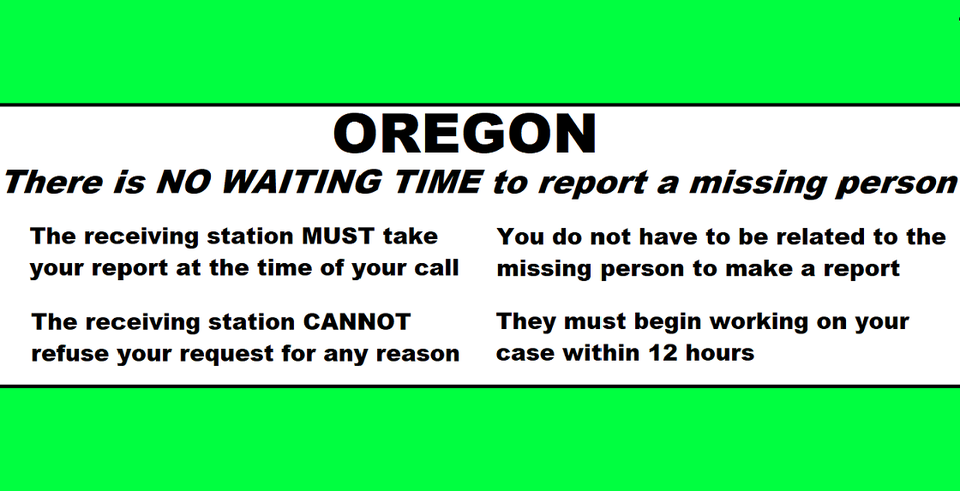
In Oregon we don’t have those rules and an officer or person answering the phone is not allowed to decide. The law decides. We have Senate Bill 351 and it states that the police CANNOT refuse a request for any reason and they must begin working on it within 12 hours. The person making the report does not have to be related to missing person either. Here is SB 351 written by families of the missing here in Oregon in conjunction with Oregon law enforcement officers. This should be common knowledge, please make it this way. https://olis.oregonlegislature.gov/…/SB351/Introduced
Find the mental health support you need

Click to see all resources https://oregonhealthnews.oregon.gov/find-the-mental-health-support-you-need/?utm_medium=email&utm_source=govdelivery

 Oregon State Police are reminding parents and students of the SafeOregon hotline. It takes reports of potential threats against students and schools. The tips can be made anonymously. They can include safety threats, fights, drugs, weapons on campus, cyberbullying and students considering self-harm or suicide. A technician reviews the reports and assigns them either to police or school administrators. Tips can be made by phone, text, email or on the website https://www.safeoregon.com
  Call us at 5 41-363-7503 Or email us at Info@RogueValleyMagazine.com