
The latest news stories of interest in the Rogue Valley and the state of Oregon from the digital home of Southern Oregon, Wynne Broadcasting’s RogueValleyMagazine.com
Wednesday, August 19, 2026
Rogue Valley Weather

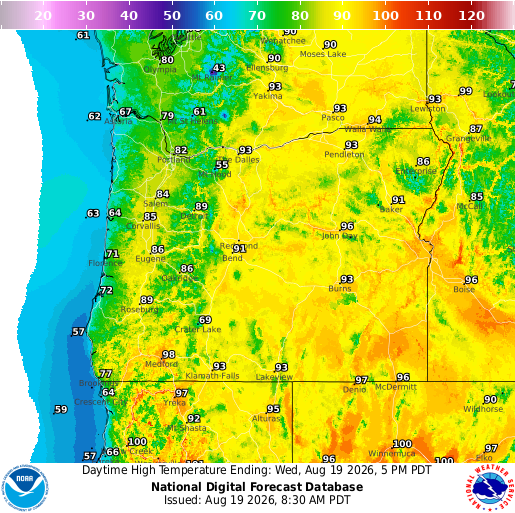
https://graphical.weather.gov/sectors/oregon.php
 https://graphical.weather.gov/sectors/oregon.php
Industrial Fire Precaution Level (IFPL) 3 is now in effect on lands protected by the Oregon Department of Forestry’s Southwest Oregon District in Jackson and Josephine counties. The Fire Danger Level remains at Extreme.

Under IFPL Level 3:
The following activities are prohibited between 1:00 p.m. and 8:00 p.m.:
- Power saws at loading sites
- Loading or hauling of any product or material
- Blasting
- Welding, cutting or grinding of metal
- Any other spark-emitting operation not specifically mentioned
The following operations may only operate between 8:00 p.m. and 1:00 p.m., provided mechanized equipment capable of constructing fireline is immediately available:
- Ground-based logging operations
- Power saws on ground-based operations
- Rotary head saw feller-bunchers with a continuous Firewatch
- Non-rotary head saw feller-bunchers
- Tethered logging systems
- Cable yarding systems are prohibited at all times, except for limited exceptions outlined in the IFPL 3 Closedown Order.
- The Firewatch requirement is reduced from a minimum of three hours to two hours during breaks and at the end of the operating period.
For more information about fire season restrictions, visit www.swofire.com or follow ODF Southwest Oregon District on Facebook.
Please pay close attention to the conditions across the state. The National Weather Service has issued Red Flag Warnings and Fire Weather Watches for a large portion of the Oregon
The National Weather Service issued a red flag wildfire warning. Forecasters issue a red flag warning when weather conditions pose an increased threat of rapidly spreading wildfire.
It’s extremely dry. Our ask: prevent sparking a wildfire. Check your tow chains. Don’t mow tall dry grass in the heat of the day Don’t park on tall dry grass
We’ve got prevention tips posted to our website to share with your friends and family. LEARN MORE: https://www.oregon.gov/…/pages/prevent-wildfires.aspx
 Emergency Alerts: https://member.everbridge.net/76864345342052/login Know Your Zone: https://protect.genasys.com/search Emergency Kits: https://rvem.org/Get-Ready-Rogue/Kit-Types WatchDuty: https://app.watchduty.org/
🚨 Fielder Mountain Fire
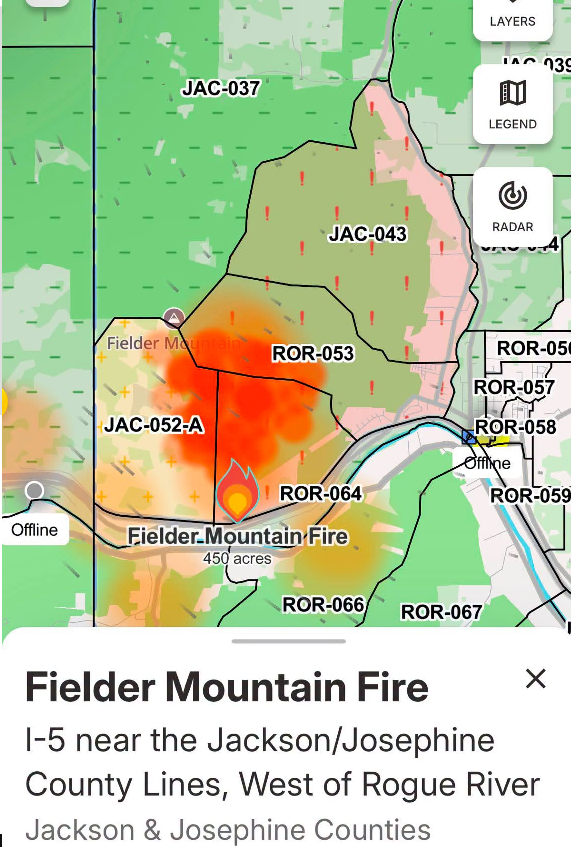
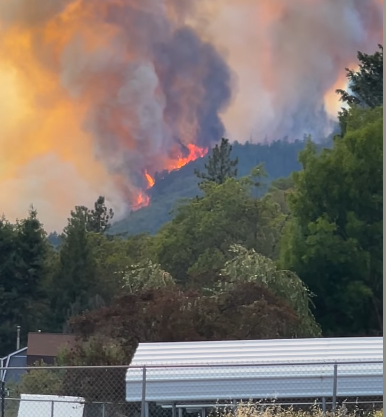
Location: Near Interstate 5, between Grants Pass and Rogue River (Southern Oregon).
𝗙𝗶𝗿𝗲𝗳𝗶𝗴𝗵𝘁𝗶𝗻𝗴 E𝗳𝗳𝗼𝗿𝘁𝘀 H𝗲𝗹𝗽 I𝗻𝗰𝗿𝗲𝗮𝘀𝗲 C𝗼𝗻𝘁𝗮𝗶𝗻𝗺𝗲𝗻𝘁 𝗼𝗻 𝗙𝗶𝗲𝗹𝗱𝗲𝗿 𝗠𝗼𝘂𝗻𝘁𝗮𝗶𝗻 𝗙𝗶𝗿𝗲
ROGUE RIVER, Ore. – Overnight, crews at the Fielder Mountain Fire, west of Rogue River, focused on mop-up operations along the fire’s perimeter. Near structures, firefighters have extended mop-up efforts to 300 feet and continue to monitor these locations to ensure no residual heat flares up and threatens homes. In other areas, mop-up has progressed 50 feet into the interior with the goal for today to keep that momentum going by strengthening the fire line and working deeper into the burned areas.
As containment increases, crews are beginning to shift from night to day operations, while others are being released to rest and recover for future assignments. The safety and well-being of firefighters remains a primary focus, supported by consistent access to care and meals. Resources from the fire are ready to respond quickly, supporting local agencies if new fires occur. Firefighters during night shift used thermal imaging cameras and Unmanned Aircraft Systems (UAS) equipped with infra-red technology to identify areas of heat that cannot always be seen during the day, allowing firefighters to pinpoint hotspots that require attention to secure the fire line as mop-up efforts continue.
Today, firefighters will continue work to extinguish these areas of heat.Rugged terrain in the northern part of the fire and poor road access are limiting water delivery for mop-up activities. Helicopters are continuing to provide support by filling up portable tanks for hose lays, ensuring enough water for a thorough mop-up. Even with the challenge of steep slopes, rolling rocks, and falling trees, fire line crews are progressing well into the interior of the fire. Firefighters remain on high alert for any spotting outside the perimeter and are working to take down dangerous snags to create a safer working environment for firefighters.
Evacuation levels were reduced on Saturday as crews continued progress strengthening control lines around the fire; visit https://readyjacksonco.com/…/emergency-information-hub… for current evacuation information. Livestock assistance is still available by calling (541) 864-0546. Road closures around the fire have been lifted, however, fire personnel are still working in the area; please be aware and drive carefully if you need to be in the area.
Conditions are expected to warm up today as temperatures climb into the low 90s, with low humidity levels and light winds increasing in the late afternoon. Evacuations: Evacuations have been issued by the Jackson County Sheriff’s Office and Emergency Management. Up-to-date evacuations are available here: https://readyjacksonco.com/…/emergency-information-hub…Find your evacuation zone here: https://protect.genasys.com/enRoad/Land Closures: All road closures around the fire have been lifted. All road closure information is available on https://tripcheck.com/
Smoke Impacts: Smoke from the Fielder Mountain Fire may settle into valleys and other low-lying areas, reducing visibility and impacting air quality in nearby communities. Individuals sensitive to smoke should take appropriate precautions. For current air quality information and smoke forecasts, visit: https://fire.airnow.gov/Temporary Flight Restriction
(TFR): A “TFR” is in place for the fire area daily (24 hours) until further notice. Complete information is available at https://tfr.faa.gov/tfr3/?page=detail_6_5072 Flying a drone near or around a wildfire is illegal, compromises the safety of both pilots and firefighters, and interferes with firefighting efforts.
Cause: The fire started on Thursday, August 13 shortly after 3 p.m. Initial reports indicated tires on a semi-truck were on fire and flames had spread to nearby vegetation; the official cause remains under investigation.
—- All evacuation levels for the Fielder Mountain Fire west of Rogue River are canceled, the Jackson County Sheriff’s Office said Monday morning.
The Fielder Mountain Fire near Rogue River, that started on Thursday August 13, has been authorized to use federal funds to help with firefighting costs.
Oregon Department of Human Services – Many Oregonians may qualify for SNAP work or activity rule exemptions without realizing it

Could you qualify for an exemption to SNAP work or activity rules? Contact us so we can talk about your situation and your options! Common reasons people might qualify include:- You’re pregnant.- You’re physically or mentally unable to work.- You’re already working enough hours to meet the requirement.- You’re participating in a qualifying education or training program.- You have moved to an exempt county or waived Tribal land.- You are responsible for caring for a child or another person, depending on their circumstances.
Learn more about exemptions in this news release: https://apps.oregon.gov/…/many-oregonians-may-qualify…Or visit https://oregon.gov/snapworkrules to find information about SNAP work rules and more.
SVU Detectives Arrest Medford Man on Rape, Sex Abuse of Teen Girl; Detectives Believe Suspect Has More Victims
JCSO Case 26-2783 MEDFORD, Ore. – Jackson County Sheriff’s Office (JCSO) Special Victims Unit (SVU) detectives arrested a Medford man this morning at a business in the 500 block of the Medford Center. The suspect, Evan James Sutherlin, 20, of Medford, is lodged in the Jackson County Jail. He is charged with first-degree rape, third-degree sexual abuse, and first-degree encouraging child sexual abuse.

The case started June 2nd, 2026, when JCSO deputies responded to a report of a then 19-year-old man sexually abusing a 15-year-old girl in the Jacksonville area. From there, SVU detectives took over the investigation leading to his arrest.
As SVU detectives continue their investigation, they believe Sutherlin may have more victims. Anyone with information about the pictured suspect is asked to call SVU Detective Jill Wenzel at 541-770-8928.
ODF Southwest Oregon District – 𝗛𝗜𝗚𝗛𝗪𝗔𝗬 𝟲𝟲 𝗙𝗜𝗥𝗘:

Statewide hotline available for Oregonians affected by wildfires and smoke
People anywhere in Oregon who have been affected by wildfires or wildfire-related air quality can call 1-833-699-0554 24 hours a day, seven days a week.


The statewide hotline is available to people experiencing any wildfire-related impact, including those who:
- Lost a home or property
- Evacuated and have ongoing needs
- Are sheltering in place and have wildfire-related needs
- Are affected by wildfire smoke or poor air quality
- Have another need or concern caused by a wildfire
“During this difficult wildfire season, Oregonians impacted by fires deserve immediate and reliable access to the help they need,” said Governor Tina Kotek. “That’s why we’ve established a dedicated, 24/7 hotline – so that no Oregonian has to navigate this wildfire season alone or wonder where to turn to for help.”
The hotline is staffed by 211info. If a call is not answered, callers can leave a message and will receive a return call within one business day.
This hotline does not provide emergency evacuation assistance or help people locate immediate shelter. People who are in immediate danger, have a medical emergency, or need emergency help evacuating should call 911. People looking for information about shelters or other immediate resources can call 2-1-1. For current 211info operating hours, visit 211info.org.
People can also enter their contact information and describe their wildfire-related needs using the Oregon Wildfire Assistance web form. An ODHS staff member will review the information and follow up with them.
“This wildfire season is already affecting a growing number of Oregon Tribes and communities,” said Ed Flick, Director, ODHS Office of Resilience and Emergency Management. “Wildfires can affect people in many ways, even when their homes have not burned. We want people to know there is one place they can call to share what they are experiencing and learn what resources may be available.”
In previous years the hotline has been used to connect people who lost homes in disasters with recovery support. This year, the Oregon Department of Human Services is expanding it to people experiencing a broader range of wildfire impacts.
ODHS has informally coordinated individual assistance following Oregon disasters since 2020. This year, Governor Tina Kotek directed ODHS to be ready to formally activate individual assistance when needed as the state prepares to establish a formal program in 2027 under House Bill 4121.
211info and ODHS will work with local communities to connect people with existing programs and local resources. If those resources are not enough to meet the level of need, ODHS will work with state leaders to identify additional support and funding options.
The hotline does not guarantee financial assistance or eligibility for a particular program. Staff will listen to each caller’s experience, document their needs and help identify available resources and next steps.
Hotline information
- Call: 1-833-699-0554
- Available: 24 hours a day, seven days a week
- Missed calls: Leave a message and your call will be returned within one business day
- Shelter and other immediate resource questions: call 211
- Emergencies or emergency evacuation help: call 911
Grants Pass Police Arrest Two Suspects For Serious Assault
On Saturday, August 15, 2026, shortly after 3:30 a.m., Grants Pass Police received a report of a physical fight involving several people in the 800 block of NE A Street. Grants Pass Police officers responded to the area to investigate. Officers learned that two victims had sustained injuries after being struck with a crowbar and were requesting medical assistance. Grants Pass Police detectives were called to the scene to assist with the investigation.
During the initial response, officers developed probable cause to arrest two Grants Pass residents: Samantha Fillmore (30) and Jeremy Whelchel (45). Fillmore was taken into custody without incident. Whelchel was believed to be hiding in a nearby apartment. Officers maintained containment of the apartment until a search warrant was obtained and executed several hours later.
Upon serving the warrant, officers located Whelchel inside the residence and took him into custody. Both Fillmore and Whelchel were lodged at the Josephine County Jail on charges of Assault II, Assault III, and Unlawful Use of a Weapon.
City of Talent We want to hear from you! 


 Take the Community Input Survey: www.research.net/r/RecReady2026
ACCESS  𝗧𝗵𝗶𝗻𝗸𝗶𝗻𝗴 𝗮𝗯𝗼𝘂𝘁 𝗯𝘂𝘆𝗶𝗻𝗴 𝗮 𝗵𝗼𝗺𝗲? 𝗧𝗵𝗲𝗿𝗲 𝗮𝗿𝗲 𝘀𝘁𝗶𝗹𝗹 𝘀𝗽𝗼𝘁𝘀 𝗮𝘃𝗮𝗶𝗹𝗮𝗯𝗹𝗲 𝗶𝗻 𝗼𝘂𝗿 𝗘𝗻𝗴𝗹𝗶𝘀𝗵 𝗔𝗡𝗗 𝗦𝗽𝗮𝗻𝗶𝘀𝗵 𝗛𝗼𝗺𝗲𝗯𝘂𝘆𝗲𝗿 𝗘𝗱𝘂𝗰𝗮𝘁𝗶𝗼𝗻 𝗰𝗼𝘂𝗿𝘀𝗲𝘀, 𝘀𝘁𝗮𝗿𝘁𝗶𝗻𝗴 𝗶𝗻 𝗦𝗲𝗽𝘁𝗲𝗺𝗯𝗲𝗿!

 The basics of mortgage financing and how to qualify for a loan that fits your needs
 Down payment and closing assistance programs for first-time homebuyers
 What to expect throughout the homebuying process and how to manage the costs ¿𝗘𝘀𝘁á 𝗽𝗲𝗻𝘀𝗮𝗻𝗱𝗼 𝗲𝗻 𝗰𝗼𝗺𝗽𝗿𝗮𝗿 𝘂𝗻𝗮 𝗰𝗮𝘀𝗮? ¡𝗧𝗼𝗱𝗮𝘃í𝗮 𝗵𝗮𝘆 𝗲𝘀𝗽𝗮𝗰𝗶𝗼𝘀 𝗱𝗶𝘀𝗽𝗼𝗻𝗶𝗯𝗹𝗲𝘀 𝗲𝗻 𝗻𝘂𝗲𝘀𝘁𝗿𝗼𝘀 𝗰𝘂𝗿𝘀𝗼𝘀 𝗱𝗲 𝗘𝗱𝘂𝗰𝗮𝗰𝗶ó𝗻 𝗽𝗮𝗿𝗮 𝗖𝗼𝗺𝗽𝗿𝗮𝗱𝗼𝗿𝗲𝘀 𝗱𝗲 𝗩𝗶𝘃𝗶𝗲𝗻𝗱𝗮 𝗲𝗻 𝗶𝗻𝗴𝗹é𝘀 𝗬 𝗲𝘀𝗽𝗮ñ𝗼𝗹, 𝗾𝘂𝗲 𝗰𝗼𝗺𝗶𝗲𝗻𝘇𝗮𝗻 𝗲𝗻 𝘀𝗲𝗽𝘁𝗶𝗲𝗺𝗯𝗿𝗲! Los conceptos básicos del financiamiento hipotecario y cómo calificar para un préstamo que se adapte a sus necesidades Programas de asistencia para el pago inicial y los costos de cierre para compradores de vivienda por primera vez Qué esperar durante el proceso de compra de una vivienda y cómo administrar los costos
Jackson County Fire District 3 Applications are now open for Entry-Level and Experienced Firefighters!


City of Grants Pass Movies in the Park. Rally the family and head to this free community event happening Fridays throughout August.


Josephine County Sheriff’s Office – FLOCK Contract Cancellation
The Josephine County Sheriff’s Office has been in contract with an Automated License Plate Reader (ALPR) company named FLOCK. A contract for 10 cameras was entered into to increase the ability to identify/locate stolen vehicles, wanted or missing subjects associated with a specific vehicle and in general enhance the ability to investigate crimes.
In recent months some of the equipment and technology has been targeted and vandalized. There has been a great deal of public concern over this technology and its potential infringement of Constitutional 4th Amendment rights. Many jurisdictions across the United States have run into the same situation of theft, damage and social concern resulting in numerous cancellations of contracts with FLOCK. Josephine County is no different. While the technology has been beneficial in solving crime and overall public safety, it is clear much of Josephine County is not ready or willing to accept the use of ALPR technology.
We at the Sheriff’s Office work for the public and we are listening to you. As a result, I have requested Josephine County Legal Counsel to send a “contract termination for convenience” letter to FLOCK. Effective immediately, FLOCK ALPRs are no longer activated in rural Josephine County and the contract with the Sheriff’s Office has ended. While some of the equipment is still in the field, it is not being used. It is unknown when FLOCK will remove their equipment at this time.
Thank you for your continued support of the Josephine County Sheriff’s Office. We will continue to “Protect with Courage and Serve with Compassion”.

The highly anticipated trial of Dani Marie Schofield in Jackson County will be presided over by retired Senior Judge Lorenzo Mejia, who has been out of the judiciary for three and a half years.
The case involving Schofield, a former nurse at Asante Rogue Regional Medical Center, faces 44 counts of second-degree assault.
Allegations against her include diverting prescribed fentanyl from patients and substituting it with tap water, which reportedly led to infections among those patients.
The trial, originally scheduled for September, was postponed at the request of Schofield’s defense team, and a new date has yet to be established. Additionally, District Attorney Patrick Green expressed his discontent with Presiding Judge David Hoppe’s decision to appoint Mejia in a letter sent last week.
𝗙𝗲𝗮𝘁𝘂𝗿𝗲𝗱 𝗙𝗼𝗼𝗱 𝗣𝗮𝗻𝘁𝗿𝘆: 𝗦𝗮𝗹𝘃𝗮𝘁𝗶𝗼𝗻 𝗔𝗿𝗺𝘆 𝗣𝗮𝗻𝘁𝗿𝘆 


Southern Oregon PBS Still on The Air Despite Federal Funding Loss

Rogue Valley Humane Society
Our Community Food Bank exists to help folks who need an extra helping hand during a difficult month to feed their pets. Our program has a limited budget and so we rely on generous members of our community to donate some of these goods to continue to help assist our community. In 2023 we fed an average of 700 pets a month!
This equates to approximately 70 – 40lb bags of food each month! Many pets have benefited from the community’s generosity, and we can’t thank you enough for your kindness.
CSO Case 24-4928 PROSPECT, Ore. – Jackson County Sheriff’s Office (JCSO) detectives and Search and Rescue (SAR) personnel continue to search for a woman missing out of Prospect, Ore. since September 2024.
Deenah Padgett, 69, was reported missing on Sunday, September 8, 2024. She was last seen camping in the Prospect area on September 4, 2024.
She is described as a white woman with brownish-red, partially gray hair, standing 4’8” tall and weighing 90-100 lbs. JCSO detectives and SAR personnel have searched the area extensively and are looking for the public’s help. If you see Deenah or know her whereabouts, immediately call ECSO Dispatch at (541) 776-7206 and reference case 24-4928.
If you have any information that might help the investigation, call Detective Friend at (541) 864-8774.
The Jackson County Sheriff’s Office (JCSO) is asking for help identifying the owner a motorhome. It could be associated with a missing person from the Prospect area. JCSO says 68-year-old Deenah Padgett has been missing since August 30 from Prospect, described as a white woman, 4’ 8” tall, weighing approximately 95 pounds with brownish red/greying hair. JCSO issued an advisory this weekend asking anyone with information about the owner of the pictured motor home or Padgett’s whereabouts to call Emergency Communications of Southern Oregon (ECSO) dispatch non-emergency phone number at 541-776-7206.
David Grubbs’ Murder Investigation Remains Active
The Ashland Police Department’s investigation into the murder of David Grubbs on November 19, 2011 remains open and active. Recently two new detectives have been assigned to look into new leads that have come in.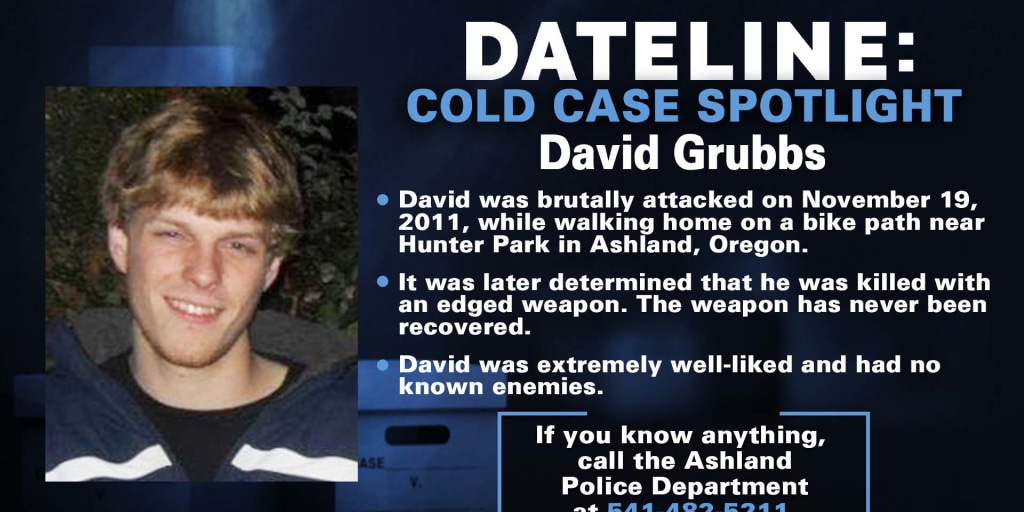 This case remains important to David’s family, the community, and the Ashland Police Department. As detectives continue to pursue these new leads, anyone with additional information is encouraged to reach out to the Ashland Police Department at 541-488-2211. The reward for information leading to an arrest on this case remains at over $21,000.
Taking Another Look at What Happened to Fauna Frey
Fauna was grieving the recent death of her brother, Dallas, when she set off from Eugene in June of 2020 heading to Grants Pass on what her family believes was both a healing trip and a mission to deliver gifts, silver coins inherited from Dallas, to a few friends. But somewhere between motel check-ins and checkouts, something went terribly wrong. Her Jeep was found months later. She was never seen again. http://bit.ly/4l63Dle

We will start resharing podcasts and articles. For starters here is a story from Danielle Denham that appeared in the June 29, 2025 edition of That Oregon Life. Ms Denham worked closely with us to insure that the facts she presented were accurate. Check out the nine episodes of the podcast Nowhere to be Found, a comprehensive, in-depth, sensitive treatment of the details surrounding Fauna’s disappearance. Hear from Fauna’s father, John, and her friends. Posted in spring of 2022, Amanda Popineau shares Fauna’s journey and the mystery that surrounds it. Go to Nowhere to be Found Season Two: Episode One “Under A Half-Moon.”
https://podcasts.apple.com/kg/podcast/s2e1-under-a-halfmoon/id1532686678?i=1000512098162
We want to remind people that Fauna’s father is offering a reward for information that brings Fauna home. Please if you have any information no matter how big or small let us know by calling the anonymous tip line or emailing. Tipline- 541-359-5638 Email – Helpfindfaunafrey@gmail.com FOLLOW on FACEBOOK GROUP: https://www.facebook.com/groups/341658526970132
Have Information on Fauna Frey? Please Speak Up!
If you know anything, no matter how small, please contact:
- Josephine County Sheriff’s Office
- Tip line: (541) 359-5638
- Email: FindFaunaFrey@gmail.com
Currrently there is a $50,000 CASH REWARD for information leading to the location of Fauna Frey. LARGE CASH REWARDS are being offered for any other relevant information, such as any objects that could be identified as Fauna’s, i.e. her wallet, keys, or Indian/Buffalo .999 silver bullion coins. Find Fauna Frey Facebook Group: https://www.facebook.com/groups/341658526970132
You can find food in your community at this link
Our network of food banks and pantries provides free food and groceries across Oregon. No proof of income or documentation required.
https://www.oregonfoodbank.org/
If you can’t make it to a food location, someone else can pick up food for you.You will just need to print and fill out the Authorized Representative form at https://lnkd.in/dsskUpkQ, and have them take it with them to the food sites. You can find step-by-step instructions at https://lnkd.in/dVBRxn-A.
Worried about recent changes or losing assistance?
Here are resources that can help: 211Info: Dial 2-1-1 or visit the211Info food webpagefor information and referrals to more than 1,500 food resources across Oregon. Oregon Food Bank: Use the Oregon Food Bank’s Food Finder Map to find over 100 food pantries, free food markets or hot meal programs near you. Aging and Disability Resource Connection of Oregon (ADRC): Call 855-673-2372 or visit theADRC food webpage to find local meal programs and food boxes in your area.

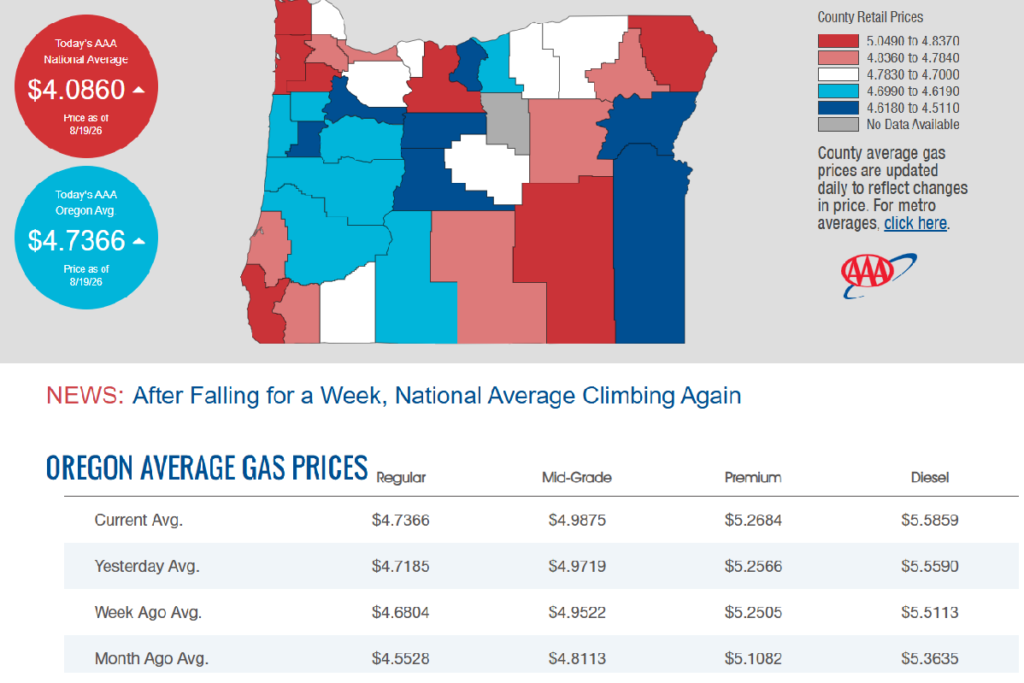
8/19/2026 — Gas Prices in Oregon Today

 PACIFIC NORTHWEST WILDFIRE UPDATE
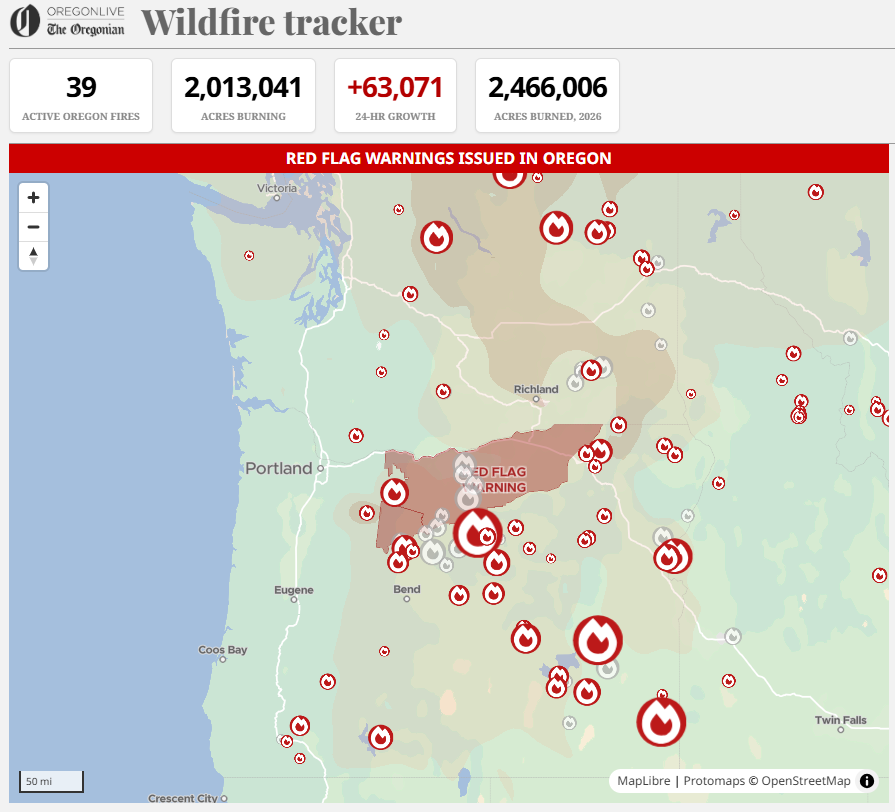
As of today, August 19, 2026, Oregon‘s catastrophic wildfire season has now scorched an unprecedented 2.63 million acres, which is nearly four times the state’s 10-year annual average. The Pacific Northwest remains the most active fire region in the United States, with crews battling intense conditions fueled by hot temperatures, gusty winds, and low humidity.
A Red Flag Warning is currently in effect for the Columbia River Gorge, Lower Columbia River Basin, and the eastern slopes of the Cascades.
Major Fire Status & Containment Updates
- Grasshopper Fire: Located east of Mount Hood in Wasco County, this remains one of the state’s most active and threatening fires. It has grown to 91,415 acres and firefighters have successfully brought containment up to 49%.
- Rowe Creek Complex: This massive incident southwest of Fossil in Wheeler County stands at 373,784 acres and is 89% contained.
- Hagen Fire: Located in the Umatilla National Forest, this fire has consumed 57,678 acres and is only 19% contained as dry conditions persist.
- Shingle Fire: Burning across Crook, Grant, and Wheeler counties, it spans 73,183 acres and is 91% contained.
- Bench Fire: Active in Jefferson County near Warm Springs, this fire is holding at 67,079 acres and is 90% contained.
- Rosenbaum & Bologna Fires: Firefighters have made steady progress mopping up and cooling hot spots, aiming to transition management back to local resources by Friday.
Active Evacuation Alert AreasDue to the volatile conditions, county sheriffs maintain fluid evacuation orders. Level 3 (“Go Now”) and Level 2 (“Be Set”) alerts are actively managed across several counties. To view real-time, pin-point evacuation maps for your specific zone, you should check the official emergency channels:
- Central & Eastern Oregon: Follow the Wasco County Sheriff, Crook County Sheriff, and Umatilla County Sheriff pages.
- Clackamas County: Check updates via the Clackamas County Sheriff.
Air Quality AlertsSmoke from these massive blazes continues to blanket much of central and eastern Oregon. You can monitor your highly localized breathing conditions and smoke forecasts using the official AirNow Fire and Smoke Map.
For real-time evacuation zones, check the local county sheriff’s pages, monitor highway updates via TripCheck, or view the interactive tracking tools via The Oregonian Wildfire Tracker.
🗺️ Critical Resources for Evacuations & Travel — Because fire behavior, road closures, and air quality fluctuate rapidly, residents should utilize official tracking platforms before traveling:
- Evacuation Maps: Check real-time statuses using Oregon’s RAPTOR tracking map or local county sheriff’s pages.
- Road Closures: View live traffic adjustments and highway conditions on TripCheck.
- Smoke Updates: Track local pollution and breathing safety recommendations via the Oregon Smoke Information Blog.
New Oregon survey for businesses facing wildfire losses could inform disaster assistance
Oregon officials are urging business owners who have closed their businesses, seen reduced customers and revenue or discovered physical damage due to ongoing wildfires to help inform future federal financial assistance efforts through a new survey.

(Photo courtesy of Oregon Department of Forestry)
The Oregon Department of Emergency Management announced the survey in a recent press release for businesses experiencing physical damage or economic losses from wildfires or wildfire smoke. State officials can use the information to make a stronger case for additional disaster funding, according to the agency.
Completing the survey doesn’t guarantee assistance, but the findings will document economic impacts to businesses and “help determine” whether areas of the state qualify for the U.S. Small Business Administration’s Economic Injury Disaster Loans.
The federal program offers funds to ensure businesses can continue offering health care benefits, pay rent and utilities and make debt payments, and businesses have a year to start repaying the loans, according to the federal agency’s website. Qualifying organizations must face “substantial economic injury” and include most private nonprofits, small agricultural cooperatives, and small businesses.
“As wildfires and prolonged smoke affect communities across Oregon, impacts can extend well beyond areas directly touched by fire,” state emergency officials said in the press release. “Businesses may experience physical damage, closures, reduced customers, canceled events or activities, lost revenue, or other disruptions associated with wildfire and smoke conditions.”
The federal government has offered such assistance in Oregon before. The U.S. Small Business Administration in June announced that it would offer the loans to Oregon businesses, nonprofits and residents affected by straight-line winds, flooding, severe storms, landslides and mudslides during December. That assistance also included physical disaster loans for up to $2 million and came in response to a request for assistance from Oregon Gov. Tina Kotek days earlier. (SOURCE) Oregonians interested in completing the survey can visit this link for the survey in English, and this link for the survey in Spanish.
The Picture Rock Fire grew to more than 1,600 acres after breaking out Sunday near Picture Rock Pass in Lake County

A rapidly growing wildfire in south-central Oregon broke out Sunday and quickly grew beyond 1,600 acres.
The Picture Rock fire is forcing Level 3 (go now) evacuation orders along Oregon 31 between Silver Lake and Summer Lake — an area home to ancient Native American petroglyphs.
While the exact locations of the historic petroglyphs are withheld from the public to protect the sites, they are scattered throughout the area between the two lakes, known as Picture Rock Pass. According to the Bureau of Land Management, some of the ancient rock carvings are located just 100 feet from the highway. State emergency maps show the fire burning up to the west side of Oregon 31 in the Picture Rock area.
The blaze is in Lake County, which has emerged relatively unscathed compared with neighboring counties where hundreds of thousands of acres have burned this season. The Picture Rock fire marks the county’s first major blaze of what has become a historic wildfire season across Oregon.
Fire crews enlisted the support of 16 aircraft and dozens of engines and water tenders Monday, helping bring the blaze to 10% containment.
Because the fire is burning in a largely remote area, the Level 3 (go now) evacuation zone is not believed to include any residents or structures. Level 2 (be set) orders are estimated to affect 24 residents and numerous structures, while Level 1 (be ready) orders are in place for more than 150 residents and 80 structures.Watch
The Picture Rock Pass Petroglyphs Site was added to the National Register of Historic Places in 1975 for its significance to the region’s prehistoric art and history. Federal records list A.D. 1000-1499 as the site’s period of significance, though some experts believe portions of the rock art could be considerably older.
Picture Rock Pass lies within a region with deep ties to Northern Paiute and Klamath-Modoc peoples, though the people who created the ancient carvings have not been definitively identified.
The BLM did not respond to multiple requests for comment Tuesday about whether the fire had damaged or threatened the historic artwork.
Footage shared by Silver Lake Fire & Rescue showed a rare fire whirl — sometimes called a “firenado” — forming Monday afternoon, with a tall, dark column of rotating smoke rising from the fire. https://mrf.lu/2RFkK
Dozer Operator Killed While Fighting Wrights Spring Fire Honored
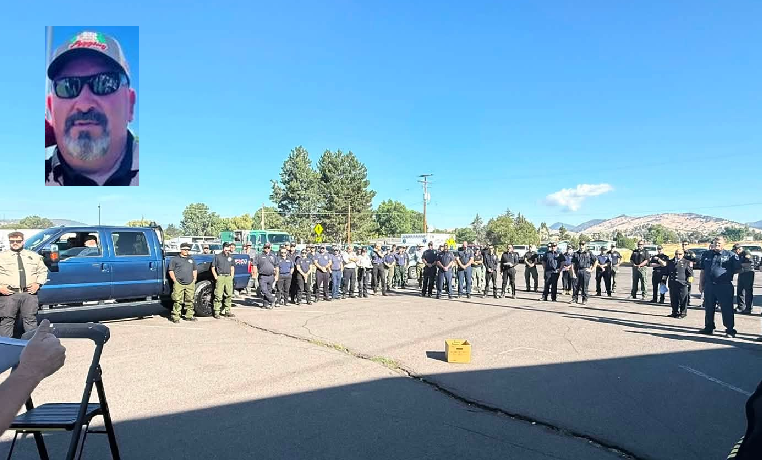
The Honor Guard service for dozer operator Jason Ensign was held on Saturday, August 15th.
Flags at all Oregon public institutions were lowered Friday in honor of Jason Ensign, the dozer operator who died in the Wright Springs Fire.
An honor guard service was held for Jason Ensign, a 47-year-old dozer operator who died while battling the Wrights Spring Fire.
A GoFundMe has been started for Jason’s daughter. Click here to visit.
Wrights Spring Fire Update August 19, 2026
Website: https://inciweb.wildfire.gov/inciden…/orfwf-wrights-springEmail: 2026.wrightsspring@firenet.gov Phone: 541-712-4438Social Media, Evacuation and Closure Information: https://linktr.ee/2026.wrightsspring Smoke Outlook: https://outlooks.wildlandfiresmoke.net/outlook/6c74f4c6

Acres: 54,131 | Containment: 55% | Detection: 08/05/2026 | Cause: Undetermined Personnel: 982 | Location: 2 miles west of Sprague River, Oregon
Last night we experienced another drone incursion on the fire. Unauthorized drone incursions over the Wrights Spring Fire are prohibited under the active Temporary Flight Restriction. If you fly, our firefighting aircraft cannot fly, stalling critical water drops and putting crews at extreme risk.
Northwest Team 8 will be timing out on August 20, 2026 and Northwest Team 7 is mobilizing to the fire to assume command on August 21, 2026. Crews achieved solid gains yesterday on the Wrights Spring Fire, focusing their efforts on bolstering control lines and opening up better access routes across the fire ground.
To optimize efforts, personnel and equipment are being relocated from the Chiloquin spike camp to the Bliss Road Incident Command Post. Night shift crews worked on line improvement on the North end of the fire in the Saddle Mountain area and on the East edge from Skeen Ranch Road down to Bliss Road. On the southwest side of the fire crews worked on mop up from Welsh Spring to Swan Lake Point.
Today on the north portion of the fire, crews will continue to work on ensuring that the controlled portions of the fire remain in their current footprint and mop up any hot spots. On the southeast side of the fire, crews will be working on increasing containment down around Horton Rim and Horton Reservoir. Resources will continue working along the southwestern flank of the fire today with heavy machinery and ground crews on track to complete direct fire line. To ensure safe access to these active areas, specialized crews will be working inside the black to fell dangerous, burned-out trees and clear blocked access roads.
Yesterday we experienced a half-acre fire north of the Wrights Spring Fire. Resources were mobilized from the fire to deal with the human caused fire. This is a stark reminder of the continued extreme fire danger we are operating under. Please do everything you can to protect our lands, firefighters, cultural resources and communities from wildfires. It only takes one spark to cause an accidental fire.
Evacuations: Multiple levels of evacuation are in effect, however, evacuation levels have decreased over much of the area. Klamath County evacuation zones and levels can be found at: https://protect.genasys.com/…/42.403038%2C-121.471546… Shelter Locations: For people (okay to bring small animals): Red Cross emergency shelter is open at Chiloquin Elementary School, 548 S 2nd Ave in Chiloquin. Red Cross emergency shelter is now open at Living Springs Fellowship, 31897 Mission St. in Bonanza. For large animals only: Contact Maria Meister, Southern Oregon Emergency Aid (SOEA), at 831-235-3031, to shelter large animal(s) at the livestock area of the Klamath County Fairgrounds. Road Closures: Bliss Road is closed, from Petersteiner Road to Sprague River.
Areas around Wrights Spring Fire are experiencing high volumes of fire traffic and ongoing suppression activity. Firefighter safety remains the top priority and the public is asked to avoid unnecessary travel to prevent congesting traffic. Forest Closures: The Fremont-Winema National Forest issued an Emergency Closure Order on August 09, 2026. https://www.fs.usda.gov/…/fire-area-emergency-closure
No Fly Zone: A Temporary Flight Restriction (TFR) over the area remains in effect. Flying drones near the fire is prohibited and can interfere with firefighting aircraft, potentially grounding aerial suppression operations. http://knowbeforeyoufly.org.
DONATIONS NEEDED FOR FIRE VICTIMS
The Klamath County Chamber of Commerce is asking the public for animal supplies and gas cards as the Klamath County Event Center and Fairgrounds houses 713 animals.
Grass hay, dog food, cat food, chicken feed and pig feed are some of the supplies being asked for as more animals are expected to arrive. Small food and water bowls, no matter the size, are also encouraged. Donations don’t need to be brand new and all donations will find a purpose.
Equipment like bungee cords and stackable wire cages are being asked for by the community for cages and security for animals. Gas cards are also being sought after as community members have been using their own vehicles and money toward assisting with animal evacuations and helping others.
As for food, donate to the Klamath Lake Food Bank. As for animal donations, the Chamber of Commerce asks those donating to enter the Klamath County Fairgrounds through Gate 3 on the Senior Center side. Donations will be available from 7 a.m. to 9 p.m. Gas card donations can be made at Ezell Suty Fuel, 2360 S. 6th Street.
Evacuations for people in need, are located at Chiloquin Elementary and Living Springs Church in Bonanza.
The Klamath Karavan is stepping up to help families affected by the Wright Spring Fire, and they need your help! Donations of bottled water, Powerade, Gatorade, light jackets, sweaters, socks, pet food—and lots of prayers are greatly appreciated. You can drop off donations at Starvn Marvn’s, 1822 Austin Street in Klamath Falls. Every donation, big or small, can make a difference for our neighbors who are going through a difficult time.
Wildfire smoke and evacuation threats can take a toll on mental health
Staying connected, taking breaks from the news and seeking support can help people cope during wildfire season
Wildfires can affect more than the air we breathe. The uncertainty of an approaching fire, evacuation warnings, disrupted routines, loss of property or community, and prolonged exposure to wildfire smoke can create stress, anxiety, grief and other emotional responses.
As wildfires and smoke continue to impact communities across Oregon, Oregon Health Authority (OHA) is reminding people that supporting mental health is an important part of wildfire preparedness and recovery.
“It’s completely understandable to feel uneasy when wildfires are threatening our communities or when smoke is affecting the air we breathe,” said Dean Sidelinger, M.D., M.S.Ed., OHA health officer and state epidemiologist. “These conditions can take a real toll on our physical and mental health. Taking care of ourselves, staying connected with others and knowing where to turn for support can help us cope during these difficult times.”
Wildfire stress can affect anyone.
People may experience a range of emotions during and after a wildfire, including fear, sadness, anger, grief, helplessness, trouble sleeping or difficulty concentrating. Children and teens may also have strong emotional reactions, even when they do not directly experience a fire or evacuation.
People who have experienced previous disasters or wildfire losses may find that a new fire or smoke event brings back difficult memories.
OHA recommends several ways people can support themselves and others:
Check in with neighbors, friends and coworkers – simple conversation can help people feel less alone. Reach out to people who may need additional support, including older adults, children, people with disabilities and those who may have difficulty evacuating or accessing resources.
Create space to express emotions — Give people permission to talk about what they are experiencing at their own pace and without judgment. This can be especially important for children and teens.
Encourage rest and recovery – Healing takes time. Maintaining routines when possible, getting enough rest and reconnecting with people and activities that bring comfort can help restore a sense of stability.
Take breaks from the news and social media – Staying informed is important during an emergency, but continuously monitoring wildfire coverage can increase stress and anxiety. Check trusted sources for updates, then give yourself permission to step away.
Prepare for evacuation – Having a plan can reduce some of the uncertainty that comes with a wildfire threat. Know your evacuation zone and routes, sign up for emergency alerts, keep important medications and documents accessible, and have a go-bag ready.
Protecting mental health during smoke events
People do not have to navigate the emotional effects of wildfire alone.
- 988 Suicide & Crisis Lifeline: Call or text 988 for free, confidential crisis support.
- Lines for Life: 800-923-HELP (4357) provides emotional support and help connecting with resources. Oregon’s wildfire recovery resources also direct people to Lines for Life for emotional support, with interpreters available.
- YouthLine: Young people can call 877-968-8491 or text teen2teen to 839863 for support.
- The AgriStress HelpLine is a free, 24/7 hotline for Oregon’s agricultural and forestry communities, including farmers, ranchers, fishermen, foresters, and their families. Call or text: (833) 897-2474. Helpline operators are trained to understand the unique stressors and situations of agriculture, forestry, and fishing. All calls are answered within 30 seconds.
People affected by a wildfire who need help finding food, shelter, health care, emotional support or other services can also connect with 211 for local resources.
Support for children and teens
Parents and caregivers can help children feel safer by providing reassurance, maintaining routines when possible and giving children opportunities to ask questions and express their feelings.
During a wildfire or evacuation, children may need additional reassurance and opportunities to reconnect with familiar people and routines. Adults can model healthy coping behaviors by taking breaks, getting rest, talking with others and asking for help when needed.
Additional resources:
- Wildfires and smoke: Oregon Health Authority wildfire resources
- Crisis and trauma resources: OHA Resources for Crisis and Trauma Response
- Wildfire recovery assistance: Oregon Department of Human Services – Get Help After a Wildfire
- Oregon wildfire preparedness and evacuation information: Oregon Department of Emergency Management
Oregon Health Authority · Emotional responses like fear, sadness, anger, or fatigue are natural and OK in the aftermath of a disaster.
However, if these feelings become prolonged, overwhelming, or begin to interfere with daily functioning, it may be a sign that someone needs additional mental health support.
It’s important to recognize when a normal reaction shifts into something more concerning.Being aware of this distinction can help individuals and communities respond with compassion and connect people to the help they need. If you need help, call or text the Disaster Distress Helpline at 800-985-5990.
Oregon state agencies remind everyone to be informed and prepared

— With the National Weather Service issuing a fire weather watchs across large portions of north‑central, northeast and southeast Oregon, the state’s public safety services, natural resource agencies, and tourism office want to remind residents and visitors to practice wildfire prevention, prepare their home and a go-bag for evacuation, and know where to go for real-time alerts and information.
According to the Northwest Interagency Coordination Center’s predictive services, each year the Pacific Northwest is at elevated risk of significant fires from now until October.
With fire crews responding to new fire starts every day, Oregonians and our visitors need to be prepared for wildfires, help prevent future ones, and be aware of up-to-date conditions as they travel across the state.
How can people help prevent wildfires?
The Oregon Department of Forestry is urging the public to actively practice wildfire prevention as the state continues to put out new fires every day. Additional human-caused fires on the landscape will draw the firefighting efforts away from the lightning-caused fires and put extra strain on ground and aviation resources, which are already spread thin. YOU can help prevent wildfires by:
- Checking and following your local fire regulations. The majority of the state is either in high or extreme fire danger right now, meaning even the smallest of sparks could start the next large wildfire.
- Debris burning may be prohibited where you live.
- Check local restrictions or contact your local ODF office.
- Return to check on your burn site if you burned earlier in the year.
- Make sure your car has been recently serviced to avoid faulty parts throwing sparks.
- Don’t drag tow chains.
- Avoid parking vehicles on tall, dry grass.
- Recreate responsibly. Where campfires are allowed, make sure your campfire is DEAD OUT before leaving it by drowning it with water, stirring it with a shovel and repeating that process until it is cold to the touch. If there is heat coming off it, there are still embers that could reignite.
Take Simple Steps to Protect Your Home from Wildfire
The Oregon State Fire Marshal reminds Oregonians that summer is not the safest time to tackle large landscaping or defensible space projects. Hot, dry conditions increase the risk of starting a fire from using tools or equipment. There are small, safe steps you can take now to reduce wildfire risk around your home. The Oregon State Fire Marshal encourages everyone to plan ahead and do light cleanup tasks that protect your property without increasing fire danger.
Easy tasks to reduce risk in the first five feet around your home:
- Clear leaves, pine needles, and other debris from your roof, gutters, and under decks.
- Trim plants and bushes that are touching your home or growing under roof eaves. Give trees and shrubs space from each other and from structures.
- Remove dead plants and wood mulch. Use nonflammable materials like rocks or gravel near your home. Avoid bark mulch or dry grasses right next to buildings.
- Move firewood, propane tanks, and other flammable items at least five feet away from your home.
- Cover attic vents, soffit vents, and spaces under decks with 1/8-inch metal mesh to block embers.
Avoid using power tools or equipment that could spark a fire, especially during the heat of the day. Summer is a good time to plan defensible space projects, so you’re ready to work safely once wildfire season ends.
For more tips or help with defensible space, visit www.oregondefensiblespace.org or https://preventwildfires.oregon.gov.
How can I prepare myself in case I need to evacuate?
The Oregon Department of Emergency Management (OEM) urges everyone to prepare for wildfires and other emergencies by knowing evacuation levels, staying informed, having a plan, and having a go-kit ready.
Evacuation Levels
- Oregon follows a three-level evacuation notification system, each structured around safety threat level.
- Oregonians should become familiar with “Be Ready, Be Set, Go!” evacuation levels to make informed decisions when receiving evacuation notices.
- OEM urges people to evacuate whenever they feel unsafe, conditions can change rapidly; individuals should always make the best decision for their safety.
- Following evacuation, people should not return to the area until public safety officials state it is safe.
Stay Informed
- Stay informed, sign up to receive evacuation at, ORAlert.gov remember to update information if need be.
- Find the websites for your county emergency management, sheriff’s office, or tribal police and follow them on social media.
- Check your phone settings to ensure wireless emergency alerts are turned on.
- Build redundancy into how you can access alerts. Have a personal C.E plan for what you will do if your cell phone stops working. A good place to start is a hand-cranked NOAA radio.
- If you use a third-party app for alerts and situational awareness and notice discrepancy information, default to the information provided by your local emergency management office.
Have a Plan
- Do you know what to do during an evacuation? This evacuation checklist explains what to do before, during and after an evacuation.
- Establish a communication plan with a list of important contacts and a safe place for loved ones to meet if they are separated during an emergency.
- Identify multiple evacuation routes from home, work, or school and plan for transportation needs.
- People with disabilities should consider individual circumstances and specific needs when planning for evacuation, such as special equipment, transportation, and service animals. Then plan extra time, when possible, this may mean treating a level 2 notice like a level 3 notice.
- Have an evacuation plan for pets, make a pet evacuation kit in a tote bag or pet crate, and plan for transportation and sheltering of large animals such as horses and other livestock.
Make a Go-Kit
- Assemble an emergency kit of essential supplies that can be grabbed quickly.
- Pack an easy-to-carry backpack or bag for each household member with health and safety items such as food, water, medication, flashlights, phone chargers, clothing, and important documents. Visit American Red Cross to learn more.
- Find more information and resources at Wildfire.Oregon.gov.
Recreate Responsibly
Oregon Parks and Recreation Department (OPRD) encourages visitors to know before they go when it comes to campfire restrictions. OPRD coordinates with local fire officials throughout the summer and bans open flames in high-risk areas around the state until conditions improve. Please check park webpages or the current fire restrictions list before your next visit. Thank you for helping to reduce the risk of wildfires.
Additionally, many waterways in eastern Oregon are currently being used by firefighting aircraft. Stay clear of the center of major waterways. Recreational boats can block aircraft from accessing the water, which means they will not be able to retrieve water to help put out nearby wildfires.
Occasionally, OPRD will need to evacuate a state park. Evacuations occur at level 2 or earlier depending on fire conditions and the time required to get in and out of the park. Please follow park ranger instructions to pack gear and evacuate. Any park closure information will be posted on the park web page and OPRD social media.
How do I know if I should change my vacation plans?
Oregon is a large state, and while wildfires can disrupt travel in some regions, those impacts are often localized and can change rapidly as conditions improve or deteriorate. Because of this, it’s important to check current alerts at the resources below to see whether your destination is affected. If you’re looking for general guidance about traveling during wildfire season, read Travel Oregon’s Wildfire Travel FAQ.
Before You Go:
- Check road conditions at TripCheck.com or by calling 511.
- Review and follow all local fire restrictions and closures.
- Be aware of air quality conditions that could impact health and visibility.
- View real-time hazard updates, maps, and fire information through OEM’s Wildfire Dashboard.
- Sign up for emergency alerts at ORAlert.gov and ensure Wireless Emergency Alerts are enabled on your mobile device.
Voters in Oregon will have the opportunity to weigh in on a statewide initiative aimed at enhancing controlled burns to mitigate wildfire risks.
The proposed Oregon Controlled Burn and Wildfire Prevention Act mandates the Oregon Department of Forestry to create and oversee a comprehensive controlled burn program. This initiative seeks to prevent catastrophic wildfires by safely incinerating hazardous vegetation before it can contribute to larger blazes.
The department will assess both public and private lands to determine their suitability for controlled burns, prioritizing areas that are at high risk for wildfires and regions where forests are in close proximity to communities. Controlled burns, as defined by the initiative, are carefully planned fires conducted by trained professionals under specific weather and fuel conditions.
These measures are intended to diminish hazardous vegetation, enhance ecosystem health, and safeguard local communities.
Oregon Division of Financial Regulation offers insurance tips for Oregonians affected by wildfires

The Oregon Division of Financial Regulation (DFR) has tips for homeowners and renters who have evacuated or been affected by wildfires, smoke, or ash damage.
“We know this is a hard time for many Oregonians as wildfires affect communities across the state,” said Oregon Insurance Commissioner TK Keen. “We want people to have these tips so they know what their insurance covers and what steps to take if they are affected by a wildfire.”
- If you were evacuated, save your receipts. Your homeowners policy may pay for expenses such as lodging, food, and even pet boarding due to a mandatory evacuation. Be sure to check with your insurance company or agent to confirm your specific coverage. Coverage is typically available for fire, smoke, and ash damage to your home and personal property.
- Additional living expenses (ALE) are typically subject to your deductible, so before you file a claim, be sure it makes sense to do so. It is important to note that a claim can be counted against you for underwriting purposes, even if the insurance company does not make a payment. Most homeowners and renters’ insurance policies help pay for extra expenses such as ALE if you are unable to live in your home. Every company handles these expenses differently. Check with your company or agent for specifics.
- If you have not evacuated and it is safe to do so, make a quick home inventory list by taking photos or video of each room in your home. Pay close attention to what is on the walls and in drawers and closets. Don’t forget storage areas such as the attic and garage. You can also check your insurance company’s website for an app or checklist that will help. Creating that list will help you after a fire or disaster. If your personal belongings are damaged, the insurance company will request a list of items that are damaged or destroyed. Take some time to work on your home inventory list now. Look through your photos and videos to help recall personal items. Be sure to look for smaller items, such as jewelry. To the best of your ability, write down the age, original cost, and replacement cost of each item.
- Ask about your auto coverage, too. You need comprehensive coverage on your auto policy to cover fire, smoke, and ash damage, no matter where your vehicle is located at the time of loss.
Following these tips will help save you money, time, and stress during a wildfire and its aftermath. For more information on preparing for a wildfire, visit DFR’s wildfire page.
If you still have questions or concerns, DFR’s consumer advocates are here to help. Call the team at 888-877-4894 (toll-free), email them at .insurancehelp@dcbs.oregon.gov“>dfr.insurancehelp@dcbs.oregon.gov, or visit dfr.oregon.gov.
### About Oregon DFR: The Division of Financial Regulation protects consumers and regulates insurance, depository institutions, trust companies, securities, and consumer financial products and services. The division is part of the Department of Consumer and Business Services, Oregon’s largest consumer protection and business regulatory agency. Visit dfr.oregon.gov and dcbs.oregon.gov.
Statewide hotline available for Oregonians affected by wildfires and smoke
People anywhere in Oregon who have been affected by wildfires or wildfire-related air quality can call 1-833-699-0554 24 hours a day, seven days a week.
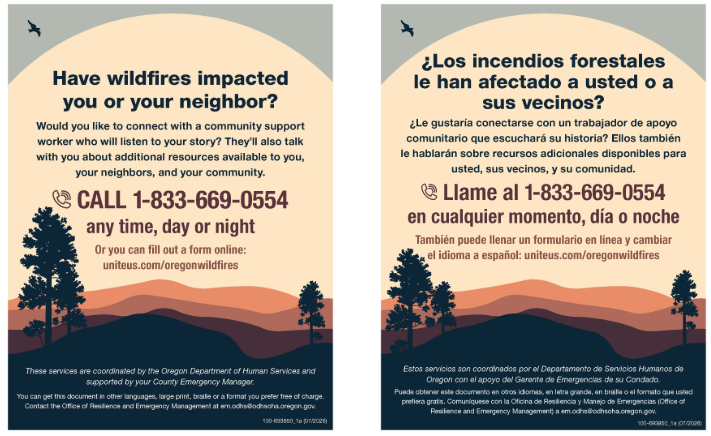
The statewide hotline is available to people experiencing any wildfire-related impact, including those who:
- Lost a home or property
- Evacuated and have ongoing needs
- Are sheltering in place and have wildfire-related needs
- Are affected by wildfire smoke or poor air quality
- Have another need or concern caused by a wildfire
“During this difficult wildfire season, Oregonians impacted by fires deserve immediate and reliable access to the help they need,” said Governor Tina Kotek. “That’s why we’ve established a dedicated, 24/7 hotline – so that no Oregonian has to navigate this wildfire season alone or wonder where to turn to for help.”
The hotline is staffed by 211info. If a call is not answered, callers can leave a message and will receive a return call within one business day.
This hotline does not provide emergency evacuation assistance or help people locate immediate shelter. People who are in immediate danger, have a medical emergency, or need emergency help evacuating should call 911. People looking for information about shelters or other immediate resources can call 2-1-1. For current 211info operating hours, visit 211info.org.
People can also enter their contact information and describe their wildfire-related needs using the Oregon Wildfire Assistance web form. An ODHS staff member will review the information and follow up with them.
“This wildfire season is already affecting a growing number of Oregon Tribes and communities,” said Ed Flick, Director, ODHS Office of Resilience and Emergency Management. “Wildfires can affect people in many ways, even when their homes have not burned. We want people to know there is one place they can call to share what they are experiencing and learn what resources may be available.”
In previous years the hotline has been used to connect people who lost homes in disasters with recovery support. This year, the Oregon Department of Human Services is expanding it to people experiencing a broader range of wildfire impacts.
ODHS has informally coordinated individual assistance following Oregon disasters since 2020. This year, Governor Tina Kotek directed ODHS to be ready to formally activate individual assistance when needed as the state prepares to establish a formal program in 2027 under House Bill 4121.
211info and ODHS will work with local communities to connect people with existing programs and local resources. If those resources are not enough to meet the level of need, ODHS will work with state leaders to identify additional support and funding options.
The hotline does not guarantee financial assistance or eligibility for a particular program. Staff will listen to each caller’s experience, document their needs and help identify available resources and next steps.
Hotline information
- Call: 1-833-699-0554
- Available: 24 hours a day, seven days a week
- Missed calls: Leave a message and your call will be returned within one business day
- Shelter and other immediate resource questions: call 211
- Emergencies or emergency evacuation help: call 911
New survey asks Oregonians how they want transportation dollars spent
The group tasked with developing recommendations on how to maintain Oregon’s transportation system wants to hear from Oregonians about what they think the state’s transportation priorities should be in a new survey. Oregonians can take the survey online at https://www.cognitoforms.com/ODOT2/ROTVSurvey.

The Oregon Department of Transportation is facing a $200 million budget shortfall in the 2027-29 budget cycle. The gap marks the fifth budget cycle in a row where the agency will have to cut services and staff unless the Oregon Legislature finds a way to provide additional revenue. The agency’s budget shortfall stems from the rising cost of materials and labor, as well as flattening gas tax revenue as more people drive fuel-efficient and electric vehicles.
After spearheading several unsuccessful attempts at finding new revenue for the state’s massive transportation agency, Gov. Tina Kotek convened 12 transportation and business experts to participate in a workgroup to help come up with solutions to the agency’s budget gap. The group has until the end of the year to deliver funding recommendations to Kotek, though lawmakers asked to receive recommendations earlier.
The survey asks Oregonians their top six transportation priorities, how they think the agency should spend its limited funding and what reductions would impact them the most.
Oregonians have until 6 p.m. Sept. 10 to complete the survey. Oregonians can also send their feedback to the workgroup’s email at rebuildingtransportation@odot.oregon.gov. — (SOURCE)
The Trump administration has moved to rescind protections for nearly 2 million acres in Oregon, potentially opening them up to development.
The U.S. Forest Service on Tuesday filed a proposal that would overturn the two-decade old “roadless rule” that protects iconic forests and recreation spots in national forests in ten Western states. The 2001 rule prohibits road construction, road upgrades and timber harvesting.
Officials say repealing the rule is needed to spur economic growth and improve forests’ wildfire resilience. Environmental groups counter that opening the protected acres to development will hurt outdoor recreation, drinking water supplies, fish and wildlife habitat and carbon storage.
Trump administration advances plan to rescind protections for nearly 45 million wild acres
The USDA decision to rescind the 25-year-old forest and wildland protections was made without officials hosting any public meetings

The Trump administration will move ahead with plans to end more than 25 years of sweeping protections for tens of millions of wild, federally managed acres across the U.S.
Brooke Rollins, head of the U.S. Department of Agriculture, on Tuesday filed a rule to rescind “in its entirety” the national 2001 Roadless Area Conservation Rule, which prohibits road construction, logging and mining on about 30% of lands managed by the U.S. Forest Service, mostly in forested areas of the West. Rollins had last year filed a notice of intent that the agency was considering “rolling back” some protections under the rule.
A draft environmental impact statement will be posted Wednesday, and the public will have until 11:59 p.m. Eastern time/8:59 p.m. Pacific time on Sept. 21 to comment before changes are finalized. Comment on the Roadless Rule termination and environmental impact statement here.
The Roadless Rule prohibitions are intended to protect wildlife, watersheds and old-growth forests from human development and human-caused wildfires. But in her announcement, Rollins said she was rescinding the rules on nearly 45 million acres under the banner of wildfire prevention, saying the protections instead have led to “overgrown stands, insect outbreaks and disease” turning “healthy landscapes into tinderboxes.”
“For too long, outdated restrictions have kept tens of millions of forested acres off-limits to the very treatments that improve forest health and reduce wildfire risk to our communities,” she said.
Rollins’ assertions are not borne out by research, including from Oregon State University Professor Chris Dunn, a forest ecologist and wildfire expert. Dunn and his colleagues found that most wildfires in Western national forests between 1984 and 2018 started near roads, showing an increased likelihood of wildfires where roads exist because the No. 1 cause of wildfires is people.
The U.S. Forest Service’s own research also shows the majority of human-caused ignitions occur on roadsides, and 20 years of monitoring data does not support assertions that repealing road prohibitions will improve forest health, researchers found.
No public meetings – Rollins first proposed rolling back the rule in August 2025, saying at the time the move would support President Donald Trump’s executive orders meant to increase logging and energy development on federal lands.
That notice of intent set off a 21-day public comment period that brought in more than 600,000 comments, most of which expressed opposition to any changes that would erode the Roadless Rules prohibitions on development. Federal officials have not held a single public meeting since then.
In the two years leading up to final passage of the 2001 rule, Forest Service officials held 600 public meetings across Western states and received more than 1.6 million public comments.
Roughly 96% of the Forest Service’s inventoried roadless areas are located in 12 western states, including 2 million acres in Oregon within places like Iron Mountain in the Willamette National Forest, Joseph Canyon in Wallowa County, Tumalo Mountain in central Oregon and Lookout Mountain in the Ochoco National Forest.
Last year, U.S. Rep. Andrea Salinas, a Democrat representing Oregon’s 6th Congressional District based in the Willamette Valley, introduced the Roadless Area Conservation Act to enshrine the rule in federal law, but it does not yet have enough support to pass. In the House, 88 of her Democratic colleagues have signed on as co-sponsors, including Oregon Reps. Suzanne Bonamici, Janelle Bynum and Maxine Dexter, as have 25 U.S. senators. The state’s two other representatives, Democrat Val Hoyle and Republican Cliff Bentz, have not signed on as sponsors.
No state would be more affected by the rule termination than Alaska, which has almost a third of the 45 million acres affected by the pending change.
Alaska is home to the Tongass National Forest, a West Virginia-sized stretch of islands and waterways in the Southeast Alaska panhandle that make up the largest surviving temperate rainforest in the world.
Idaho and Colorado would not be impacted by the rule changes because the two states negotiated their own agreements with the federal government more than a decade ago to permit projects that would “reduce hazardous fuels” near wildfire prone communities and to allow some local and state decisions about development on the federal acres.
Different takes on the past 25 years – U.S. Forest Service Chief Tom Schultz, who previously worked for one of the country’s largest lumber producers in Idaho, said in a statement last year that the Roadless Rule has frustrated land managers for years and served as a barrier to commercial logging.
“More than 40% of inventoried roadless areas, primarily in the West, have high or very high wildfire hazard potential. And only 5% of those areas have received hazardous fuels reduction treatments since 2014,” he said.
Rollins’ announcement included praise from the Republican governors of Montana, Utah and Wyoming, who said rescinding the federal protections would give their states flexibility to manage land locally. Democratic governors and other elected officials in states including Oregon, Washington and New Mexico have criticized the administration’s efforts and blame a century of largely unrestricted logging on federal lands, climate change and recent losses to Forest Service staff for worsening fires and declining forest conditions in the West.
Statements following Rollins’ announcement made clear conservation and logging groups have seen the last 25 years of the Roadless Rule quite differently.
Abigail Dillen, president of the nonprofit environmental legal group Earthjustice, said in a statement that the group will likely sue to stop the rule changes from moving forward.
“For 25 years, the Roadless Rule has kept our wildest forests intact. The benefits have been incalculable for people, for water, for wildlife, and for the climate,” she said. “Earthjustice has successfully defended the Roadless Rule for a quarter century, and we are not going to stop now.”
Travis Joseph, president of the American Forest Resource Council, a trade association representing the timber industry, said in a statement that the Roadless Rule is among “failed policies” meant to protect forests.
“The Forest Service is right to take a hard look at a policy that was written for forest conditions that looked very different 25 years ago,” he said. “Our national forests are experiencing severe wildfire, drought, insects and disease on a scale that few anticipated when the Roadless Rule was adopted.” https://oregoncapitalchronicle.com/2026/08/18/trump-administration-advances-plan-to-rescind-protections-for-nearly-45-million-wild-acres/
Division of Financial Regulation finalizes 2027 health insurance rates, acts to preserve coverage choices statewide
The Division of Financial Regulation (DFR) has issued final 2027 rate orders for Oregon’s individual and small group health insurance markets. As the trend continues to show decreased enrollment of the individual market and greater than expected financial losses in recent months, DFR is taking action to stymie even higher rates by using available state dollars for the state’s reinsurance program.
In the individual market, DFR approved individual market increases that averaged 21.6 percent based on the new data and updated rate requests. DFR scrutinized the rate requests under actuarial standards to ensure that the rates were actuarially sound and justified based on additional market changes.
In the small group market, final orders reflected DFR’s 1.5 percent reduction of insurer’s proposed average rates of 17 percent to 15.5 percent, including some reductions of up to 8 percent.
The finalization of rate orders comes as carriers gained more experience in the market and re-evaluated their market presence. Continued marketplace uncertainty with the loss of the enhanced federal Affordable Care Act subsidies, heightened medical costs, tariff pressures on durable medical equipment and pharmaceuticals all caused greater cost pressures that were reflected in the rates. Statewide, in the individual market, two carriers are available statewide, seven counties will see four choices, 23 counties will see three choices, and six counties will have two choices. A table of county participation and final rate decisions for both the individual and small group markets can be found on our website.
To help stabilize the market in 2027, DFR is budgeting for an additional $15 million in reinsurance funds from the Oregon Reinsurance Program to offset anticipated higher-than-usual claims costs. DFR will also explore enrollment caps to certain plans to balance consumer choice with marketwide financial stability.
The Oregon Reinsurance Program is one of the tools Oregon uses to hold down health insurance premiums. The state helps insurers absorb the cost of the most expensive medical claims, which reduces their risk and means lower premiums for people who buy insurance on their own. The reinsurance program lowered rates by an average of 10.7 percent, including 1 percent reduction due to the additional budgeting of $15 million for the 2027 plan year. Reinsurance minimizes the price increases felt by consumers and operates to lowered rates for the ninth straight year. Oregon has resubmitted a renewal request to the federal government to maintain this program. The Oregon Legislature adopted Gov. Kotek’s 2025-27 funding plan, which continued revenue streams that keep the reinsurance program stable.
Consumers seeking information and assistance with individual market plans can reach out to the Oregon Health Insurance Marketplace at OregonHealthCare.gov or by phone at 855‑268‑3767 (toll‑free).
BLM Geothermal Lease Sale in Oregon Nets More Than $1 million
The Bureau of Land Management accepted winning bids on two parcels in Oregon totaling more than 9,500 acres for $1,155,706 in total receipts for a geothermal lease sale. The parcels are located on the Mount Hood National Forest.
“Geothermal is an abundant resource, especially in the West, with the potential to provide reliable energy,” said Kim Prill, BLM Oregon/Washington State Director. “The BLM is committed to unlocking that potential to support American energy production and our local economies.”
The BLM may issue the leases once review and payment are complete. The combined bonus bids, rentals and subsequent royalties from the leases will be distributed among the U.S. Treasury, the State of Oregon, and Marion County.
Geothermal lease sales support domestic energy production and American energy independence while contributing to the nation’s economic and military security. Consistent with Executive Order 14154, “Unleashing American Energy,” the BLM’s geothermal lease sales help meet the energy needs of U.S. citizens, solidify the nation as a global energy leader long into the future, and achieve American Energy Dominance.
Leasing is the first step in the process to develop federal geothermal resources. The BLM ensures geothermal development meets the requirements set forth by the National Environmental Policy Act of 1969 and other applicable legal authorities. Planning documents for this sale are available at the BLM National NEPA Register. The BLM’s lease sales are held online through EnergyNet.
The BLM has authority to manage geothermal resource leasing, exploration, and development on approximately 245 million surface acres of public lands and the 700 million acres where the United States owns the subsurface mineral estate.
Oregon congresswoman proposes program to support first responder mental health
Salinas’ bipartisan proposal is similar to a 2017 law that provided funding for mental health programs for law enforcement
This story discusses suicide and mental health. If you or someone you know may be experiencing a mental health crisis, contact the 988 Suicide & Crisis Lifeline by calling or texting “988” or chatting online at http://988lifeline.org/.
An Oregon congresswoman is proposing a new grant program to support the mental health needs of firefighters and emergency medical services staff.
U.S. Rep. Andrea Salinas, a Tigard Democrat representing Oregon’s Willamette Valley-based 6th Congressional District, is seeking to establish a grant program that would fund $7.5 million a year in nationwide suicide prevention programs, peer support and counseling for first responders and firefighters.

The bill is similar to a 2017 law directing the U.S. Department of Justice to fund mental health and treatment programs across the U.S for law enforcement, except Salinas proposes the first responder program be administered through the Office of Emergency Medical Services, a branch under the U.S. Department of Transportation.
Studies show that first responders experience negative mental health outcomes at a higher rate compared to the general population, including higher rates of suicidal ideation and attempts than the general population. Additionally, stigmas behind mental health keep many firefighters and responders from seeking mental health support.
“Just as we ask our first responders to be there for us, we, as Congress, must be there for them,” Salinas said at a press conference at a Tualatin Valley Fire & Rescue station in Lake Oswego Monday morning.
The proposal comes as Oregon faces a record-breaking wildfire season, and as state officials explore the impacts between wildfire and mental health. Last year, the U.S. Department of the Interior and the U.S. Forest Service announced a new program aimed at addressing the mental health of wildland firefighters, providing up to 16 free therapy sessions a year regardless of whether they are in permanent or temporary positions.
‘It’s a lifeline’: First responders discuss need for mental health support — First responders at Tualatin Valley Fire & Rescue experience about 500 traumatic events over a 30-year career, Deputy Chief of Strategic Services Patrick Fale said.
“As leaders, it’s critical that we put infrastructure, resources and programs in place to not only help with these acute incidents but to ensure that our responders are resilient throughout those 30 years and beyond,” Fale said.
Tualatin Valley Fire & Rescue Lt. Erik Peterson said the legislation would give first responders the tools they need when members are experiencing their own crises.
“We’re really good at showing up when the tones go off, but we’re not good at asking for help when we need it,” he said.
Serving his community is a privilege, but it comes at the expense of his own mental health. This often contributes to strained family relationships — a pattern he said many of his peers experience.
Salinas’ bill would fund family services support and training to identify and respond to mental health crises within firefighting and emergency medical service staff.
“This has to be something that we get through,” Peterson said. “This is important. This isn’t just a priority, it’s a lifeline for members who are struggling with mental health issues.”
The bill has bipartisan support from U.S. Reps. Gabe Evans, R-Colorado; Sharice Davids, D-Kansas and Tom Kean, R-New Jersey. (SOURCE)
L. L. Stub Stewart and Rooster Rock State Parks will host OMSI Star Parties this summer

— L.L. Stub Stewart and Rooster Rock State Parks will celebrate the night sky with free stargazing parties in July, August and September.
The parks are partnering with OMSI and Rose City Astronomers to host an OMSI Star Party 2026, which includes a presentation at dusk and stargazing from 9 to 11 p.m. Telescopes will be provided by volunteers, and visitors are welcome to bring their own. Depending on the weather, stargazers will search out stars, the moon, and planets.
“We love helping people experience the park in a different way. After dark, everything feels calmer, quieter, and a little more magical,” shared Park Ranger Jeremy Williams at L. L. Stub Stewart State Park.
These events are free. Parking in the day-use areas requires a $10 parking permit per vehicle or you can use an annual parking pass if you have one.
Visitors are encouraged to bring their own chairs, blankets, warm clothing, snacks and water. Bug repellent is always a good idea. Please use red flashlights to avoid interfering with the dark sky viewing. You can also cover your flashlight or smartphone with red electrical tape.
Star maps will be provided along with recommended astronomy apps that visitors can load on their phones if interested.
Visitors should arrive early to familiarize themselves with the area and park only in designated spaces. Overnight camping is not permitted in day-use areas, though campground reservations are available at stateparks.oregon.gov.
On the scheduled day for OMSI Star Parties, visitors should visit the OMSI website for possible weather-related cancellations. The long-range forecast looks promising for excellent viewing.
“Whether you come to Rooster Rock to count Perseids or simply to spend a peaceful evening under the stars, the meteor shower is a wonderful excuse to slow down, look up, and experience the Gorge in a whole new light”, said Park Ranger Elika Paki at Rooster Rock. “And if you lose track of how many shooting stars you’ve seen, don’t worry, that just means you’re doing it right.”
All events begin at dusk. We recommend arriving early to accommodate parking. Parks will close at 11:45 p.m.
- Equinox Celebration | Saturday, September 12
- You can find additional details about the event, parking logistics, whether pets are allowed, and how to request accessibility accommodations on the L.L. Stub Stewart State Park and Rooster Rock State Park event pages, and the OMSI event page.
Oregon State Parks often hosts stargazing events across the state. More opportunities can be found on Oregon State Parks’ event page.
Public invited to comment on plan to possibly triple logging in eastern Oregon national forests
The U.S. Forest Service’s proposed revisions to the Blue Mountain Forest Plan would allow more logging and taking older trees in the name of wildfire prevention

Officials at the U.S. Forest Service are proposing new management plans for eastern Oregon’s Blue Mountains that include potentially tripling the amount of logging across 5.5 million acres in the next decade.
The Forest Service published a draft of proposed changes to the 35-year-old Blue Mountain Forest Plan last week. It would allow more logging, mining and grazing across four national forests spread across eastern Oregon, as well as parts of southeast Washington: the Malheur, Ochoco, Wallowa-Whitman and Umatilla National Forests.
The public has until Sept. 30 to submit comments on the 350-page draft proposal. Submit comments on the revised Blue Mountain Forest Plan here.
The draft plan describes increases in logging and animal grazing as important to local economies and to preventing wildfire.
It predicts everything from habitat conservation to forest carbon storage would improve over the long term if more logging is allowed because strategically logging and grazing parts of the forest would prevent wildfire, which officials characterize as the biggest threat to habitat and forest loss.
Environmental advocates disagree with the framing.
The Blue Mountains encompass Oregon’s largest protected wilderness areas. Conservation groups have expressed concern and outrage over the draft management plan, which they say could exacerbate area drought and water quality issues, wildfire risks and impact habitat for elk, wolverine, wolves, moose, owls and salmon.
“This plan seeks to open up and pillage one of the wildest places left in the U.S.,” Lauren Anderson, a climate forests manager at the nonprofit Oregon Wild, said in a statement. “The Trump administration is already taking a hatchet to protections for water, wildlife and the public’s voice. This plan is that philosophy in action, putting at risk the very values that make the Blue Mountains special.”
Bev Law, a forest scientist and professor emerita at Oregon State University who has studied extensively the potential forest carbon storage in Oregon forests, found that protected wilderness areas in the Blue Mountains contain the second highest proportion of above-ground carbon stocks in all of Oregon’s protected wilderness areas.
Nick Smith, a spokesperson for the American Forest Resource Council, a trade association representing the timber industry, said in a statement that the group is still reviewing the proposed updates but that change is overdue.
“These national forests face some of the highest wildfire, insect and disease risks in the West. At the same time, the region is steadily losing the sawmills, logging contractors and the skilled workforce needed to carry out active forest management and provide markets for the material that needs to come out of the woods,” he said.
The draft Blue Mountain Management Plan proposal also includes rescinding a 32-year-old rule called the Eastside Screens that prohibits logging trees that are 21 inches in diameter or larger on six eastern Oregon and Washington national forests. Forest Service officials attempted to rescind the rule during the first Trump administration, but conservation groups sued and it was blocked by a federal judge.
Forest Service officials have argued that some younger trees that grow fast should be able to be removed even if they are more than 21 inches in diameter, because they are crowding out other tree species that take longer to grow but are important to the forest ecosystems.
The proposal also assumes Congress will soon rescind the 25-year-old Roadless Rule, which prohibits road construction, logging and mining on roughly 60 million acres of public land, including about 2 million acres of forests in Oregon. That alone would increase the amount of land classified as open for logging in the Blue Mountains by 17%, according to the draft.
Most of the increased logging would take place in the Malheur National Forest, followed by the Wallowa-Whitman and then Umatilla national forests. (SOURCE)
Check out Oregon State Parks with your library card
Borrow an Oregon State Parks parking permit for free at 82 libraries statewide.

– Oregon Parks and Recreation Department (ORPD) and the State Library of Oregon are partnering to offer free state parks parking permits to Oregon public libraries. There are currently 200 parking permits available at 82 libraries across the state.
“Oregon’s state parks are for everyone,” said OPRD deputy director JR Collier. “As we assess ways to manage our budget responsibly, we also want to uplift equitable access to our parks.”
Each participating library received up to four parking permits. These are the physical hang tags you check out from the library and put in your car. The permit covers parking in all Oregon State Parks day-use areas for one vehicle. Go to the Oregon State Parks website to find participating libraries. All you need to participate is your library card.
“Libraries help make life more affordable for Oregonians. This program leverages the existing borrowing system to help connects folks of all income levels with the beauty and splendor of Oregon’s State Parks,” said Wendy Cornelisen, State Librarian.
Both OPRD and the State Library contributed 100 parking permits to the program to distribute to libraries. The agencies determined how many passes each library would receive based on interest from the library, its proximity to a park charging a day use fee, and the size of the population it serves. The State Library purchased permits with Library Services and Technology Act funds from the federal Institute of Museum and Library Services.
OPRD first distributed parking permits to 28 libraries as part of a year-long pilot program starting in August 2024. Those passes were checked out more than 2,100 times. At the pilot’s conclusion, OPRD evaluated how to best move the program forward in the context of its changing fees. In 2027, OPRD and the State Library will continue to explore options for an expanded long-term program that will serve even more libraries and people in Oregon. Learn more about the OPRD Library Pass Program.
Oregon Department of Veterans’ Affairs
No veteran should be without a place to call home, and the Oregon Department of Veterans’ Affairs is committed to ending veteran homelessness in our state. The new ODVA Houseless Veterans Program collaborates with federal, state, county, and Tribal agencies, veteran services offices, and community homeless service providers to meet the urgent and unique needs of Oregon’s diverse veteran communities challenged with housing stability. In addition to advocating for Oregon veterans experiencing or at risk for houselessness, the program provides direct service to veterans and their families seeking federal and state veterans’ benefits, including access to local VA health care, documentation of service, as well as other available state benefits, and local homeless services organizations and low-income assistance programs. If you or a veteran you know is dealing with homelessness, contact the ODVA Houseless Veterans Coordinator today at houselessvets@odva.oregon.gov or visit https://ow.ly/V4EH50VnL93 to learn more.
Staying Informed During a Communications Outage: Best Practices for the Public
Disasters can damage critical infrastructure, leading to temporary outages in cell service, internet, and power. When communication systems go down, it’s vital to be prepared with alternate ways to get emergency information and stay connected. Here’s how you can prepare and respond:
Have a Battery-Powered or Hand-Crank Emergency Weather Radio
- Why it matters: Emergency radios can receive Emergency Alert System (EAS) broadcasts via AM/FM or NOAA Weather Radio frequencies—even when cell towers and the internet are down.
- Note: Emergency radios do not receive Wireless Emergency Alerts (WEA) like cell phones do. Tip: Pre-tune your radio to your local emergency broadcast station (e.g., OPB in Oregon or NOAA frequencies).
Turn On WEA Alerts on Your Phone
- Make sure Wireless Emergency Alerts (WEA) are enabled in your phone’s settings. These alerts include evacuation orders, severe weather warnings, and other urgent notifications.
- WEA messages are sent through cell towers—if cell service is out, WEA alerts will not be delivered. This is why having backup methods like a radio is essential.
Charge Everything in Advance and Have Backup Power
- Charge phones, power banks, laptops, and rechargeable flashlights before fire weather conditions worsen.
- Consider solar-powered chargers or car chargers as backups.
- If you are sheltering in place, a generator (solar or gas powered) is helpful.
Know Your Evacuation Routes in Advance
- Save printed or downloaded evacuation maps in case you can’t access GPS or navigation apps.
- Most mapping services (like Google Maps or Apple Maps) offer the ability to “Make maps available offline.” Download your area in advance so you can navigate even if cell towers or internet access are down.
- When in doubt, call 511 or visit the TripCheck.com website if you have cell service.
- Don’t wait for a notification—if you feel unsafe, evacuate early.
Print or Write Down Critical Contacts and Info
- Phone numbers of family, neighbors, and local emergency contacts.
- Address of evacuation shelters, veterinary services (for pets/livestock), and medical facilities.
- Your own emergency plan, including meeting locations.
- Have copies of vital documents in your go-bag and take video of your property (inside and out) for insurance claims later.
If Calling 9-1-1 Over Wi-Fi or Satellite, Check Your Location Settings
If you call 9-1-1 using Wi-Fi calling or a satellite-connected phone (like an iPhone or Android), your location might not be automatically visible to dispatch. Instead, it may rely on the emergency address saved in your phone’s settings.
- Update this emergency address when you travel or relocate—especially in evacuation zones or rural areas.
- Most importantly, always tell the dispatcher exactly where you are—include your address, landmarks, road names, or mile markers to help first responders reach you quickly.
Sign Up for Alerts Before There’s an Outage
- Register for OR-Alert and your county’s local alert system.
- Follow your local emergency management officials’ and bookmark resources like: wildfire.oregon.gov.
Prepare for Alert Delays or Gaps
- Know the three levels of evacuation:
- Level 1 – Be Ready
- Level 2 – Be Set
- Level 3 – GO NOW
- If you hear a siren, see a neighbor evacuating, or witness fire behavior increasing—take action even if you haven’t received an alert.
Be Your Own Info Network
- Check on neighbors, especially seniors or those with disabilities.
- Post printed signs with updates for those passing by.
In rural areas, community bulletin boards or fire stations may serve as local information points. Support and Restoration in Progress To help maintain emergency communications during this incident, OEM deployed eight Starlink terminals under the guidance of ESF 2 and the Statewide Interoperability Coordinator (SWIC). A Communications Technician (Jeff Perkins) was also deployed to assess connectivity needs on the ground. These Starlink terminals have been providing service to the Lake County Emergency Operations Center (EOC), Oregon State Police (OSP), Warner Creek Correctional Facility, and will soon support the town of Lakeview, the Bureau of Land Management (BLM), and the Lakeview Ranger Station. OEM’s Regional Coordinator (Stacey) is also on-site supporting the Lake County EOC. Coordination has been strong across local, state, and private sector partners. *** Update: As of 7/10/25 at 1:47 PM, fiber service has been restored.
Reconnect When Service Returns
- Once communications are restored, check official websites:
- Oregon.gov/oem
- Your county emergency management page
- TripCheck.com for road conditions
- Share verified info—not rumors—on social media or community pages.
Prepare for Delays in Restoration
- Communication may come back in phases. Damage to fiber lines or cell towers can take time to repair.
- Continue using backup methods and stay alert for updates via radio or in-person notices.
Final Tip:
In an emergency, CALL 9-1-1 to report life-threatening danger, not for general information. Use local non-emergency numbers or go to physical information points if needed. You can find more tips for preparing in OEM’s Be2Weeks Ready toolkit.

Oregon’s Missing Persons
Many times you’ll see postings without case numbers or police contact. There is rarely a nefarious reason why (the nefarious ones are pretty obvious). Usually the loved one tried to call to report their missing person and they are either refused or told to wait a day or two by people who are unaware of SB 351 and the laws that they are bound to when answering the phone. Many people don’t bother calling LE if their loved one is homeless or in transition because they believe LE won’t care. The biggest myth is the 24 hour rule.

In Oregon we don’t have those rules and an officer or person answering the phone is not allowed to decide. The law decides. We have Senate Bill 351 and it states that the police CANNOT refuse a request for any reason and they must begin working on it within 12 hours. The person making the report does not have to be related to missing person either. Here is SB 351 written by families of the missing here in Oregon in conjunction with Oregon law enforcement officers. This should be common knowledge, please make it this way. https://olis.oregonlegislature.gov/…/SB351/Introduced
Find the mental health support you need

Click to see all resources https://oregonhealthnews.oregon.gov/find-the-mental-health-support-you-need/?utm_medium=email&utm_source=govdelivery

 Oregon State Police are reminding parents and students of the SafeOregon hotline. It takes reports of potential threats against students and schools. The tips can be made anonymously. They can include safety threats, fights, drugs, weapons on campus, cyberbullying and students considering self-harm or suicide. A technician reviews the reports and assigns them either to police or school administrators. Tips can be made by phone, text, email or on the website https://www.safeoregon.com
 Call us at 5 41-363-7503 Or email us at Info@RogueValleyMagazine.com